Teachers Should Be Beginners


Most adults don’t try new things very often, that’s dependant on the adult of course, but in general we seem to stick to our routines. It has been told to us for years that failure is bad, and more recently that you shouldn’t post it on Instagram unless it’s perfect. Fear of failure is often felt when being courageous and attempting something new, say,  a yoga class.

Emotions such as frustration, comparison, jealousy, anger, and other similarly negative emotions are felt when our foot slides off our leg in tree pose and there is someone else in the class who looks like they could knit and do tree pose at the same time. I know this because I’ve felt it and I’ve seen it in my classes. In fact, it happens in pretty much every single class that I teach, I can’t speak for the emotions felt, but certainly not every single person can do every single pose in every single yoga class, myself and all teachers included.

That is why I remind my students over and over again to move out of the negative emotions and into a spirit of playfulness. Negative self-speak almost always creeps into our heads when unable to do something new and while witnessing someone else do the same challenging thing in a seemingly carefree manner.

Personal examples of things that I have tried in the past few years in which I have felt down on myself for struggling with include: learning to drive a standard drive, learning phrases in new languages, handstands, running, learning to swim better, learning to sew, etc. Luckily, most of those things I have learned with the guidance of my supportive husband. Sure, there were arguments, most notably during the teaching and learning to drive a stick shift, but mostly there was encouragement.

IMG_4663

As a yoga teacher I value those new experiences, even those outside of my yoga practice, because they put me into an uncomfortable state of fear, frustration, anxiety, stress, and doubt in my abilities which are the same sorts of sensations felt when trying half moon for the first time and during crow pose at almost every attempt. Facial expressions in class give me insight into what emotions my students are feeling and I try to lead them to positive optimism. I also remind students that difficult yoga poses are just that and take many hours of training and practice to achieve until the right muscles are built, awareness is learned, and technique is taught, then one day a pose will just click and will be felt for a microsecond until balance is lost, but the aha moment exists and suddenly the pose seems less evasive.

If you are a yoga teacher, or a teacher of anything to anyone – teaching your partner to salsa, your child how to read, you daughter how to knit; remember that trying new things is challenging and sticking to them is even more difficult. Walking into a yoga class and being unable to do 25% of the class might put people off from ever returning, which is why as teachers we have a duty to warmly reassure those that trust us to teach them that while many yoga poses seem impossible, with dedication and commitment the challenging can possibly one day become our realities.

Yoga teachers must be able to empathize with their students, but most yoga teachers have been doing yoga for a long time so forget just how much the thighs burn and shake in warrior two because it’s such a common pose that it can feel as easy as sitting in a chair to teachers. That is why being a beginner in other arenas or pushing your practice with new challenging poses for yourself is one of the best ways to improve your teaching skills. Empathize with your students in warrior two the same way that you would want empathy in tortoise pose.


Do Yoga for Your Mom, Your Neighbor, & Your Dog

I have heard it said, I have said it to classes, and I strongly believe that a yoga practice not only benefits the person practicing, but also every single person that they have contact with, in person, daily, now and again, passing by, or via a screen. This is not a truth just for yoga, if you do what brings you joy, then that joy will shine for others to see and benefit from.

In my case, and for many that I know, that thing is yoga. When I teach beginners I tell them that the difference between yoga and a general exercise class such as Zumba or Spin, is the link between breath and body. That’s usually where I leave it. I don’t dive into the mind and body connection right away. That comes with time and practice, but breathwork is from day one on the mat. It is through an elongation of the breath and concentration on breathing that the mind can slightly settle and calm. A deep exhalation releases tension in the muscles and the mind. By making inhales and exhales as long as possible your nervous system moves from the sympathetic nervous system into the parasympathetic nervous system, or from the fight or flight setting to the rest and digest setting.

You may be thinking that you never get to that fight or flight state of being because you have a typical life – work, kids, house, etc., but anyone can find themselves in stress, and I probably don’t have to say this, but we all live stressful lives even if a tiger isn’t staring us down in the jungle. Simply driving to the yoga studio and experiencing some road rage can get your heart rate up and quicken the breath, not to mention larger stressors such as financial troubles, work situations, or health issues. In general, our lives have become very comfortable and many of us have enough to eat and a rough over our heads (of course, not all of us though,) but our modern lives are still stressful.

There’s no denying that I am an advocate of yoga. As a teacher for more than five years there haven’t been many (or any?) students that I have taught yoga to and that have left high-strung. They may enter the sidewalk and encounter something that annoys them and go right into a state of annoyance and stress, but right after rolling out of Savasana they’ve all been pretty well relaxed. Concentration on breath is a skill that can be taken from the yoga mat to everyday life, a way to manage stress. The gentle and slow movement of a yoga class is also rejuvenating for most. If you’re someone that’s already on the yoga boat then you’ve probably seen those memes about yoga, for those of you who don’t primarily follow yoga accounts on Instagram, they read things such as – Yoga, because punching people is unacceptable.

Sunset Savasana

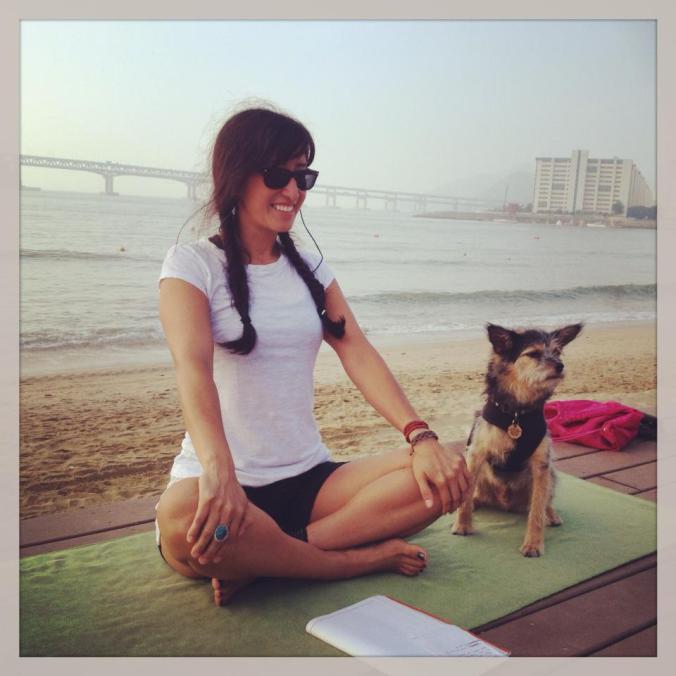
So, how does going to a yoga class benefit those around you? Well imagine a scenario of a disagreement between you and your loved one, a shop attendant, coworker, etc. and imagine that you have been practicing breathwork and discipline through a yoga class. Hopefully you will think to utilize those skills in the argument. Also, when you are happy and care for yourself you are better able to make those around you happy and to better care for them. Selfcare is not just good for the self, it is good for the whole. Even your dog. One way that yoga benefits my dog is through empathy. There are times when it’s cold out and I don’t want to go for a walk with him, but then I think how happy it makes him to go for walks, the same way that doing yoga makes me happy and I don’t want to keep happiness from him (not to mention the bodily need he has for a walk!)

There’s never been a time when I thought, ‘ugh, I wish I hadn’t gone for this walk with him,’ the opposite is true – I generally enjoy the walk, get fresh air and more movement in my day. Likewise there’s never really been a time when I’ve left a yoga class and thought –  ‘ ugh, wish I wouldn’t have done that.’ My yoga’s good for my physical & mental health and good for my dog.

teachingyogagwangan