Savasana- Not to be Skipped!

Lying on your back on the floor with eyes closed might not seem like an advanced yoga pose, but it is, and it should not be ignored. Savasana, or corpse pose in English, is how most classes end, and what a good ending it is. Dim lights, bundle up, and get comfy, cover the eyes, and just be. Students have asked me if it’s ok to skip Savasana and just jump back into their day; my answer to this question is no.

Here’s why Savasana should not be skipped:

  • Absorb All the Goodness – After the challenging work of a vinyasa flow class, or after long holds in a restorative class, Savasana gives your body and mind the opportunity to soak it all in.
  • You Deserve a Rest – Nap time ended long ago for most of us and we rarely allow ourselves the gift of just taking a break. A yoga class might seem like the only break you need, so why not just get on with they day, right? Wrong – let yourself have a few minutes of quiet before rolling up your mat.
  • Still Your Mind – During a yoga practice the goal is to focus on the breath and movement, but how many of us find our minds wandering to thoughts of dinner, wondering how our poses look, or to the song playing in the car that’s driving by, “Wait, is that Miley Cyrus? I like Miley Cyrus.” Focusing, in other words not being distracted, is a little bit easier in Savasana, since by closing your eyes you shut out the outside world; you let your body lie still as can be, and you let go of even the controlled breath, of the practice. Don’t fidget and try not to sleep. Be sure to be as comfortable as can be before totally letting go. It will be hard at first and maybe for a long time to follow (it took me years to relax in Savasana fully, and there are days when I still struggle,) but try your best to still your mind along with the body. Thoughts will come, but just let them go, do not hold on.

How  To Do Savasna:

  • Make your way to seated. Bring your feet in front of you, firmly planted to the mat with your knees pointing up to the sky. Hold behind your knees for support  raise your arms out in front of you, palms face each other. Slowly, roll back onto your back one vertebrae at a time. If this is difficult for you, then lower one elbow at a time down next to, and slightly behind you, to begin the rolling of your spine on your mat. Then gently lower your entire back onto the mat behind you.
  • Extend your legs out in front of your body down onto your mat. Allow your feet to splay to either side of the mat naturally, toes, feet and ankles relaxed. If you feel any tension in your low back, place your feet flat on the mat (knees point up to the sky,) apply gentle pressure through the feet, and lift your bottom up and off of the floor, think of rolling your pelvis out and down towards your feet. Place your lower body back onto the mat. This should give you more length in the low back.
  • Rest your arms out by your side at an angle, not right next to your body, but a bit away. Flip your palms up to the ceiling; this rolls your shoulder blades down your back. Be very relaxed and let your fingers curl ever so slightly inward towards your palms. Adjust the shoulders until you are perfectly comfortable. There should be no fidgeting after you have found your perfect pose. Keep your eyes closed through the entirety of the pose and keep them closed as the teacher brings you to the end of the class until instructed to open them. Placing an eye pillow on your eyes will block any and all light and is a relaxing touch.

Savasana

It seems like Savasana should be an easy pose, but easy it is not. We are so used to multitasking and filling our schedules that we constantly think about what did or didn’t get done and what has yet to be accomplished. All of this thinking can get overwhelming and lead to anxiety, worry, or stress. By calming the mind we give ourselves a little break. It is inevitable that when you first begin to practice Savasana that you will either A) fall asleep – that’s ok, your body might really need it! or B) continue to think, but keep practicing and it will get easier. Savasana is a yoga pose that requires practice to improve.

May you delight in your practice and destress in your Savasana.

Namaste.

Acro Yoga – A Performance

Recently I was approached by my friend and studio owner, Mindy Sisco, to represent her studio along with three others in an acro yoga performance. Mindy is away, traveling and training in the US so cannot perform herself, so instead the line up is: her business partner, Simon, two other talented local acro yogis, and myself. An event in Seoul celebrating International Yoga Day on June 21, 2015 is where  we will show off our work.

It is because of this upcoming performance that I have been doing less and less yoga and more and more acro yoga these days.UNWorldYogaDay As mentioned in a previous post, I am fairly new to acro and do not have a solid and disciplined practice like I do with my traditional yoga. Therefore, I must admit that I was hesitant to agree to join the group when first asked. I didn’t feel that I was good enough or well-practiced enough. I also struggled with the idea of “performing” when it comes to yoga. I’m aware that there are such things as yoga asana competitions in which men and women push their bodies’ to the limit in order to demonstrate advanced postures in front of judges who then chose a winner. Odd, right? To me yoga is about the body and mind; it is a personal and mental practice of leaving your ego off of the mat. Competing with others to see who can do a balancing pose the best seems to me to be the antithesis of yoga. Logically then, I should have politely declined the opportunity, of myself performing yoga in front of people at a big event, right? Well, maybe, but there are a few reasons why I went against my beliefs.

First of all, acro yoga and traditional yoga are similar, yet different. Acro is generally done not only for the enjoyment of working with a partner and pushing individual/partner limits, but also to be watched and appreciated by others. Often groups of friends or strangers get together in public spaces to practice and play. I am sure that the majority of acro yogis do not practice in public simply to boost their ego, but more likely it is to share their art and skill.

It would be a sad, sad world if artists and musicians practiced and played mostly behind closed doors; I think it is the same for acro yoga.

Secondly, I knew that pushing myself and having a clear deadline to perfect a performance piece with others would be good for me. There is never an endsight with an asana yoga practice, it always continues, it is unlikely that someone will practice for years on end and then one day – “poof!” cross the finish line and complete their yoga practice. Yes, it is common to use a certain pose as motivation, for example trying to hold headstand (Salambasana) in the middle of the room is a common goal, but once that is achieved there are other variations of it to try and so many other challenging postures to work towards. It is exciting and rewarding to push the limits, which is how I look at this performance.

The final, reason why I am practicing 5-6 days a week, 2-3 hours at a time is because I hope that our final product will act as inspiration to others. I know I am not the only one who searches for images or videos of yoga or acro yoga. I enjoy finding new yoga-eye-candy online to watch in awe and admire the feats of the human body. I am a humble person, but I do hope that the audiance at the event, as well as those who view a video of our practices or performance will take something away from it that tickles their acro or yoga fancy and inspires them to jump back into bird after repeatedly falling on their face.

Beginners’ Yoga with Kara – Tuesdays, June & July

My good friend and studio owner, Mindy Sisco, is ditching town for a few months to lead workshops in the United States and get some training in acro a littler further north in Montreal. While she’s away being amazing at what she does, I’ll be subbing at her studio, leading class every Tuesday through July.

The class that I’ll be leading is a Beginners’ Yoga class. All of my classes are designed with beginners in mind, as well as advanced students, but teaching this class gives me an opportunity to really break it down for students (which all levels benefit from.)

During the eight week session, classes will teach students about the basics of standard yoga poses, give great alignment cues to improve studio/home practice, and utilize a lot of props. As the weeks progress students will notice a building of strength, flexibility (of body and mind,) and understanding of yoga. Poses will also progress into more playful and empowering balancing poses and inversions.

Classes begin this Tuesday, June 9th and run every Tuesday through July 28th. Directions and costs can be found on the Facebook page.

Lessons from Acro Yoga

Acro yoga was never very appealing to me. I had played around with it here and there in the past with friends, but with no technique or guidance it never went far. I am so deeply in love with my asana yoga practice, that I never considered experimenting with acro, all that much… until I attended Little Birds, a beginners acro yoga series taught right here in Busan. The series is held monthly at Kaizen, and is taught by a good friend and fellow yoga teacher, Mindy Sisco.

It has been about a year since I first dipped my toe in the sea that is acro, and during the past year I have been wading deeper and deeper into the experience. It can be said that acro is both very similar to hatha yoga and at the same time completely different. If you’re coming from a yoga background  and try acro, then you will notice that a lot of the shapes and even the vocabulary are similar, Vishnu’s Couch and Parsarita’s Twist are two pose name examples. Also, strength and flexibility built-in a regular yoga practice will compliment acro immensely. How acro differs from yoga requires a longer description. Here are my personal lessons from acro.

Lessons from Acro

  • Trust – Falling onto someone’s legs, especially a stranger’s, and giving them all of your weight and yourself means that there must be a lot of trust between partners. There are drills to build trust that helped me to trust. In the beginning I was very untrusting, it was hard to give up the control, but with time and practice and learning of technique, I have grown to be open and comfortable to new bases and partners.
  • It’s ok to Fall – Just as it’s ok to fall out of a balancing pose in a hatha class, it is ok to fall out of an acro sequence. Falling is part of the learning process. If you never try you will never succeed. You need to try new poses to test your limits and build the strength and flexibility needed to hold the pose later on down the road. That being said, I don’t recommend trying to mimic an advanced acro video off of youtube if you don’t have the basics down. Know your limits and be realistic.

“Falling is part of the learning process. If you never try you will never succeed. You need to try new poses to test your limits and build the strength and flexibility needed to hold the pose later on down the road.”

  • Importance of  a Spotter – Acro is a two person activity, but should always be considered a three person activity in actuality, when you include a spot. The spotter has a highly important job of trying their best to make sure that neither participants break their noses or crack their teeth. As a yoga teacher, I have found that practicing spotting has mirrored my yoga teaching in that I have to be very aware of others’ bodies and I feel a real sense of responsibility in both.
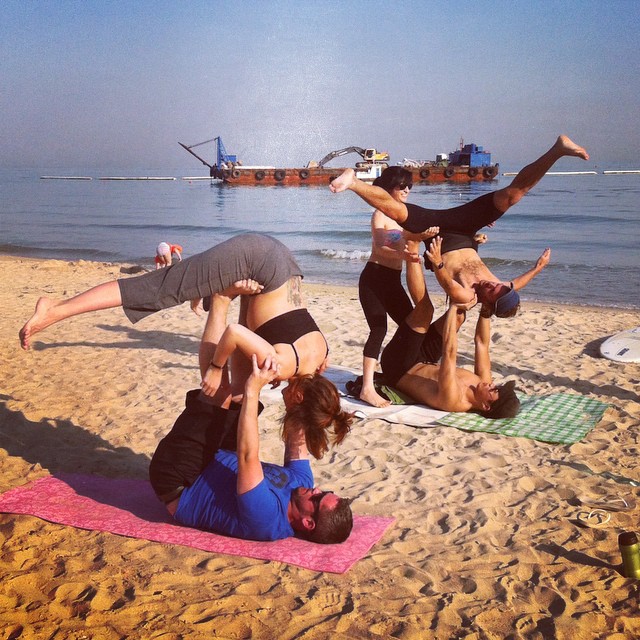
Spotting during some play time at the beach.

Spotting during some play time at the beach.

  • Communication – I’m fairly certain that ESP has been mostly disproven, which is unfortunate, as it would be really useful in acro, instead we must resort to speech. After working with a partner for a long time and learning the sequences it would be possible to get in a flow and feel it out, but in the beginning you must declare what you’re feeling and what you need, to help each other out.
  • Just Flow With It – Arguably my most important lesson from acro, is to let go of hesitations and worries and just flow with it. My day-to-day yoga practice can be rigid in terms of correct alignment; I sometimes play around with less traditional variations, but in general I tend to be a stickler for tradition. Attention to detail is primary in my practice – every joint must be in the right place, the gaze correct and strong. With that background, it was hard for me to just jump into an acro position, and I mean that quite literally – jump into a position! After some time and a little mental conversation with myself, I realized that it’s ok to do things less rigidly than I am used to. Had I not come to that realization, I never would have amazed myself with my acro abilities (if I do say so myself!) Similar to yoga, acro can be very empowering.

My acro yoga practice has grown leaps and bounds (and flips and turns!) in a matter of months. It took an open mind and willingness to fall into another person, but with each session of practice and play, I began to feel more comfortable in my own skin and with others. I suggest seeking out an acro workshop or jam in your area if you haven’t tried it. It’s a great activiity to do with friends, a partner, or family – heck, it’s even fun to do with strangers. There’s a high likelihood that you will learn a lot, not only about acro, but also about yourself, and an even higher chance that you’ll laugh while learning.


Information about acro sessions, classes, and workshops held at Kaizen in Busan can be found via their website at: http://www.kaizenkorea.com/ or on facebook via their page or the Busan Yoga & Meditation page.

Mindy and Simon of Kaizen, Busan.

Mindy and Simon of Kaizen, Busan.