Auschwitz – A Remembrance

Today, January 27th, is Auschwitz Remembrance Day/Holocaust Memorial Day. Seventy-two years ago the massive and horrific concentration camp, Auschwitz-Birkenau, was liberated after five years in 20160428_104418existence as a concentration and death camp, the largest death camp of Nazi Europe. It is recorded that around 1.1 million people lost their lives at Auschwitz, people whom were sent from countries all over Europe, mostly Jews, many Poles.


In late April of last year, I visited Poland, spending some time in Krakow. From Krakow, my boyfriend and I got on a bus to Auschwitz. We initially thought that we were too late to book a tour of the concentration camp, so we went extra early  in order to learn on our own before the gate shuts to those without tickets of tours. We arrived around 8:00 am and got in line to buy tickets as soon as we could, reserving tickets for a 10 o’clock tour. All in all we spent around 7 hours learning about the camps.


Before the tour we walked Auschwitz on our own and then reconvened inside with our 20160428_083822English tour, we received headphones which is how the tour guide communicated to our group throughout the day, necessary since hundreds of people were touring that day, all in different languages, we then followed our Polish tour guide from harrowing landmark to harrowing landmark.  Our guide stopped us outside the buildings and told us how the S.S. made the prisoners stand outside in freezing winter temperatures while they called roll, at times making them stand and wait for up to 24 hours straight, no food, no rest.
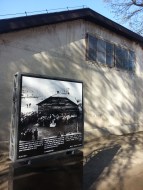
 

We went inside buildings that housed prisoners – prisoners whose main offenses were to defy and disagree with the Nazi Party, political prisoners. One hallway was lined with intake 20160428_090122photographs of prisoners, the last image of many them to ever be preserved in history. There were exhibitions of belongings that had been taken from the prisoners. The volume of the items piled up high on top of each other put into perspective just how many innocent men, women, and children were sent to the camp and perished there. On our tour I learned of unspeakable atrocities, of unthinkable “living” conditions, if you can call the labor-prison-death camp existence “living.” The masses of people who were thought of in by the Nazis as fit enough to work, or too weak to live. The disabled or injured were sent straight to the gas chambers while the young and healthy were put to tiresome, endless work, producing for Germany. The gate at the entrance of reads: “Arbeit Macht Frei – Work Sets You Free.”

20160428_111312

A display of prosthetics and braces collected at the camp before their owners met thier untimely deaths.

Auschwitz-Birkenau is separate from Auschwitz I camp. After touring Auschwitz I, our tour group got on a bus and rode for a few minutes to Auschwitz II-Birkenau. This is where the gassing of tens of thousands of Jews, political prisoners, gypsies, and opposition of the Third Reich took place. The dark scene of crammed-cattle-cars slowly rolling up to the main gate of Birkenau is one that many of us have seen in Holocaust movies. Scenes that usually include smoke stacks emitting dark, thick debris. Direct signs of what was to come of many in the cattle cars. Arriving by bus decades later I was aware of what took place there and I was shocked at how extremely large the camp is. The small brick structures that housed the victims go on and on in a square grid for what seems like miles and miles.

Both camps mostly remain standing, one building that was destroyed by the Nazis before Soviet liberation was one of the larger crematoriums (photo above, next to it are the cyanide-based pesticide-pellets that were dropped into the gas chambers.) Out of fear, the Nazis set the building to fire, but of course their heinous crimes were discovered and are remembered.

While touring in late April it was eerie how beautiful the landscape was, the grass, trees, and birds have continued on after the camp was liberated and the sun was shinning during our tour. The spring beauty was an odd juxtoposition to what went on in the past there.

The natural beuty of the Polish countryside that surrounds the ugly history of the big brick buildings is a metaphor to me of how we tend to live our lives. We are mostly distracted by the simplicities of our lives, our jobs and families, and we often overlook the tragedies happening right in front of our eyes. We put our blinders on and surround ourselves in the comforting safety of ignorance instead of remembering the genocides of the past and present. We look beyond the brick buildings and focus on the trees.

This post is short and lacks all of the detail that I could have included had I written closer to my visit, but I hope that it is an insight into the largest Nazi concentration camp. May we never forget the past; we celebrate victories and advances in society, but we must also remember the dark days of history, lest we repeat them. It is an especially necessary lesson to remember at these times of created division of race and religion. A time when many world leaders leave human rights and peace and justice behind for strict nationalsim and fearmongering of immigrants and outsiders. As one Holocaust survivor wisely stated,

“The Germans were well-advanced, educated, progressive. Maybe civilization is just veneer-thin. We all need to be very careful about any hate-propaganda.This is very important. It starts as a small stream, but then it has the potential to erupt – and when it does, it’s too late to stop it.”

Rise Up! MLK Day Flow @ embrace yoga d.c.

This past weekend was a long holiday weekend here in the U.S.; the holiday was in celebration of the great life and work of Dr. Martin Luther King, Jr., a remarkable man remembered by history as peacefully bringing attention to race inequality in the fight for Civil Rights and to beginning work towards ending segregation. Every January American’s remember his legacy and on the third Monday of the month schools are closed and adults have the day off from their jobs in honor of Dr. King. In many communities there are events that commemorate Dr. King and his life’s work; gratefully, while visiting my sister in Washington D.C. such an event was being held at a downtown yoga studio, embrace yoga d.c., and we were able to attend.

The class was entitled “Rise Up! MLK Day Flow” and was more of a workshop than a class which included a flow, relaxation, meditation, and community building. In the description of the class, which was free, the class was described as being held in honor of Dr. King’s legacy and was meant to empower attending students’ noble work in our changing world. Work that could be professional or personal, but all the same powerful.
The class was collaboratively taught by five different teachers from the embrace studio, which made the event feel as if it really were based in community building and collaboration.  It is enjoyable as a student to receive multiple styles of teaching in one class, because sometimes a teacher doesn’t jive with a student in terms of style of yoga taught, adjustments given, cues spoken, or levels of spirituality. In a collaborative class, students can be happy with the blends of styles and learn more than they would by having just one, solo teacher.
The teacher’s at the MLK class broke up their teachings to cover a warm up, gentle-modified sun salutations, a high-intensity flow of standing poses, calming cool-down poses, a guided Savasana, and a lovely meditation. The transition between teachers was smooth and each one had a strong point of view and confidently led their sections. Before the movement began an introduction was given which included a reading by Dr. Martin Luther King, Jr. as well as a reflection by head teacher, Faith Hunter.
img_0025The heavy theme of creating community is something longed for by many during this tumultuous time of political transition in the U. S. The studio is located in the center of D.C., a city that is smack-dab in the center of the White House transition, or rather the White House transition is smack-dab in the city. The 2016 American presidential election was an emotional event for many because the country is extremely polarized politically, with Washington D.C. being no exception. An NBC Washington news poll claims that more than 90% of D.C. voters voted for Hillary, so therefore it is safe to say that there is a lot of unrest about the outcome of the vote and a lack of support for the incoming president, mostly due to his hateful rhetoric during the campaign trail, insensitive speech that is still being spouted via twitter and press conferences. Posters, such as the one to the right, were visible throughout most neighborhoods that I traversed while in D.C., there was a strong anti-Trump sentiment.
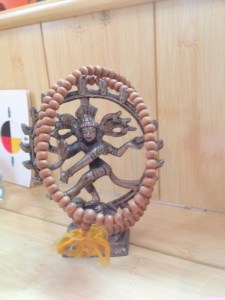
One idea expressed by Faith Hunter that got me excited was her insight that we are in a time of Siva at the moment. In Hinduism, Siva is the destroyer of the universe, and while destruction is often thought of as something very negative, it is also sometimes necessary. In order to come into a new era, the last one must be come to an end. Phoenix rising, you could say. Yes, it is a difficult and dark time to many in this country, but we must be hopeful and positive that the time of Siva will come to an end and we will reemerge into a bright, new era. As President Obama said after the November 8th election, “The sun will come out tomorrow.”
img_0028
The MLK yoga class addressed the darkness felt by many by taking a few moments in the middle of the class to have students voice their fears. The cathartic screaming out of fears, which seemed to be generally fueled by social injustices in the city and the country as well as race based issues, had the entire room of students closing their eyes and yelling out the first things that came to their minds as causing fear in their lives, many specific to the political change in their city. As loudly as they could, students yelled out  whatever it was that has been unsettling them. The small, intimate studio was filled with individual shouts by students. A lot of emotion was felt during this powerful exercise, and while it might be assumed that one of those most strongly felt emotions may have been anger about the issues being aired out, instead an emotion of relief was prevalent over anger. Personally, I felt relief in the fact that there were others, others around my age, whom practice yoga, and who have the same fears as I do in this country. It gave me relief that I wasn’t alone and then I felt hopeful that through building community and discussing uncomfortable topics, that we will be able to overcome hate and celebrate diversity.
Immediately following that exercise Kapalabati was practiced to build a fire, to grow strength to conquer the hate and injustices. Then the flow began to slow into a cooldown and ended in a group meditation. The focus of the meditation was on reaching out to others, to take this experience and go and spread it to those surrounding us outside of the studio and yoga community, to share our ideas of caring and love and to support those who are victims around us.
Yoga is not just a means of toning and stretching, yoga is a tool to better the self and the community. By practicing with others and taking the time to learn their names and their stories, we can better understand the larger community and country. By meeting our neighbors and joining together we can bit by bit get a better grasp of what’s really going on in this divided nation. “Rise Up! MLK Day Flow” was exactly what I needed to refuel my soul, to be filled with the needed energy to live each day from a place of love and kindness and to remember that we will overcome hate and injustices, one day at a time.

Yoga Butts

Introducing Mindy Sisco, yoga teacher extraordinaire, this first post, Yoga Butts, is a perfect post to have in mid-January, a time when we’re tempted to body-hate ourselves after weeks of holiday parties and Resolutions that aren’t always fulfilled. In this writing, Mindy gets personal and insightful about yoga and it’s back-end-benefits, that aren’t for show, but for strength and empowerment.


Many have lusted after it. Lululemon made millions off of it. It has its own entry in Urban Dictionary. The holy grail. The Quan. The Yoga Butt. Against all my scoffing, it turns out to be just as powerful as all the hype.

But(t) before going further, let’s go back. Practicing outside of a Western context, I’m new to the concept having only heard it uttered by a non-yogi friend last summer in Montreal. A Google search of “where did yoga butt start” led me to a string of articles about struggles with body image. This is particularly topical as of late in Korea as pop star, JYP, just released a song about butts. I’ll let you google that on your own. To even greater disgust (I’m looking at your Bill Maher!), afterwards he was chastised, not for his objectifying message, but that the butts he chose to lust after weren’t big enough.  Korea is first in the world for number of cosmetic procedures, a whopping 1/5 have had some sort of augmentation. In a place of immense competition and commodification, Tina Fey’s sentiment couldn’t ring more true.


I’m not immune from the sexualization of yoga here in Korea but I do have the luxury of being sheltered from it. This is based purely on limited passive exposure to media in my native language. I don’t pick up on ads playing in restaurants or images in print the same as I would back in the States. I’m lucky and thankful to be in these circumstances, this bubble. Beyond the bubble, it was yoga that gave me back some ownership of my body. It wasn’t about how it looked, it was about what my body could become capable of. Nobody really looks cool splaying their toes likes a monkey, but mine definitely outstretch most. And I love them. They are hands (feet?) down some of the most dexterous toes in the game.

I decided: I’m reclaiming it. The Yoga Butt is real, and it’s awesome.  When I talk “yoga butt,” I’m going past an ornamental accoutrement made to parade around overpriced pants. Sure, let that be the bait to get you there. I’m talking ass-blasting power that keeps your sacrum stable and you balancing on one leg like King Flamingo. I venture to say that a majority of people don’t walk into a studio seeking enlightenment. What keeps you there is feeling like a badass doing something in the skin you’re in – not 10lbs lighter you, not two inches taller you, not 20 years ago you, not fatter ass you – YOU. Exactly as you are, exactly in that specific moment.

To the undiscerning eye (I’m looking at you, Bill Maher!) my butt is more pancake that apple. If you ever catch me out on a Saturday night, ask me about the time I met Sir Mix-a-Lot doing a radio show. Suffice it to say I was vapor in that studio. Dumps like a truck? No. Yoga butt? Like it’s my job. Honestly, I like it. I feel kind of like a superhero- packing heat undercover.

This is 40 inches -around- of pure balancing power. Photo by Amy Brassington

Insider’s secret: standing balances.

For a big chunk of my time with yoga, both as a teacher and student, I avoided standing balances. I like feeling fire as long as I can move with it. Standing balances were like being forced to stand still in the middle of a furnace while being melted alive. First coming to yoga as a means to work out, I expected to move, not stand still. It took me 12 years to really gain an appreciation for this part of the practice.

The science: body imbalances between the front and back body.

The problem most common across the board is a world full of “lazy butts.” Office life and desk warming leaves us sitting. The gluteal muscles aren’t put to use and if you don’t use it, you lose it.  Without the support of strong glutes, the psoas ends up working overtime to stabilize the pelvis. Hip flexion muscles, the psoas in particular, stay in a shortened position while sitting. This causes tightness over time and can change the default angle of the pelvis. A “neutral” pelvis should tilt slightly forward with the tailbone pointing down. This is why so many people struggle to sit upright on the floor. This imbalance is the start of a world of hurt: knee pain, back pain, eventually spiraling up the length of the spine to affect the shoulders and neck. Time to put that butt to work!


Click here to see the original posting of “Yoga Butts” by Mindy which includes a short sequence that will burn your glutes so good. For more information on the author, go to the About section of the blog to read Mindy’s bio.

The Maloca: Types of Natural Building

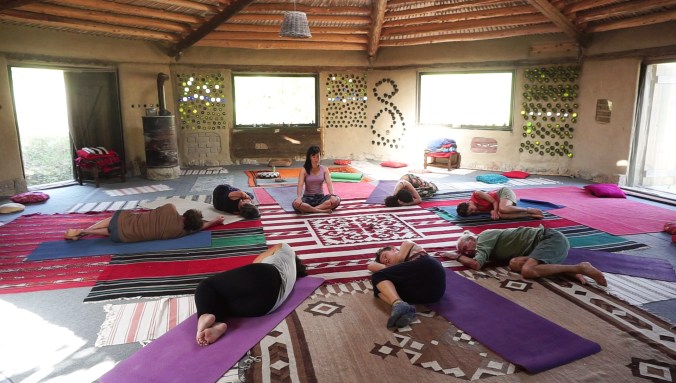
A couple of weeks ago I wrote an introductory post about natural building, explaining briefly about what it is. As mentioned in that post, I have been very fortunate to have had multiple opportunities of traveling to multiple countries to learn more about natural building. One trip took me to Re-Green in Greece where I stayed, learned, and laughed with some of the most amazing people who I’ve ever met. While there I also had the marvelous opportunity to teach yoga in the stunning Maloca, which is the magnificent meeting room at Re-Green. The Maloca, is a round structure that was built by hand using multiple natural building techniques and it derives its name from the Amazon where a maloca is a long house used for communal meetings.

Not only is the Maloca a place of beauty and a space used for yoga, but it is also an exhibition of multiple natural building techniques. Each wall is built using a different technique and as is common in natural built structures, each wall has its own truth window. Truth windows are cute little peeks into what’s underneath the plaster. It’s a way for owners and builders to display the technique used to build the space. Generally there are small shutters or doors that you open to find Plexiglas which shows what lies behind and between the interior and exterior walls. The Maloca has exactly this on each unique wall, but without a door or shutter, it’s simply the Plexiglass displaying what’s really there.

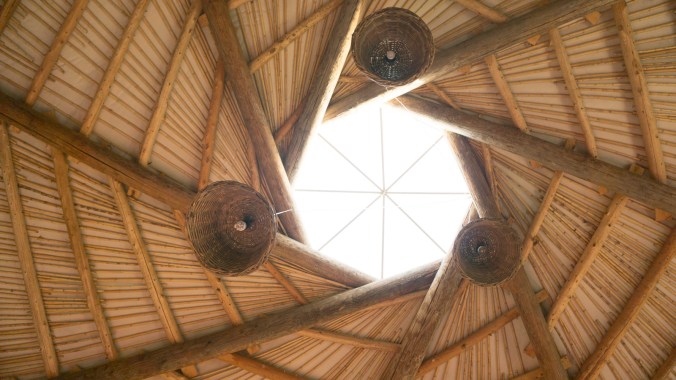
One wall shows straw bale, another rammed earth, there’s earthen bags, and straw clay, plus cord wood,  and adobe brick. That is six examples of natural building in one 100 sq meter beauty of a building. The quite literal icing on the cake is the masterfully constructed reciprocal roof, pictured as the feature image and below (it’s so beautiful I had to show it twice.)

_dsc4372

To break down those techniques a little more here is an outline of each of the six techniques displayed in each of the Maloca’s truth windows.

Straw Bails

_dsc4368

Straw bales

Straw Bail houses and buildings are becoming somewhat more known in the U.S. and the rest of the globe. They are as they sound, houses built of straw bales – Three Little Pigs style, I’m sure one of them made a house out of straw! Well these walls won’t be blown down by a nasty wolf nor a nasty north wind. As you may have guessed, the walls are thick, as thick as a straw bail as a matter of fact! Now of course there’s more to it than stacking bails on top of each other into the shape of a house. To finish the walls earthen plaster (mud) is applied to the exterior and interior. This keeps the critters out.

Straw Clay

Straw clay is likewise made from straw, but this time the bails are deconstructed and the straw is blended right into the mud-clay mix, either by hand, taking handfuls of loose straw and drenching it in the mud mix, or by mixing it with machinery. A structure must be built first in order to hold the straw-dipped material inside. The wood is put together so that there is a hollow space in the middle where the straw clay will be packed, and it must be packed tightly or hollow spaces will be left, where those same nasty critters could burrow in through the tiniest of holes in the external wall; trust me, you don’t want squirrel pee soaking in to your living room wall! Pack it tight!

_dsc4369

Straw clay

Rammed Earth

A rammed earth wall is a show piece of a natural home. Rammed earth is layers of soil and clay rammed down hard so that it becomes sturdy and permanent. Did you ever go to a state fair and fill a glass jar or vase with different colors of sand through a funnel to make an elementary master piece? Well, that’s pretty much what rammed earth looks like. Layers of earth-tones on top of each other. These walls take a lot of time and brawny muscles, so an entire house is not likely to have all of its walls made like this, but an island in a kitchen or a wall near a fire-place could be examples of ways to use rammed earth as show pieces. Structural and beautiful all in one.

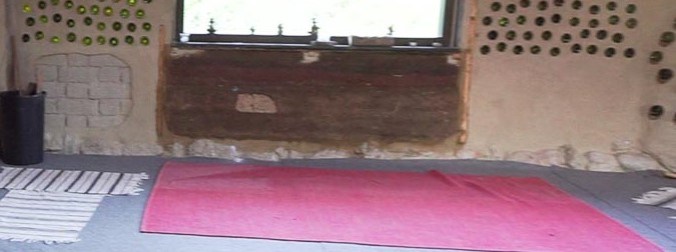
vlc_picerror212

Central, under the window, is rammed earth, shame that it’s not a closer shot as you miss the beauty. To the left is clay brick.

Clay Bricks

Clay bricks are commonly known in the U.S. as adobe. These types of buildings are, or were, prevalent in the south-western United States. These are bricks made from clay that are molded or formed and then dried in the sun. they then are mortared together to form walls. Unlike hobbit-house straw bale houses, which are more organic in shape and can look like they’ve come straight out of Middle-Earth; adobe walls tend to be straighter and more uniform. Adobe is also good for building more complicated forms such as arches.

Cord Wood 20160420_090612

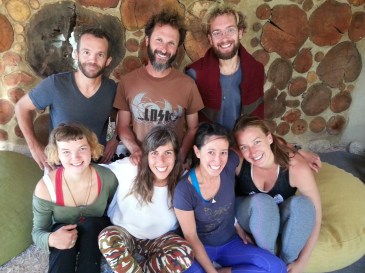
Imagine a big tree that’s been timbered and the logger starts to cut the tree like slices of bread creating great big circular remnants of the tree. Now imagine that those pieces of the tree are inserted into a wall, that’s what cord wood looks like, although of course the cord wood isn’t just inserted into the wall, it is inlaid slowly as the wall is built. Cord wood structures are quaint and very reminiscent of the nature from which the wood has been derived. One thing to know about building with pieces of a tree is that wood moves, breathes, and contracts with the weather, so gaps may form if the malleability of the wood is not kept in mind while building. You can see an example of a cord wood wall behind the gang of us after a morning yoga class at Re-Green, a superb backdrop for any photo.

Earth Bags

vlc_picerror926

Earth bags just behind this gal doing a handstand.

Earth bags are large bags filled with soil then piled on top of each other to build a wall. This is a form of natural building that is quick and relatively easy, although of course, some building knowledge is required. The gags are filled with earth that contains some amount of clay or another substance such as volcanic rock. This is a good technique to use if your build site does not contain much clay, as less is needed. Of course the major elephant in the room is the bag which the earth fills. The bags are as most bags are in our modern world – plastic. Now you know how I detest plastic bags, so I would not choose to build with earth bags if I could build anoterh way, but I understand that using earth bags is the lesser of the two evils when the alternative is to use conventional building supplies that have more chemicals and are likely not produced localy.


And there you have it, the techniques used to build the sacred space that is the Maloca at Re-Green, Greece. There is a lot more to say about each and all of these styles of natural building. For now I’ll let you day-dream over your little hobbit house, a great day dream to have as winter surrounds us. Just picture sitting by the wood stove, wrapped in a blanket (or not, these houses are energy efficient, but the blanket helps the vision of coziness I’m going for here,) sipping tea, reading a book with your dog at your feet inside the natural house that you built with your own hands. What a dream, and it’s a dream that becomes more and more realistic the more you learn about natural building. I can almost guarantee that once you get your hands in the dirt, you’ll be back for more, just as I was.

I hope that these photos of the Maloca have directed your day-dream in the right direction. Keep following this blog for more information on natural building and other things natural and yoga.

vlc_picerror360