Leave No Trace – Litter on Korean Mountains

Surrounding myself by nature is a wonderful luxury that I try to make part of my life as much as I can. Living smack in the middle of a city, it is not always easy to feel totally engulfed by the beauty of the natural world. Don’t get me wrong, Busan has great hiking and of course beaches, but often reminders of being in a city are there – noise pollution, light pollution, and straight up litter. Recently though, I was able to get out of Busan for a little trip up north over the Chuseok holiday to visit Seoraksan National Park.

Years back when I made my first trip to Seoraksan, a fellow American expat taught me about the idea of Leave No Trace, it’s as simple as it sounds, take with you whatever you brought up when you go, leaving no trace of your visit. This means clean up after yourself, that simple rule we learn in kindergarten. Don’t leave any wrappers, single use utensils, or even fruit peels (as they are more than likely tarnished with pesticides and are probably not native of the land so therefore might cause disruption to the ecosystem.) This is a rule that I strictly follow whenever I get up into the mountains (or parks, beach, etc.)

Admittedly though, I am not an avid hiker. When given the choice I much prefer to stay near sea level as opposed to climbing up a big ‘ol mountain, but once I have been dragged along on a hike I always love that I’ve done it. It feels rewarding and the views are fantastic.

Seoraksan

Unfortunately, not all of the views are beautiful. On my most recent hike I couldn’t help but be upset by all of the litter left behind by fellow hikers. Feeling affected, I collected as much of the litter as I could and stuff it in the side mesh pocket of my backpack, by the time I finished the hike the trash was spilling over the sides.
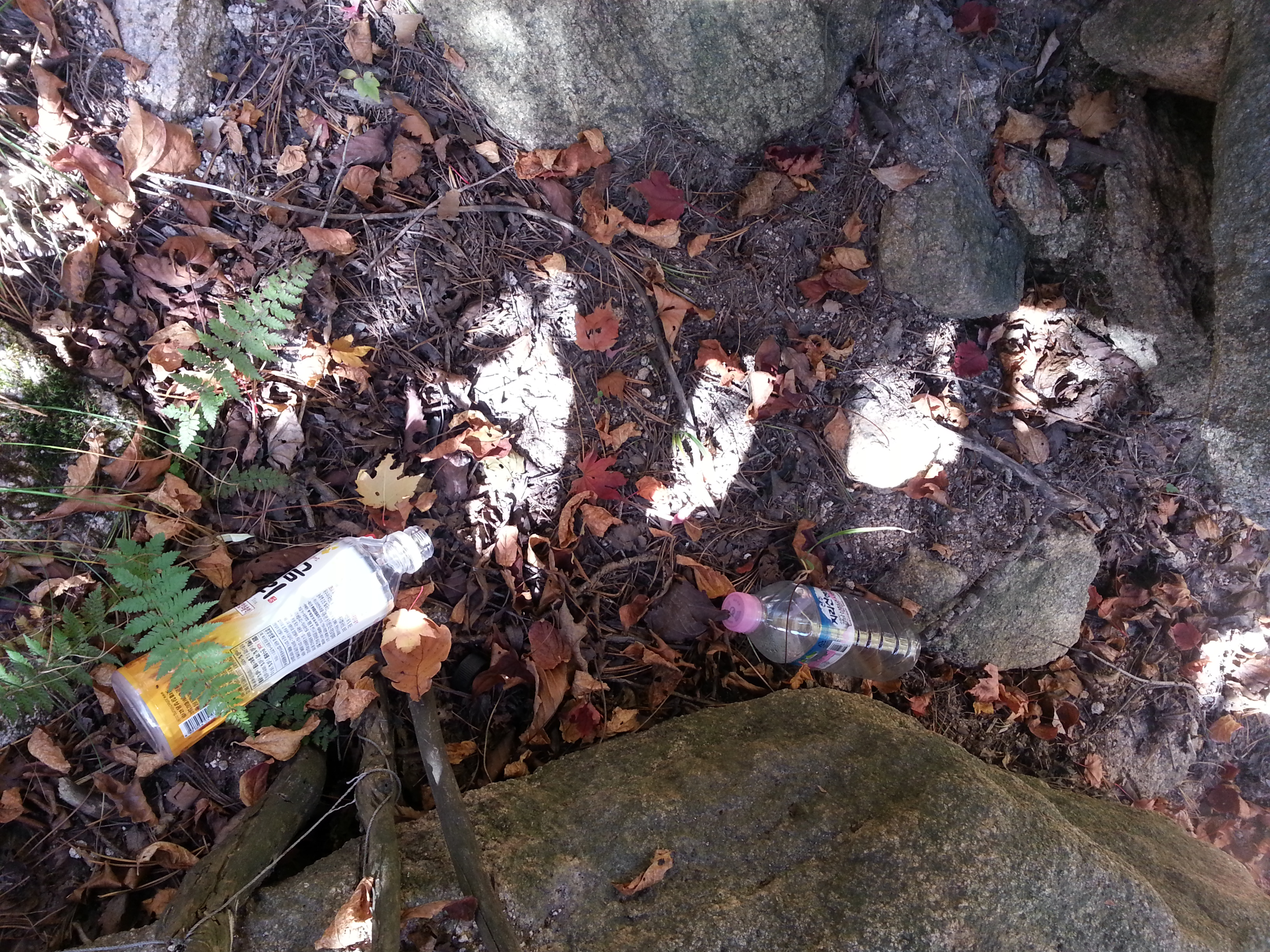
Water bottles were a common sight

Water bottles were a common sight

When I returned to my hotel I emptied it all out and arranged it to have a closer look. It seems that most of the trash was individually wrapped candies. (Candy wrappers are also one of the most frequently littered items on my local beach.) If only the sweet-toothed, nature “lovers” loved nature enough to leave no trace. Other items I took notice of were bits of gear that had apparently fallen off mid-hike, a reminder to buy quality when you shop so that you don’t have the problem of your backpack or footwear falling apart during use, and if it does, please take it with you and dispose of it properly.

It is so important to Leave No Trace; I can’t imagine how long all of this might have stayed on the gorgeous Seoraksan floor. Sure, there are probably teams that go up and clean, but wouldn’t it be nice if everybody took their own responsibility and left places as beautiful as they found them, with no traces?

Autumn Equinox Event – Busan 2015

A few weeks ago I was fortunate enough to be part of another seasonal, community event. Our local Busan community really came together for the Autumn Equinox with organizers working together from the cycle, yoga, and food communities, all for the local foreign involved environmental group – BCA, Busan Climate Action.

An already active community member and activist, Sunny, has been organizing Critical Mass rides in Busan to bring awareness to cycle safety on the road. I know first hand how dangerous it is to cycle here as a commuting cyclist due to inconsistent cycle paths and drivers who don’t always accept or appreciate me being on “their road.” It’s true that Busan has great cycle paths along rivers and the coast, but the city is lacking in areas of the inner city and less touristy neighborhoods. Critical Mass brings together other concerned cyclists whom ride the streets of a certain route, as a big community, to feel safe from drivers and to make those drivers aware that they share the road (whether they like it or not) with bicycles. Critical Mass is held most third Sundays of the months, so it worked out perfectly to combine the yoga equinox event with the cycle ride.

The route ended early in Gwangan so that I could lead an hour-long yoga class. Many regular students joined the cyclists and we practiced a root chakra class, to ground ourselves in the changing times of the seasons. After the yoga class there was some playtime of acro and then we made our way towards a rooftop restaurant for a vegan-family-style dinner.

Donations from the events went towards the upcoming BCA Film Festival. This is the second film festival held by the group and will be on November 6 & 7th at the Busan Community Media Center. The film festival aspires to make the community aware of the dangers of our changing climate, causes of global warming, and changes that can be made to decrease an individuals carbon footprint.

I had a wonderful time being apart of another seasonal event and look forward to participating  again in winter when that comes around. How have you been recognizing the changing of the seasons?

Root Chakra and the Autumnal Equinox

Today, September 23, 2015 is the Autumn Equinox. It marks one of two days of the year when the length of day and night are about equal. It also marks the end of summer and beginning of autumn here in the northern hemisphere.

With the theme of equality in mind, it is a good time to reflect on how to find more balance in your life. For our local Busan event which happened on Sunday the 20th, I taught a special root chakra class to find balance in the first chakra – muladhara chakra. I felt inspired by the colors of the changing leaves focusing on the color red.

Root chakra is the first chakra and is characterized by the element of earth, and represents security, its color is red. Living abroad as expats, it can be common to have feelings of uncertainty about the next step. Most of us here in Korea come on a short-one-year visa that is either extended or left behind for travel or settlement elsewhere. It’s figuring out which choice to make that can leave us feeling uncertain about the future, which can equate to an imbalance in the root chakra. No matter what your situation is, times of feeling ungrounded are sure to arise here and there.

Yoga poses to help ground you are poses that are quite simply near to the ground – seated postures. Muladhara chakra is located at the base of the pelvic floor, focusing on that area during your practice is helpful, as well as grounding through the feet in standing poses. Here are a few poses to practice if you feel you need to dig your roots in a bit deeper.

  • Sukhasana Start seated in a simple cross-legged position. Shift around until you find a comfortable position. If you have tight hips, then lift your sit bones up onto something to give yourself a little more height, such as a yoga block, blanket, or pillow. However, sitting directly on the floor will give you a better sense of grounding. Use your hands to feel heavier on the mat, with the thumbs inside and just below the hip bones, apply pressure with the palms to the top of the thigh to push yourself deeper into the mat. Close your eyes and breathe.

Sukhasana

  • Vrksasana Ok, so this one’s a standing balancing pose, but it makes total sense to do when focusing on the root chakra, I mean of course you have to do Tree Pose when balancing the root chakra! Stand firmly in your standing foot and raise your other foot with control to a comfortable position for you. Keep rooting through the standing foot as you allow your torso to lift, if it feels good, lift your arms towards the sky.
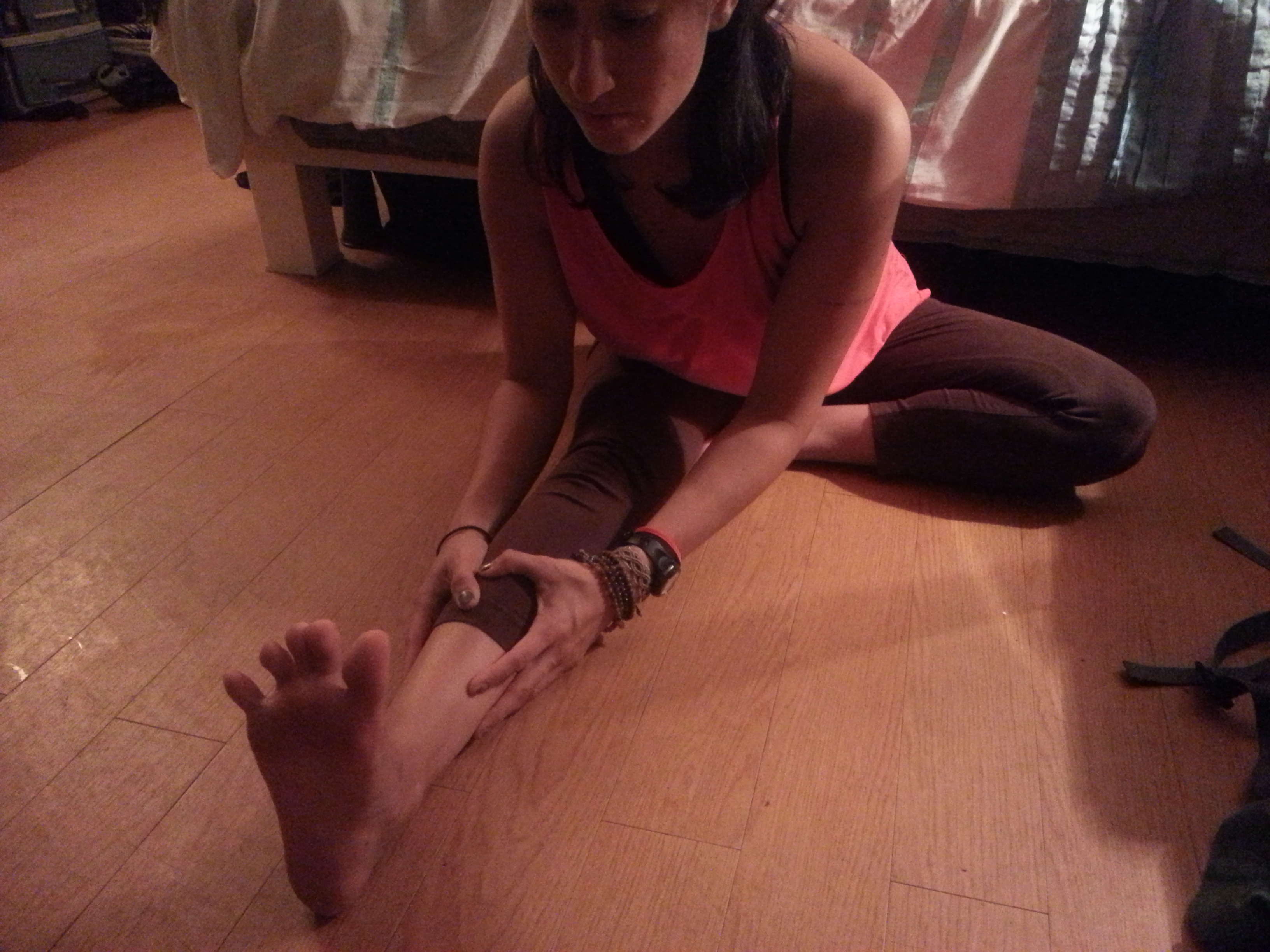
  • Janu Sirsasana After performing a standing sequence to warm up, or a few sun salutations, bring yourself back to the floor for more seated postures. Just as the temperature drops with the season change, so too might your yoga practice, moving from more of a yang to a yin. Sit on the mat with both legs extended long in front of you, draw your right foot into the left inner thigh and let the right knee fall over to the right. Use your finger tips to lift your chest, then on an exhale begin to fold over your extended left leg. Place your hands where you can reach (it is totally not necessary to hold the foot) and breathe as you let the head relax. Come up on an inhale and perform on the second side for balance.

Janusirsasana

  • Upavisthakonasana From the last pose, splay your legs wide out in front of you. Flex through your heels to keep your leg muscles engaged. Be sure that the toes and knees always point up to the sky together. If your hamstrings are tight, you might find relief by placing two small, rolled towels or blankets under each knee. Again, find length through the torso by lifting into your fingertips behind you. Stay there, while feeling completely supported and grounded in the mat, or begin to fold forward. Stay on the hands, go to the forearms, or release onto your belly. Stay and breathe. Come up slowly on an inhalation when ready.

Seated wide leg forward fold

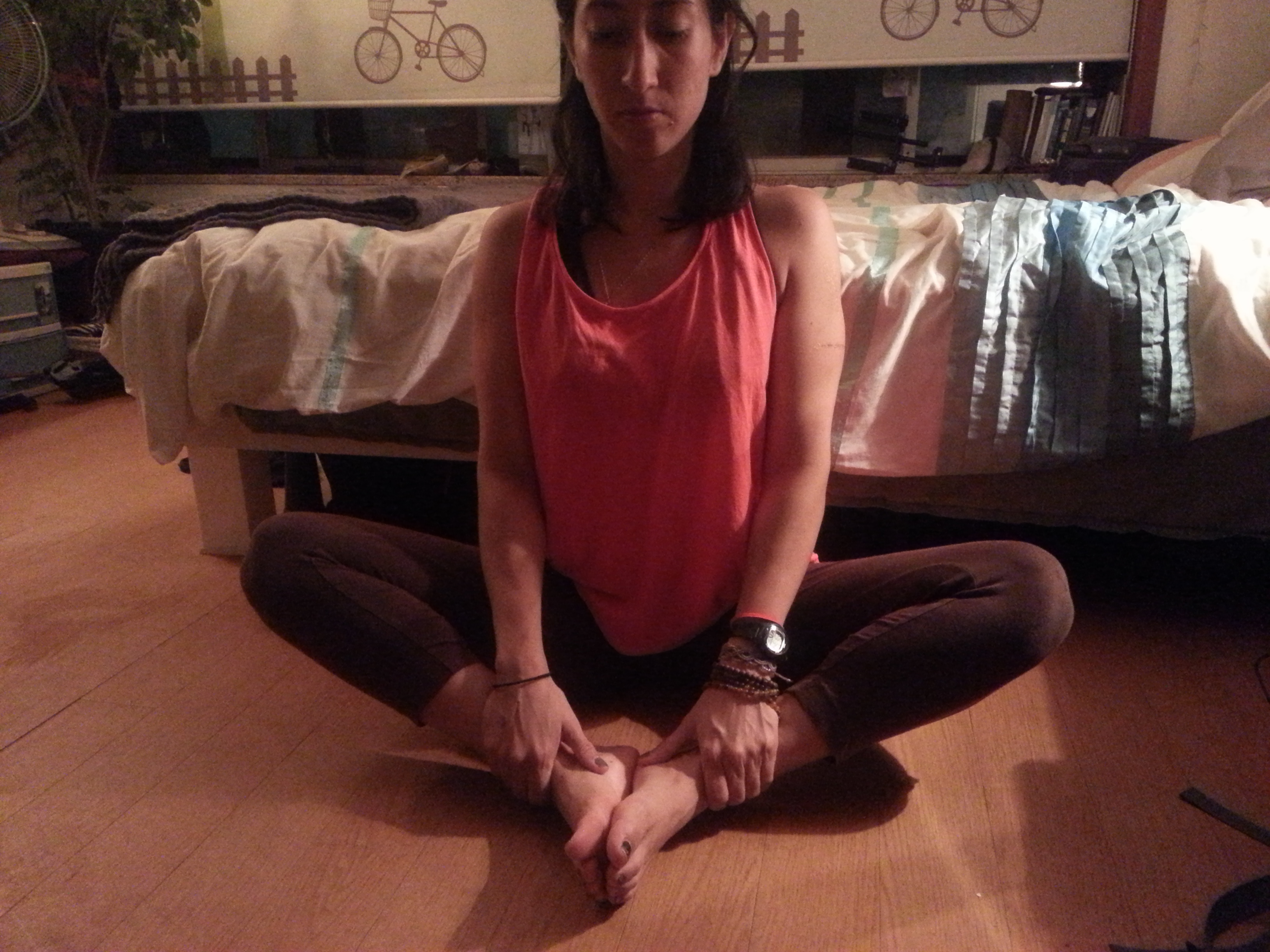
  • Baddha Konasana From the wide leg fold, pull the soles of your feet together for bound angle pose. Let your knees fall apart. With your feet away from you in a diamond shape (tight hips) or heels drawn in close to the body (open hips,) find your open chest and stay or fold. Breathe into the pose focusing on the pelvic floor.

Bound angle pose

My final thought on the root chakra is to get into nature. The element of earth is associated with the root chakra, so spending more time in nature can help you rebalance. After your yoga practice you might choose to take a short meditation focusing on the color red, a strong tree rooted securely in the ground, or with eyes closed envision a glowing red sunset or the changing colored leaves, as I asked my students to do in Savasana at the recent Autumn Equinox Event.

Warm colors of sunset

Conscious Dining – Boycott Single Use Plastics at Restaurants

I’ve written before about the importance of switching from a plastic to-go-cup to bringing your own tumbler whenever you get an iced coffee out at a cafe or restaurant to save landfills and energy of recycling hundreds of plastic cups, lids, and straws. I am really proud of the plastic that was not used by me in the past five years since I’ve been using my tumbler daily. There’s really no need to create all that waste – either bring your own or ask for a mug in the cafe. Recently I have expanded my actions of decreasing my single use plastics, I now pay attention to the restaurants and cafes that I visit and have made conscious decisions to boycott  places that regularly serve with plastic utensils or cups.

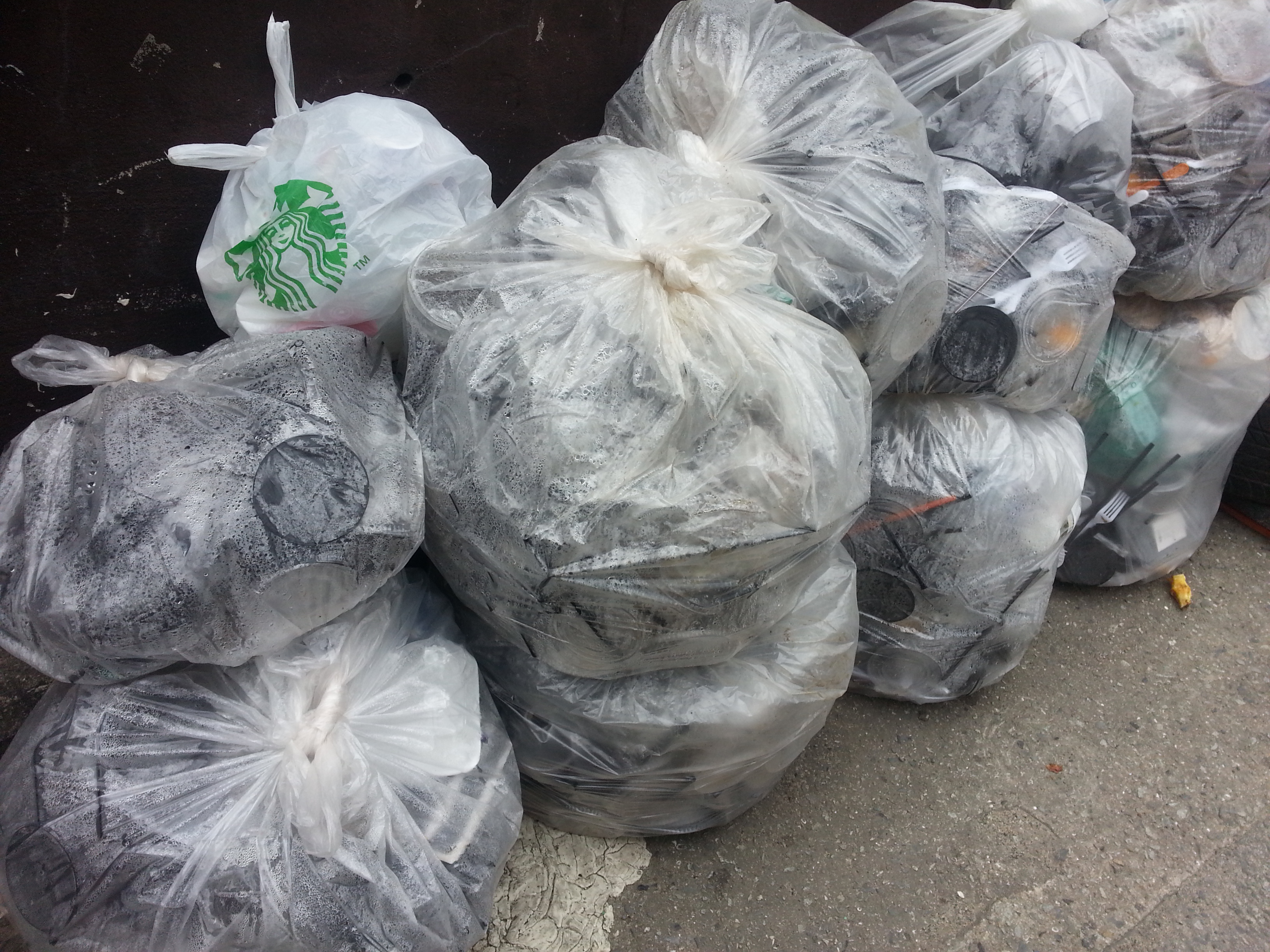
Waste behind a local cafe, these bags are filled mostly with plastic cups/lids/straws.

Waste behind a local cafe, these bags are filled mostly with plastic cups/lids/straws.

There are of course times when plastic silverware has its benefits, say for a picnic, but even then there are alternatives such as metal or single use wooden utensils. But at a sit down restaurant, I see no logic in it. It was over a year ago that I went to an expensive restaurant here in Busan that sits on a marina, has modern interior design, and caters to wealthy customers. Their fare follows their aquatic theme, concentrating on deep-fried seafood baskets with french fries – fish ‘n chips basically. At this “nice” establishment the food comes out in a cardboard box with a wax paper lining, to eat they supply plastic forks and knives, and condiments are given in 2oz plastic dishes with lids (With lids! With lids to sit down and dip your fish into and then immediately throw away.) That is a lot of waste from one meal. And is it just me, or doesn’t using disposables cheapen the image of a restaurant?

Lids! To dine in! Madness

During my first visit there I sulked as I ate, trying not to ruin the vibe for my friends, and I vowed to never go there again. Over a year later the place was suggested to eat at for a friend’s birthday and I had to speak up and be the Debbie Downer that often makes an appearance as an environmentalist and say that I could not eat there based on the waste. It was uncomfortable to vocalize and certainly put a damper on the issue, but I had to say it. In the end, plans changed and we didn’t go there, but I am glad I spoke up none-the-less.

I also once ate at a pizza place that serves by the slice. They served that slice of pizza on a nice wooden board but also lined that board with a piece of paper – totally unnecessary. Plates were of course paper as well. The utensils were plastic so I opted to just use my hands. Even the draught beer, which was from a local brewery, was served in plastic cups. I really enjoy that local beer but couldn’t bring myself to order it.

Side note on the beer cups; there are times when they are required, say a crowded concert floor where glass could be a danger, or at an outdoor event where again it’s a hazard to have glass. In that case, breweries and restaurants could serve their beer in a compostable, corn-based cup, which is what I found back home in the U.S. at my favorite local brewery – Southern Tier Brewery of Lakewood, NY. I was sad to have to switch to plastic in order to follow my friends onto their stones course*, but was relieved when I saw that it was a compostable plastic cup. (I heard from a friend that there is a cafe in Busan that serves their to-go coffees in a similar cup, it’s on my to-do list to check it out and of course there shall be a post.)

Compostable Corn Cup, Made in U.S.A - dream product

Compostable Corn Cup, Made in U.S.A – dream product

It really might seem crazy to most people that I am so affected by this issue (I once described how it feels as if I’m strangling a kitten, or some other such heinous crime, whenever I use plastic, or worse still, don’t have the option to recycle it) but since I have been living by the sea and witness the amounts of litter and waste that makes its way into the water, I have been more and more adamant about limiting my contribution to our dying oceans.

Bring Your Own EVERYTHING!

Bring Your Own EVERYTHING!

So, what to do about this? After I realize what’s going on, I decide not to visit the restaurants again. Another option could be to go but to bring my own utensils and tumbler. I have even gone so far as to bring my own dishes along to an event that I knew would be using single use. Sure, I got a few weird stares, but I also got some compliments and hopefully inspired at least one or two people to be more aware. I wouldn’t suggest lugging your picnic basket around with you everywhere you dine, but sticking some silverware in your purse at all times might be a good middle ground. They’re not big and you can even find compact camping style ones. One of my next projects is to sew a little fabric carrier to keep my chopsticks and spoon clean when I carry them around. Post on that when I get around to it. Until then, I shall simply be boycotting single use plastics at restaurants.

How do you avoid it?


100% recycled apparel

*Footnote: Stones is a cool new game which from my understanding was invented in my region of south-western New York State. It’s a game similar to bocce ball that requires a grass and sand course. I noticed it was gaining a lot of popularity at Southern Tier, they even had T-shirts, which to my delighted surprise were made from 100% post-consumer recycle material. High five!

Ride the Wind – Therapeutic Flying

This past weekend I performed with my Kaizen Acro Yoga Crew at a university festival.  We made the five hour bus trip up to Seoul to perform our two, four minute songs which we rehearsed for weeks prior. Indeed it was a lot of work, but it was well worth it.

For this performance we had a little less time to prepare than we did for the first one, maybe three or four weeks to create, choreograph, and rehearse which meant that we practiced a lot. Our high-flying group met 4-5 times a week and practiced for 2-4 hours each time. I was bruised up and my muscles have been achy, but in that way that I love, the rewarding soreness that tells me that I’ve been working hard.

No pain, no gain.

No pain, no gain.

But with everything in yoga a balance needs to be found. My well trained body was yearning for some relaxation and rest, which is why I was allowing myself frequent naps these past few weeks, a luxury that doesn’t usually make it into my schedule. I knew that my body needed to recuperate, so I hit the pillow for 10-20 minutes before training.

Last week on a Wednesday was one of those long training nights, we met at 6:30 to warm up, ran our routines over and over again, tweaking as we went, and then it was class time. From 8-10pm was the Big Birds class at Kaizen, the studio run by my very good friends Mindy and Simon. The class is usually really intense and forces me to push myself to my physical limits. Last week’s class however, was a little more on the chill side which was exactly what my body had been desiring.

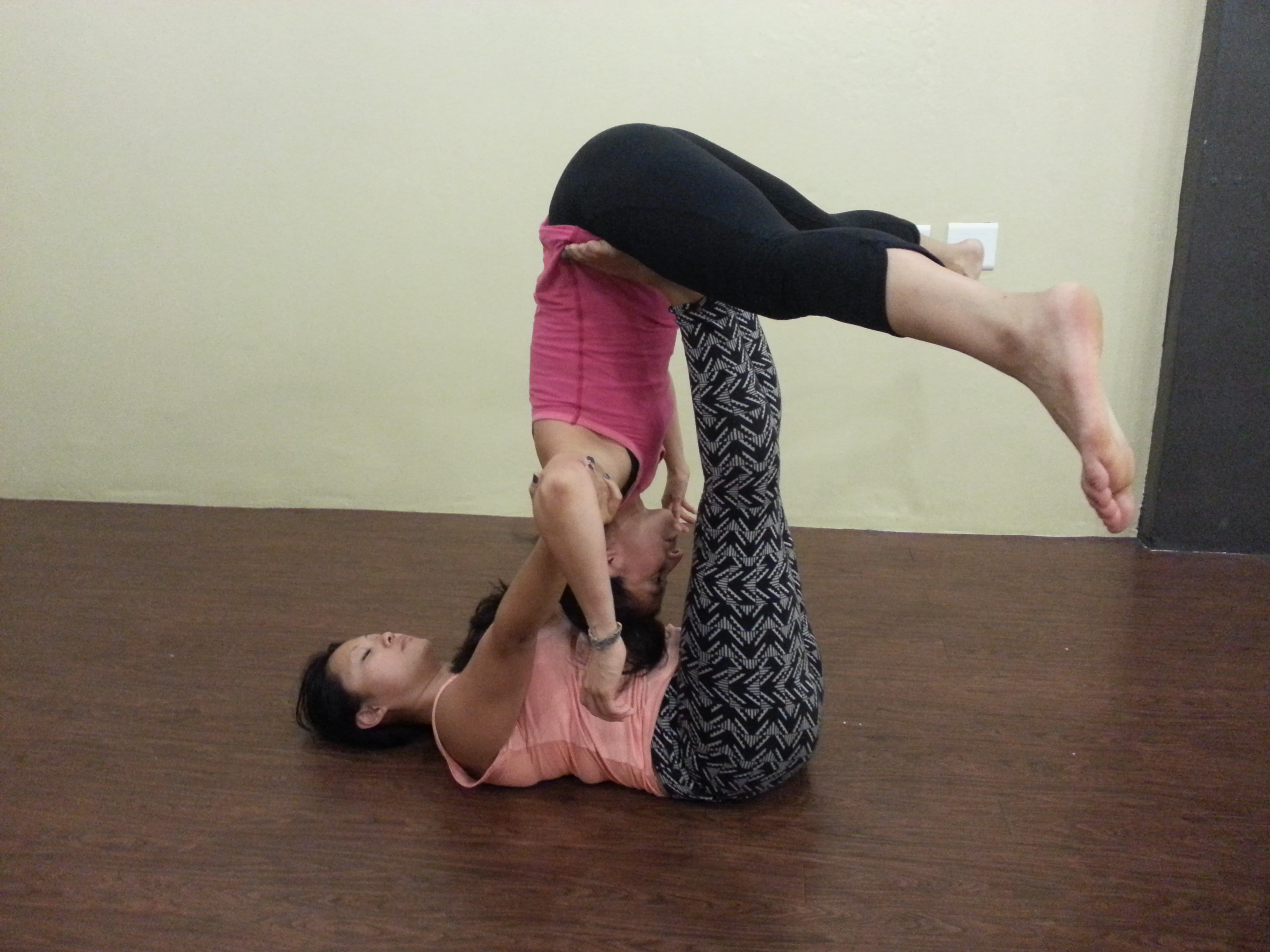
In the middle of class Mindy asked us to switch it up a bit, so instead of drilling press ups (her new favorite activity,) she had us partner up and (thank the lord!) do therapeutic flying. You can think of therapeutic flying as receiving a massage in the air by your acro partner. The base is the masseuse and the flyer is the very passive, limp, receiver of the massage. It is the yin to the yang of the high powered washing machines in acro yoga.

At last week’s class we were instructed to focus on the shoulders, so my partner put me in folded leaf and started massaging my traps and neck. Folded LeafIt.was.wonderful! I also played masseuse and based her in folded leaf. Having those 10 minutes of therapeutics was so very welcomed by my tired body; I wasn’t actually sure that I was going to be able to push through an intense traditional acro class, and was pleasantly surprised when class ended up being gentler than normal. Also, I slept so well that night, which isn’t the norm; usually after finishing class at 10 and cycling home from the studio, I am up and wired for a few hours, finding it difficult to quite my body and mind for bed, but last night I had no problem sleeping – maybe partially due to the therapeutics.

If you get the chance to attend a class or workshop which includes therapeutic flying, then I suggest going. It can be done with a stranger or friend, or it can be practiced with a partner to create more intimacy and give you a skill that will keep on giving.


Acro yoga classes can be found here in Busan at Kaizen. Classes are offered for beginners, intermediate, and advanced students. Every Friday there is an acro jam, free for all to attend and play. Check their website for times and pricing.

Detoxify Your Home – Natural Soaps

As I have become more and more mindful of chemical ingredients found in the average cleaning supply, toiletry item, beauty product, or almost anything else that lines my cupboards and sink – I have made conscious efforts to detoxify those items. The shower is a primary area where I think that it’s important to kick the chemicals to the curb. Think about it – those very unnatural products, full of chemicals and dyes are applied directly to the skin (body washes, face wash, lotions, make up, the list goes on,) sometimes applied multiple times a day. And our skin is our largest organ, which is porous and absorbent.

For over a year now I have made the switch from cheap, packaged grocery aisle soaps to handmade soaps. Fortunately, artisan soaps are prevalent and easy to find. Many small boutiques often sell beautiful handmade soaps, made of few ingredients which are non-toxic. You can search online to find suppliers as well, whether you search large scale with Amazon or find a small producer on Etsy. Make your way to a farmers market or craft show and I’m sure someone there will have some soaps. You could also go for a big brand  name, such as Dr. Bronner’s.

Back in 2013 I found my natural soap supplier while browsing a foreigner market in my former Korean city of Ulsan. A lovely market had been organized in which mostly foreigners set up tables and sold their handmade items. Amongst those tables was a well-stocked soaps table by Mama’s Binoo (binoo is soap in Korean.)

Mama’s Binoo is an artisanal soaps producer run by Stacey Fells, originally of Canada, but now living in Korea. A short list of her products are: soaps, massage oils, lotions, bug spray, shampoo bars, candles etc. You can find the full list directly on her Facebook page, or visit her table at one of the foreigner markets that has since been started up here in Busan.

Mama's Binoo Logo

Stacey is extremely knowledgable about her products and their benefits and she freely shares that knowledge with her customers in order to keep them clean and satisfied. Some of her most popular products are: zinc cream, shampoo bars and Bug Off, a natural bug spray that smells amazing. Stacey began making homemade products a few years back for her son who suffered from eczema. As she explains, “Even though I could speak Korean well it was hard deciphering the ingredients on the labels here sooo… I decided if I couldn’t find what I needed that I’d make it myself.” I can relate to that feeling of helplessness as an expat who doesn’t know the native language, but I’d challenge anyone to pull their body wash out of their showers and try to read those ingredients, even in their native language: sodium lauryl sulfate, toluene, propylene glycol anyone?

“Even though I could speak Korean well it was hard deciphering the ingredients on the labels here sooo… I decided if I couldn’t find what I needed that I’d make it myself.” – Stacey of Mama’s Binoo

The main reason that I made the switch from chemical to natural was because I was weary of what I had been applying to my skin day after day and what sort of long term effect that might have been having on my health. My boyfriend and I have a simple rule that we try to stick to when it comes to what we keep in our house – If we can’t eat it, then it doesn’t belong. Of course, we’re not going to be having our soaps with dinner, but you get the point. The products we buy and the companies we support are as natural as we can find and afford.

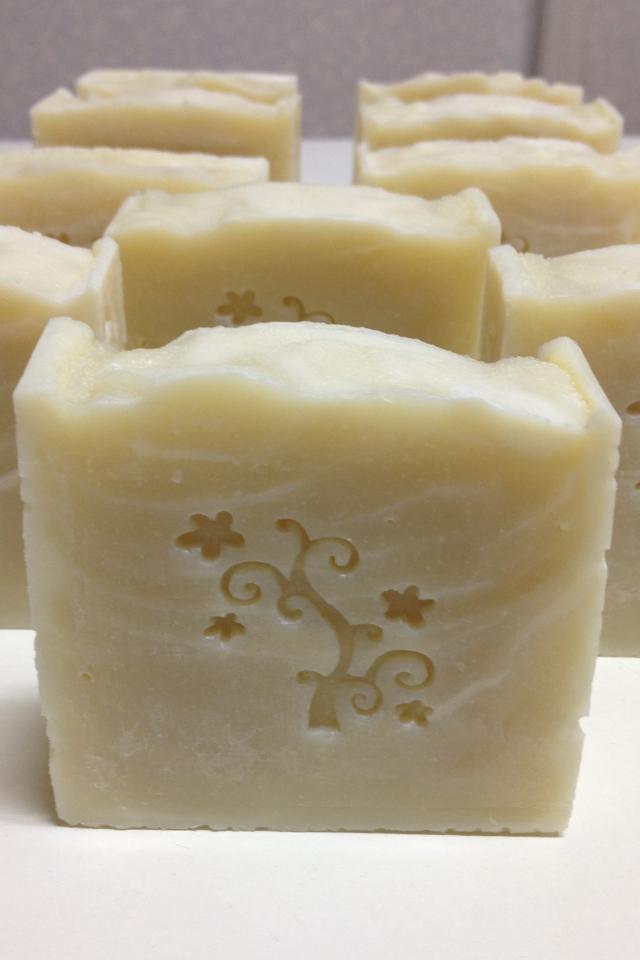
Mama's Binoo Soap

By buying and using handmade, natural soaps I not only make my home a little less toxic, but I am also supporting those making the soaps. Another benefit is decreasing the amount of packaging that comes home with me from the shop.You could go the next step and take a class on soap making and provide for yourself, I however, will just continue to shop local and use the wonderful products of Mama’s Binoo. Who’s your favorite local soaps producer?

Korean Templestay – Lessons from a Monastic Meal

One of the highlights from my recent Korean templestay was definitely the monastic meal experience. I wasn’t sure what to expect when I saw it listed on the itinerary, well, actually I envisioned a beyond simple bowl of the smallest portion rice, which would leave me immensely hungry for the rest of the night, but that wasn’t the reality.

The meal was actually quite filling and was made up of typical Korean fare. There was the ubiquitous kimchi and rice, as well as a soup and some bancheon (side dishes.) It was of course vegetarian. The contents of the meal are not what stuck with me the most though, it was the strict ritual of how to properly serve, accept, eat, and clean up after the meal that I found memorable.

The head monk that guided us through our templestay, sat at the head of the rest of us and taught us how to perform the ritual. We all sat on cushions on the floor with a bundle of dishes wrapped up tightly in a fabric bundle. We were instructed very carefully on how to unwrap the fabric, remove the four bowls of varying sizes, and how to display them in front of us. Each bowl served a purpose. One for water to be used to do the washing after the meal, one for the soup, one for the rice, and one for the side dishes.

As volunteers began to offer the rice to each participant we were strictly instructed to take only what we could consume entirely. Other volunteers served the soup and side dishes, beginning always with the head monk. There was to be absolutely no talking during the process which made it meditative and mindful. Only non-verbal communication was allowed.

The head monk said again and again not to waste any food. Every last grain of rice was to be eaten, and she was going to check at the end of the meal. When we were done eating we used the water in the water bowl to rinse all of the bowls out. During the middle of the meal she instructed us to save one of our half moons of yellow, pickled radish. The reason was that it was to serve as our scrubber for the dishes. We used our chopsticks to control the radish as we swiped it around every surface space, moving from bowl to bowl in the directed order, and then we ate the radish. The washing water we were to drink, ending up with absolutely no left over food or even any residue of our meal.

I loved it. No waste! Even the scrubber and wash water was consumed by us. Our translator expressed that although it might seem “dirty” to drink the wash water, it really wasn’t, because it only contained tiny bits of the food we had just been eating (no soap was used.)

After we drank the water our water bowl was filled with some scorched rice water which was to act as the final rinse. We poured the water from bowl to bowl and when we were finished we dumped the scorched rice water into a community collection pot. I volunteered do the collecting. If all had done their eating and washing correctly, then the community water at the end should have been crystal clear, lacking a single particle of food. As I collected I witnessed our failed attempted; as expected – we did not clear our bowls as efficiently as monks. Fortunately though, the head monk did not make us drink the community scorched rice water as a group, which is what real monks are made to do if they waste any food. Not a very delicious punishment, but an effective threat.

Eating just one meal as mindfully and thoroughly as a Korean monk has had a lasting impact on the way that I consume my daily meals. My daytime job is an English ESL teacher at a private kindergarten which feeds me lunch every day. Just as the children are taught, and as was reinforced at the templestay, I try every day to take only what I can eat completely, ending with no waste. I haven’t gone so far as to transfer the radish method into my school lunches, but I remember it as a lesson in sustainability and not wasting.

Unfortunately I did not take a single photo during the monastic meal as I didn’t want to interrupt the atmosphere and learning experience. Below is a gallery of photos from Hongbeopsa Temple where I did my stay.

Third Clothing Swap Success!

This past weekend I hosted my third community clothing swap here in Busan. The idea was exactly the same as the last two that I’ve hosted, all are welcome, donate what you can or come empty handed, walk away with as much as you like. The reasons why I don’t require donations by all are: 1. There’s an excess of clothing left behind by expat teachers whom have moved on from Korea and 2. My hope is that people will find clothing through this sustainable manner rather than by supporting Fast Fashion.

Although this swap was very similar to my past two, there were a few minor differences I made after learning some lessons from the previous ones. Here’s what was different.

  • More Strict Donation Requirements –
    About half of what was left over from the swap.

    About half of what was left over from the swap.

    At the last swap I got swamped with left over donations. A handful of friends and I took hours to sort through the piles and piles of clothes, placing them in either a massive garbage bag (we filled three,) a bag to be taken to a second hand shop (there were about 10,) or a pile to be sold at a market. This time I asked that people bring only high quality, no stains, no intimates. Initially I had faith that an outline like that wouldn’t be needed, but I turned out to be wrong. At this swap the clothes were in nicer condition and there weren’t as many to sort through in the end.

  • Change of Venue – The cafe where my first two swaps were held has sadly since shut down, so I moved location to a foreign-run bar in Gwangan – HQ. It was fun to have the swap at a bar. When I contacted them I referenced having a girls brunch day and they complied with a mimosa special during the time of the swap. Just like the last two swaps, purchase of a drink was suggested in lieu of an entrance fee.
  • Sneak Attack Ethics Lecture – Ok, so that might be misleading, but I did give a short five minute talk about my reasons for hosting swaps. At the very first swap I incorporated a talk about the fashion industry and sustainability (or rather lack of sustainability) which was scheduled to happen right before the swap began. A few people attended and were interested, but a lot of people didn’t come early for it, so this time I didn’t tell anyone I was going to do it, I just requested a mic from the bar and stood on my soap box at the height of the swap. I’m not sure how well received it was, but I hope that I reached a few people.

Swaps are really fun and easy to organize. I received a lot of feedback from attendees that they enjoy them and look forward to the next one. I hope they realize that they don’t have to wait for a large community swap to be organized; it would be super easy to host seasonal swaps with friends in your home. All you need to do is set a date, inform others, dig a bit through your closet, and swap till you drop.

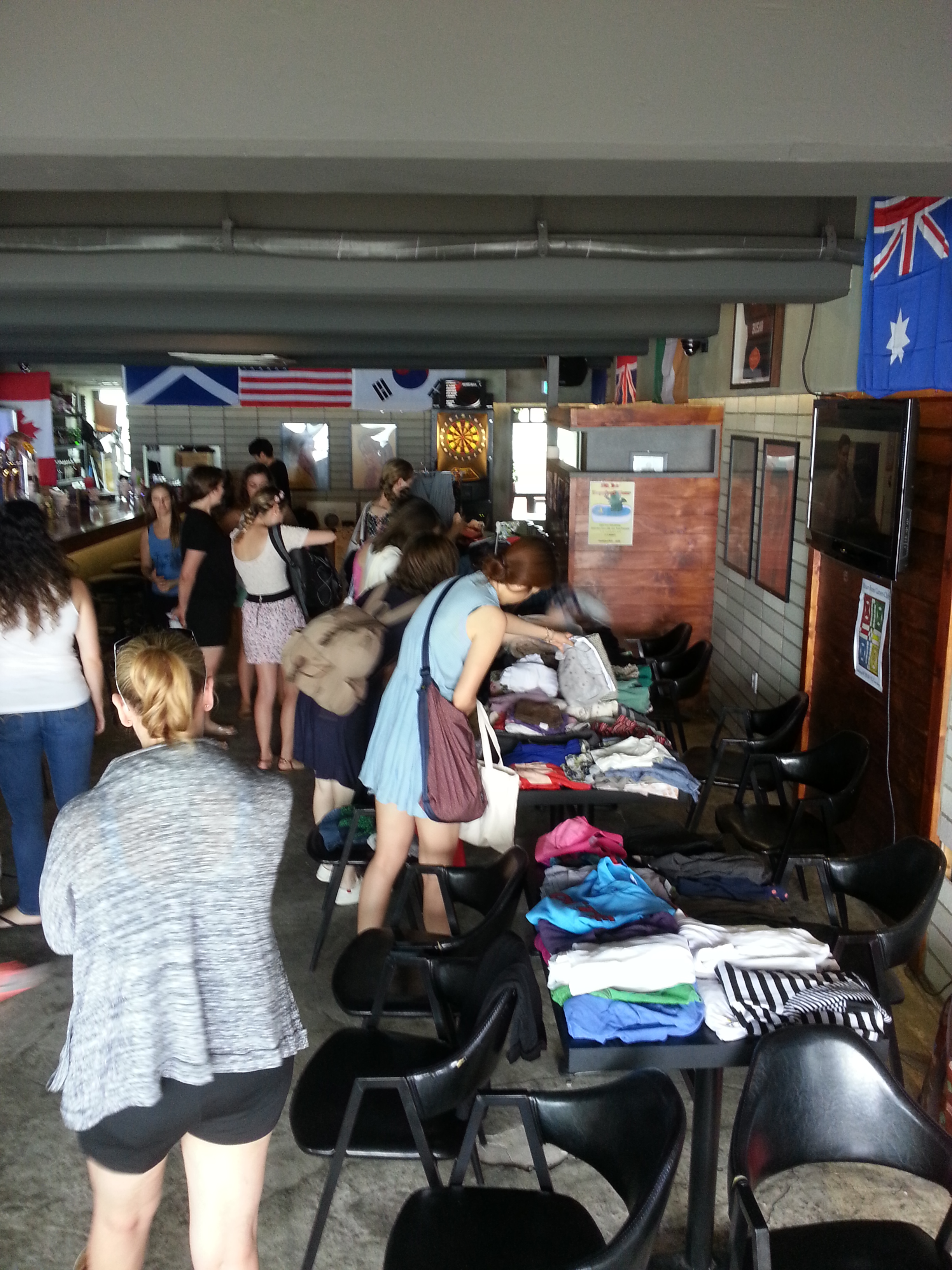
Swap in full Swing

Three Ingredient DIY Yoga Mat Cleaner

A friend of my shared this “recipe” for a DIY yoga mat cleaner that I’ve been making and using for a few years now. It’s a really easy mix to make and is made up of just three ingredients: water, vinegar, and peppermint essential oil. The vinegar acts as the cleaning agent, the water is to water it down and makes up the bulk of the mix, and the peppermint oil is added to make it smell a bit nicer. Here’s how to make it.

  1. Find an empty spray bottle. Buy one at a dollar store or box store or be green and reuse an old one that’s contents have recently been used up. Be sure to properly wash it if it’s been used before.
  2. Fill the bottle 1/4 of the way with your choice of vinegar. I suggest using either an unscented, mild vinegar like simple white vinegar, or try using a lemon vinegar which gives an extra clean smell.
  3. Fill the remainder 3/4 of the bottle with water.
  4. Add  5-10 drops of your choice of essential oil. I use peppermint because I like the combo of lemon and mint. The two scents together have a crisp, clean smell.
  5. Put the top of the spray bottle in place, secure tightly, and swirl the bottle to combine all ingredients together. It’s ready!

This is a great little spray to have around. It’s nontoxic, easy to make, and very versatile. It works on most yoga mats and is even safe for my pure rubber travel mat. Off the mat, I use the spray as a general cleaning spray in both my kitchen and bathroom. It works great on mirrors; which brings me to another green tip, to clean mirrors: spray your DIY mat cleaner and wipe clean with old newspapers. It leaves mirrors streak free and is a way to give a second life to the sports section.

I hope you enjoy this easy peasy mat cleaner – Namaste!

3rd Busan Clothing Swap

Join me in less than two weeks time, on August 29th from 2-4pm, for the third Busan clothing swap. I am excited to host this event, the past two were hugely successful, not only for those who attended, but in my eyes they were a success because they stopped people from buying fast fashion as well as kept some clothes out of landfills.

Below are the details for the upcoming event. See you at the swap!


Start going through your wardrobes! Coming Saturday, August 29th – Busan’s third clothing swap event. I’m excited to move locations to HQ Gwangan after the sad closing of Table Talk.

What’s a Swap? A clothing swap is a fun gathering of people looking to get rid of their gently used, undesired items in exchange for someone else’s gently used, undesired items. There is no requirement to donate clothes (I understand that some people are new and didn’t come with much,) just come and have a search through and hopefully go home with something new. This is also a good opportunity for those leaving us to get their extra pieces to other expats or Koreans.

What to Bring? **Please Read** This event is all volunteer run almost solely by myself, Kara Bemis, thankfully I have been fortunate enough to have some friends volunteer to help me on the day of the swaps to sort through clothes, with that being said- it is hard work. We must go through all the left over clothes and get them to the correct location: garbage or thrift store. Please be very selective of what to donate.

**NOTHING WITH STAINS, HOLES, NO INTIMATES.**

Use this simple rule, if you wouldn’t re-buy it like new, then it doesn’t pass the test. All seasons permitted, summer to winter. Also, by being selective, please limit the amount that you bring, if you have a suitcase full of high quality items – great! If you have two suitcases full of low quality items that saw better days, then please leave those at home (again, due to the fact that it’s hard work to sort through the left overs.)

Moving from a cafe to a bar, HQ and I are happy to announce that there shall be drink specials! Details to follow.

Make an afternoon of it, bring some friends, grab a drink, and swap till you drop. Just as before, this is a free event with a drink purchase your entrance fee, let’s support HQ who is letting us hold the event at their waterfront spot.


Directions to hq gwangan
  • Take the green subway (Line 2) to Gwangan, stop 209.
  • Take Exit 3.
  • U-turn towards Gwangali Beach, walk straight towards the beach until you reach the main road that runs along the beach. You will be in front of Lotteria/Baskin Robins.
  • Turn left at Lotteria and walk a few yards. HQ is on the fourth floor of the building with a chicken restaurant on the first floor and Cross Fit in the basement.
  • If you reached Starbucks then you went too far.