Korean Templestay – 108 Prostrations

In the past I have been invited to teach for yoga mala’s which are events where participants do 108 Sun Salutations (Surya Namaskar.) Teachers guide students through traditional Sun A and/or B, or through variations of both. It is both challenging and rewarding to push yourself to perform all of the sequences and as a teacher it has been fun to be creative and come up with variations. Although I have taught and participated in a few yoga malas, I never really knew what that number 108 was all about.

Recently, I took the opportunity to participate in a Korean Templestay. Templestays are little nightly or weekend getaways to a Korean temple. They are geared towards foreigners visiting or living in the country. During the stay, participants experience a brief monastic 24 hours (give or take.) At my templestay I wore simple cotton pants and a vest (worn over a T-shirt as showing shoulders is a big no-no at Korean temples,) ate and experienced the process of eating a monastic meal, attended two Buddhist ceremonies, made a strand of mala beads, and did 108 prostrations.

The Beads

Making the mala strand of beads felt a little bit like a summer camp activity. The other 20 or so participants and myself gathered in a beautifully painted room, sat upon meditation cushions, and were given little kits which included rough wooden beads, thick string, and a small metal tool that was to be used to push a better hole into the bead if it hadn’t been properly punched out.

While we made the malas our guide asked questions of us about Buddhism, such as what are the six offerings people bring to temple (I remember four of the six – rice, incense, flowers, fruit.) The guide/translator also explained that the beads were made of cedar which gave them a strong scent. According to her the scent is offensive to mosquitos and helps ward them off – bonus!

The number 108 was also explained, but in a mathematical-windy way reminiscent of conspiracy theories that add, subtract, and multiply to find their way to a meaningful number that supports their case. I’m not good with numbers in any sense, so unfortunately those numbers went in one ear and out the other. The following morning after stringing the beads we performed the 108 prostrations in the main hall and that’s where the magic happened.

108 Prostrations

After an opening ceremony of tycho drum, chant, and a few introductory bows, we began the 108. As I mentioned, the event was for foreigners; none of us were Korean speakers and the monks didn’t speak English, so during the bows they played a youtube video that gave a meaning to each bow. At first the video was offputting because the anouncer had a very cultish, deep, monotone voice, but what was being said by him was actually quite moving.

Reasons for bows came in groups. For example, for six or so bows there would be reasons about repenting. This is a rough memory, but a few  that I remember went something like this: “I prostrate in repentance for ever having taken my family for granted.” Then it continued with the same, “I prostrate in repentance for ever having taken my friends/nature/teachers for granted.” Another theme I remember was gratitude for similar topics: “I prostrate in gratitude for all the teachers that have touched my life,” for example. Having the sound of the video going, which visually displayed monks in monk like settings, helped the bows go by more quickly and gave them meaning.

Physically I didn’t find the bowing to be taxing, minus the speed. We bowed to the count of the youtube video which runs around 25 minutes, about 20 of those minutes being the actual bows. Doing 108 bows in 20 minutes is quick. The bows were similar to Sun Salutations and were performed by bending at the knees, hands at prayer at the chest (Namaskar,) lowering the knees down onto a meditation cushion, placing the forehead on the cushion, and then going to standing again. I overheard other participants complaining of the difficulty of it; it might be that my consistent yoga practice made the act easier for me.
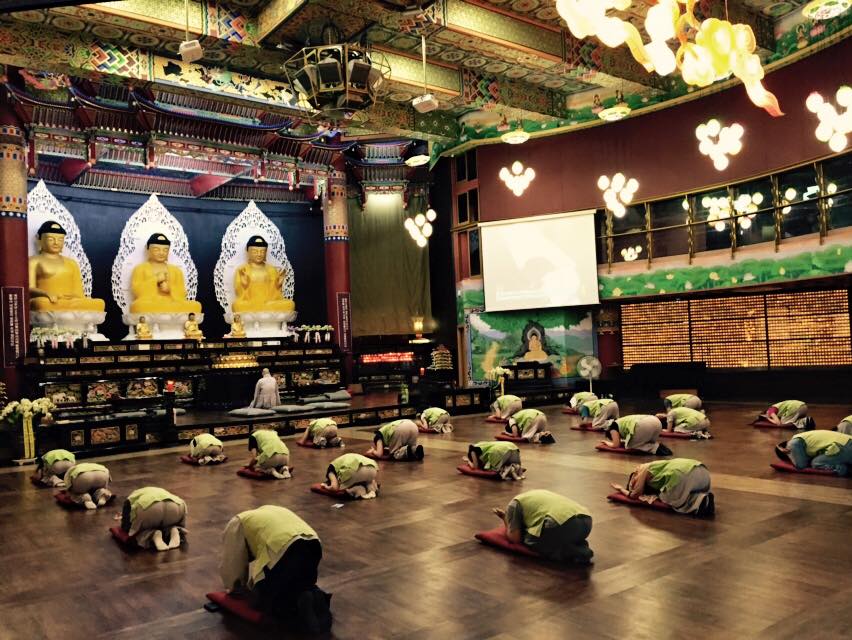
Full bow.

Full bow.

Here is the link to the video to listen to while performing 108 bows, or while you do your dishes, give it a listen.  The intro of the video is a child giving a little background to the number 108 and then it gets right into the creepy voice reading of the 108 prostrations. As much as that description is not enticing, I encourage you to listen, it honestly moved me into conscious reflection.

If you ever get the opportunity to attend a Yoga Mala or a Korean Templestay, take the opportunity. Through both you can learn a lot about yourself while participating in events that lie outside of your comfort zone. Coming soon will be a write-up of the monastic meal that was the highlight of the first evening at the temple.

The templestay that I participated in was at a temple named Hongbeopsa. It is north west of Busan and can be reached by shuttle bus or taxi from Nopodong Bus Termanl. Hongbeopsa generally hosts monthly cultural events for foreigners such as lantern making, tea ceremonies, and kimichi making. To find out more about their events follow them on facebook here.

Observations of an Environmental, Yogini Traveler

I recently took my summer vacation to visit my family in Western New York. It’s a long, taxing trip from Busan to Buffalo and totaled roughly 26 hours door to door. As usual, my mind was observant of waste created in airports on planes. Here is a short list of what I saw as well as some tips for having comfortable travel.

  • Plastic on Planes – Thankfully, airlines feed travelers on longer flights and I’m always grateful for some grub before attempting rest on a flight. Of course airlines have strict health and safety guidelines to follow when serving so many people in a short time frame, so a lot of plastic is used for sterility. I saw plenty of plastic cups for all those beverage stops, saran wrap on fruit cups, and plastic utensils. Sadly, I also noticed that pop cans, utensils, napkins, and all other waste was jumbled together in the same garbage collecting, leading me to believe that nothing was recycled.
    • My Tip! Bring your reusable water bottle or tumbler with you on the flight and have the attendants fill that up with water or your choice of drink rather than getting a plastic cup every time. I estimate that I saved the disposal of at least 10 plastic cups on my recent flights this way. Having a water bottle handy also saves a few bucks at the airport as there are usually drinking fountains found near bathrooms. At New York’s JFK I saw this nice little reminder of a drinking fountain, and smiled.
  • Hold Out for Recycling – When I first entered JFK’s immigration area I saw only a collect-all garbage can which got me feeling a bit down, but after going through security and walking around the terminal I noticed that there were in fact recycling receptacles throughout the airport. Relief!

Recycling Bins

  • Get Fresh Air – JFK had a cool new rooftop area at Terminal 5. I had some time to waste so I checked it out. After being around so many people and breathing the dry, stale air on the plane, the outdoor rooftop was a welcoming retreat. It also featured recycling bins. The grass wasn’t real, but plants and flowers bordered the area. It was nice to stretch my legs and do a little yoga after the long journey.
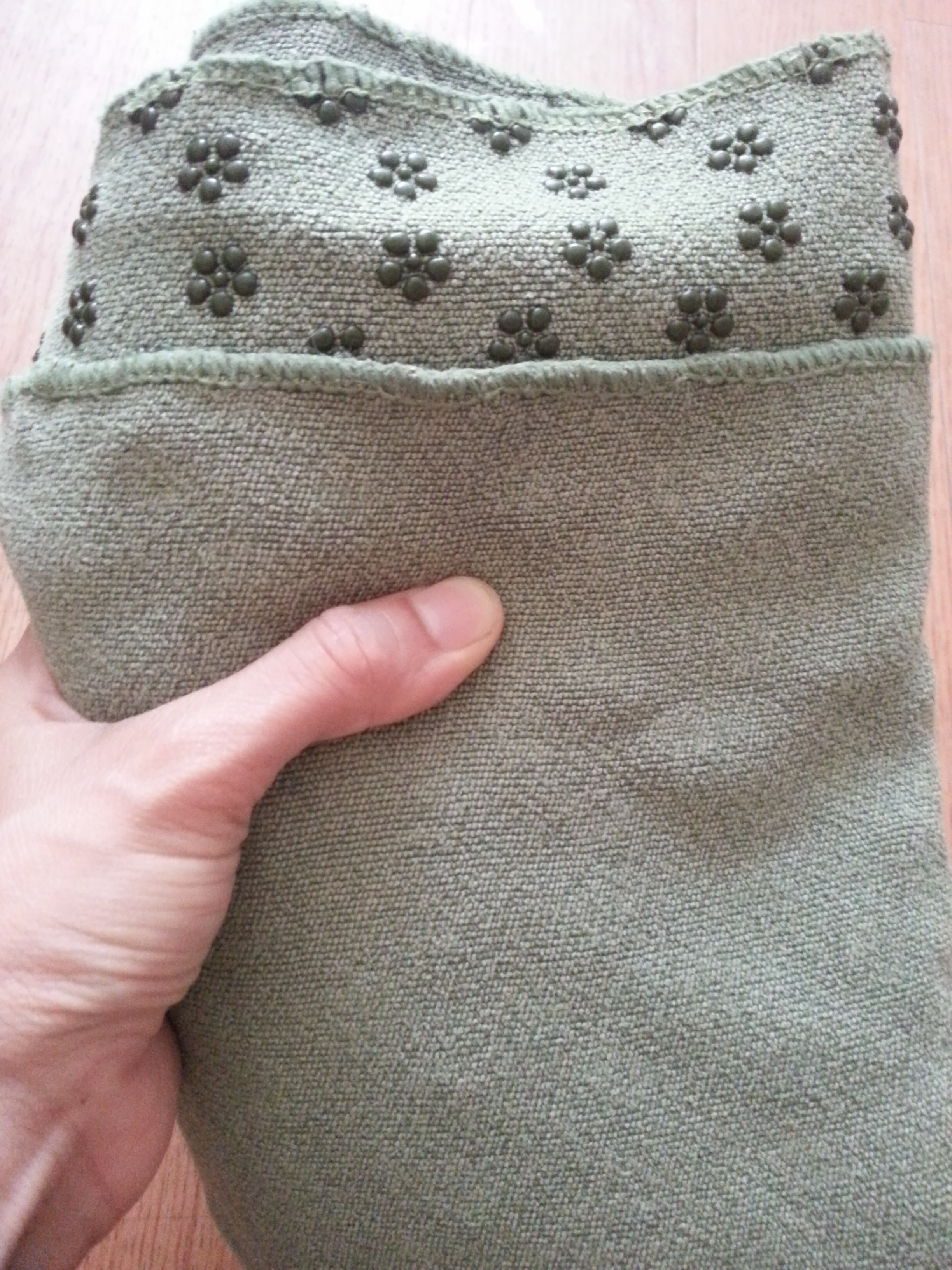
  • Bring a Travel Mat – If you don’t have a packable, travel yoga mat that folds up easily, then I suggest getting your hands on a yoga towel. They’re commonly used for hot yoga classes as the micro-fiber prevents sweaty palms from slipping in downdog. When
    Folds up easily.

    Folds up easily.

    traveling, I toss mine into my carry on bag, this way I can whip it out during lay overs and stretch my weary muscles. If you don’t have a yoga towel, then striking poses in a quite corner right on the carpet would suffice, just as well (I’m just a bit of a germaphobe!) Another bonus of the towel is that it doubles up as a blanket or rolls up as a pillow on the flight. Tucking your improvised pillow between the back of your seat and your lumbar spine (low back) adds an exponential amount of comfort from those flat-backed seats as well.

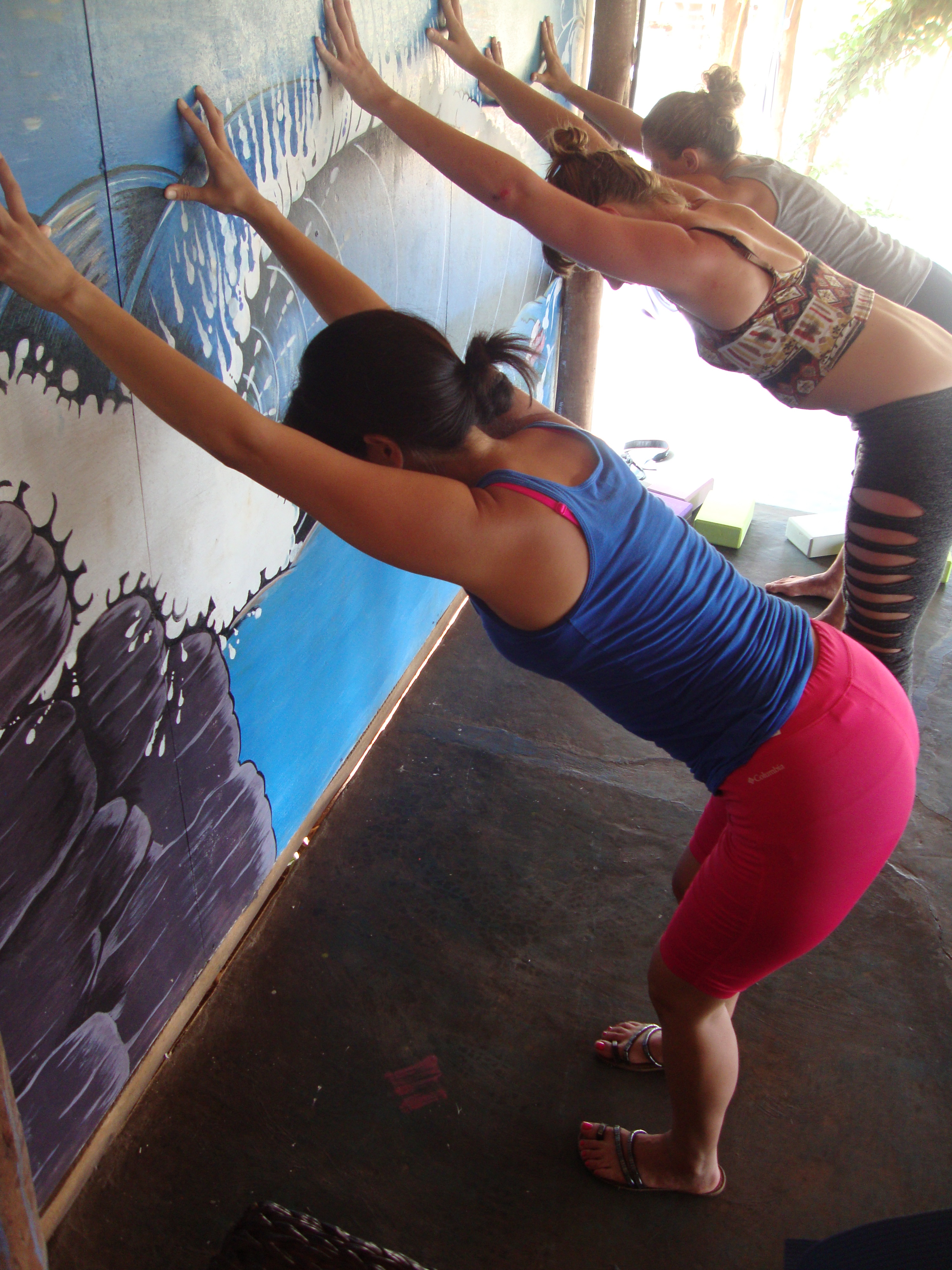
  • Aisle All the Way – For long flights I always request an aisle seat. Because of the dry air I drink a lot of water on flights which means a lot of bathroom breaks. While I wait in line I take the opportunity to do a simple, standing runner’s stretch to create space in my front body. Another good one to do is to find a flat surface and do downdog at the wall.
    • How To Standing Runner’s Stretch: Stand next to a wall, bend one knee and reach down for the foot with your hand. Pull the heel in towards your glutes, lining the bent knee up with the standing leg’s knee. If balancing is difficult, then use the wall to support you. Hold for a few breaths and switch sides.
    • How To Downdog at the Wall: Stand hip distance, facing a wall, with a slight bend in your knees. Be close enough to the wall that you can lift your arms overhead at shoulder’s distance and place the hands on the wall, elbows straight.  Gently bend at your hips and knees and press in and down into your palms on the wall. Stretch from the shoulders down to the low back. Stay and hold for a few breaths. Repeat as necessary.

Travel is a rewarding privilege; it is a way to see and learn about the world, a chance to relax and take a break from work life and daily chores, but the act of traveling is not always so fun, especially on trips that last literally for days. Take the time in preparation for a trip to make sure to have your essential water bottle or tumbler tucked away in your carry on. Bring along your travel mat or yoga towel for impromptu yoga sessions in the airport. Breathe long through the process of travel and know that you shall reach your destination in time.

Tropical Storm Brings Trash to Gwangan Beach

Last Sunday, July 12, 2015, was a turbulent day of wind and rain brought to Busan by tropical storm Chan-hom. There had been talk of a typhoon making it’s way to us, but it settled down into a tropical storm. Winds were high and the rain went from heavy to light throughout the day. This article on weather.com, states that winds were recorded as high as 47mph here in Korea.

Although it was not an ideal day for a bike ride, that’s exactly what I did during a period when the rain wasn’t so heavy. We took the boardwalk path on the way back to my apartment and were shocked by how much trash had washed up on the beach from the winds and surf. I snapped a few pictures, but most of the photos in this post are from early Monday morning, the following day. This amount of trash on the beach is extreme; there is always litter, casually dropped by beach walkers (cigarette cellophane, lighters, candy wrappers, straws, coffee cups, etc.) but the storm brought a whole array of trash.

Things that I noticed were shoes, balls, a lot of plastic drain filters, plastic beverage containers (water, soju, makgoli,) styrofoam and so on. There were great big styrofoam buoys, corners and bits from styrofoam coolers, and tiny pieces that had been broken down by the ocean. These little pieces are the ones that threaten the life of birds and fish because they resemble fish eggs so are consumed as food.

I noticed that there were still tourists snapping pictures at Gwangali Monday morning, however they were ignoring the length of beach covered in trash and instead aimed their phones at the bridge. I suppose to most people when they see a sight like that they think about how ugly it is and feel no responsibility to it so simply ignore it, but when I saw it, I wondered where was it coming from, how do we stop it, and how many innocent wildlife will die from our waste?

As I was taking pictures Monday morning, about half of the beach had already been cleaned up. Busan is great about getting crews out there every morning to make the (tourist) beaches look pristine. While the beautifying of the beach seems beneficial to us all, I can’t help but wonder if habits would change if people’s litter and trash stayed on the beach instead of miraculously disappearing every dawn.

Witnessing the debris that was washed up on the shore was depressing but also inspiring for me to question how I can decrease my impact on this finite planet even more. This month there has been a campaign online – Plastic Fee July, take a look at the link of their facebook page where you can get ideas about how to decrease your plastic use. Here’s a previous blog post of mine with tips. We can all do our small bit by carrying reusable bags, refusing bottled water, creating and using DIY cleaning/beauty products and most importantly sharing and inspiring others with our efforts.

How are you having a Plastic Free July and Plastic Free Life?


Better quality photos taken by Ben Lear.

Busan Beach Yoga

This is my third summer leading yoga on the boardwalk at Busan’s Gwangali beach and each year gets better and better. Sure, our beach may not be a white sandy one with palm trees galore; it’s more of the man-made type with neon lights, but there is still a lot of beauty to be seen during the practice. Here are a few specifics to Busan’s beach yoga scene that I’ve observed in the past three years.

  • Boardwalk vs. Sand – It is my experience that practicing on the boardwalk is more beneficial than on the sand. One reason is pretty obvious – keep those grains of sand off of you. But if you have no problem being one with nature and getting sand in all your nooks’n’crannies, then by all means, give it a go! The second reason, and more importantly, is that the boardwalk provides a flat, even surface that is needed for balancing poses. Actually, in any and all circumstances, I would suggest practicing yoga on a flat and even surface because it allows for the best support for the wrists and ankles. It may seem idyllic to plop down into Downard Facing Dog on the sand, but you’ll be brushing the sand away endlessly and you might even be straining your wrists.

Boardwalk Yoga

  • Accept Your Performance – Practicing yoga in public is not a time for you to feel as if you’re being judged, really at no time should you feel as if you’re being judged, other students are more concerned about their own practice than seeing what’s going on over on your mat. There is no judgement in my classes, but for sure in Busan at beach yoga, there are pedestrian observers. Here is why: There is a different sense (or lack of?) of personal space here than we are used to in many of our home countries, people brush up right next to you, stand uncomfortably close in lines, on buses, and almost everywhere. Practicing yoga is no exception, people will stop and watch, try the poses with you, and many even take out their phones and take pictures. At first I tried to protect my students’ privacy by shooing them away, but I have come to accept it now as a major cultural difference. It’s not harmful, just different. As a student practicing on Gwangan’s boardwalk, I hope that you can remember that by practicing in a public space you may be subject to what we in many other countries consider an invasion of privacy, but try to see it from the eyes of the country that you are in and know that things are just different here. People are curious. And as for taking photos of a group of strangers practicing yoga, well their kakao story has to be updated with something today!
  • Prepare for the Elements – The sun has left it’s mark on me even through a cotton shirt, so I try to wear screen when I practice on the beach. It helps as well to have sunglasses and/or a hat. These days I’ve been wearing a baseball cap to shield my eyes yet still make it possible to look students in the eyes without being weird in my sunglasses. I look a bit like a yoga camp counselor, but it saves me from early-onset-crows feet!
  • Practice with the Sun – The best times to practice are when the rays aren’t so strong. Early morning, around 7AM and sunset, at 6PM are good times here in Busan. My 10:30AM class is also a good time slot and has been much more popular than the sunrise class – understandably, it’s not easy to wake with the sun for most of us! Sunday Sunset classes have been well attended as well, a great way to end the weekend and start the week.

Wherever you are located, I hope that you can seek out a yoga class in the elements. Beach, park, riverside, your own backyard – they’re all great locations. If you are here in Busan and would like to join a class, then please follow below.


Beach yoga classes led by Kara are held most weekends in Busan. Follow the Busan Yoga & Meditation group on Facebook and check out the group’s events to find out more.

Sunset Yoga at Gwangan.

Sunset Yoga at Gwangan.

Savasana- Not to be Skipped!

Lying on your back on the floor with eyes closed might not seem like an advanced yoga pose, but it is, and it should not be ignored. Savasana, or corpse pose in English, is how most classes end, and what a good ending it is. Dim lights, bundle up, and get comfy, cover the eyes, and just be. Students have asked me if it’s ok to skip Savasana and just jump back into their day; my answer to this question is no.

Here’s why Savasana should not be skipped:

  • Absorb All the Goodness – After the challenging work of a vinyasa flow class, or after long holds in a restorative class, Savasana gives your body and mind the opportunity to soak it all in.
  • You Deserve a Rest – Nap time ended long ago for most of us and we rarely allow ourselves the gift of just taking a break. A yoga class might seem like the only break you need, so why not just get on with they day, right? Wrong – let yourself have a few minutes of quiet before rolling up your mat.
  • Still Your Mind – During a yoga practice the goal is to focus on the breath and movement, but how many of us find our minds wandering to thoughts of dinner, wondering how our poses look, or to the song playing in the car that’s driving by, “Wait, is that Miley Cyrus? I like Miley Cyrus.” Focusing, in other words not being distracted, is a little bit easier in Savasana, since by closing your eyes you shut out the outside world; you let your body lie still as can be, and you let go of even the controlled breath, of the practice. Don’t fidget and try not to sleep. Be sure to be as comfortable as can be before totally letting go. It will be hard at first and maybe for a long time to follow (it took me years to relax in Savasana fully, and there are days when I still struggle,) but try your best to still your mind along with the body. Thoughts will come, but just let them go, do not hold on.

How  To Do Savasna:

  • Make your way to seated. Bring your feet in front of you, firmly planted to the mat with your knees pointing up to the sky. Hold behind your knees for support  raise your arms out in front of you, palms face each other. Slowly, roll back onto your back one vertebrae at a time. If this is difficult for you, then lower one elbow at a time down next to, and slightly behind you, to begin the rolling of your spine on your mat. Then gently lower your entire back onto the mat behind you.
  • Extend your legs out in front of your body down onto your mat. Allow your feet to splay to either side of the mat naturally, toes, feet and ankles relaxed. If you feel any tension in your low back, place your feet flat on the mat (knees point up to the sky,) apply gentle pressure through the feet, and lift your bottom up and off of the floor, think of rolling your pelvis out and down towards your feet. Place your lower body back onto the mat. This should give you more length in the low back.
  • Rest your arms out by your side at an angle, not right next to your body, but a bit away. Flip your palms up to the ceiling; this rolls your shoulder blades down your back. Be very relaxed and let your fingers curl ever so slightly inward towards your palms. Adjust the shoulders until you are perfectly comfortable. There should be no fidgeting after you have found your perfect pose. Keep your eyes closed through the entirety of the pose and keep them closed as the teacher brings you to the end of the class until instructed to open them. Placing an eye pillow on your eyes will block any and all light and is a relaxing touch.

Savasana

It seems like Savasana should be an easy pose, but easy it is not. We are so used to multitasking and filling our schedules that we constantly think about what did or didn’t get done and what has yet to be accomplished. All of this thinking can get overwhelming and lead to anxiety, worry, or stress. By calming the mind we give ourselves a little break. It is inevitable that when you first begin to practice Savasana that you will either A) fall asleep – that’s ok, your body might really need it! or B) continue to think, but keep practicing and it will get easier. Savasana is a yoga pose that requires practice to improve.

May you delight in your practice and destress in your Savasana.

Namaste.

Acro Yoga – A Performance

Recently I was approached by my friend and studio owner, Mindy Sisco, to represent her studio along with three others in an acro yoga performance. Mindy is away, traveling and training in the US so cannot perform herself, so instead the line up is: her business partner, Simon, two other talented local acro yogis, and myself. An event in Seoul celebrating International Yoga Day on June 21, 2015 is where  we will show off our work.

It is because of this upcoming performance that I have been doing less and less yoga and more and more acro yoga these days.UNWorldYogaDay As mentioned in a previous post, I am fairly new to acro and do not have a solid and disciplined practice like I do with my traditional yoga. Therefore, I must admit that I was hesitant to agree to join the group when first asked. I didn’t feel that I was good enough or well-practiced enough. I also struggled with the idea of “performing” when it comes to yoga. I’m aware that there are such things as yoga asana competitions in which men and women push their bodies’ to the limit in order to demonstrate advanced postures in front of judges who then chose a winner. Odd, right? To me yoga is about the body and mind; it is a personal and mental practice of leaving your ego off of the mat. Competing with others to see who can do a balancing pose the best seems to me to be the antithesis of yoga. Logically then, I should have politely declined the opportunity, of myself performing yoga in front of people at a big event, right? Well, maybe, but there are a few reasons why I went against my beliefs.

First of all, acro yoga and traditional yoga are similar, yet different. Acro is generally done not only for the enjoyment of working with a partner and pushing individual/partner limits, but also to be watched and appreciated by others. Often groups of friends or strangers get together in public spaces to practice and play. I am sure that the majority of acro yogis do not practice in public simply to boost their ego, but more likely it is to share their art and skill.

It would be a sad, sad world if artists and musicians practiced and played mostly behind closed doors; I think it is the same for acro yoga.

Secondly, I knew that pushing myself and having a clear deadline to perfect a performance piece with others would be good for me. There is never an endsight with an asana yoga practice, it always continues, it is unlikely that someone will practice for years on end and then one day – “poof!” cross the finish line and complete their yoga practice. Yes, it is common to use a certain pose as motivation, for example trying to hold headstand (Salambasana) in the middle of the room is a common goal, but once that is achieved there are other variations of it to try and so many other challenging postures to work towards. It is exciting and rewarding to push the limits, which is how I look at this performance.

The final, reason why I am practicing 5-6 days a week, 2-3 hours at a time is because I hope that our final product will act as inspiration to others. I know I am not the only one who searches for images or videos of yoga or acro yoga. I enjoy finding new yoga-eye-candy online to watch in awe and admire the feats of the human body. I am a humble person, but I do hope that the audiance at the event, as well as those who view a video of our practices or performance will take something away from it that tickles their acro or yoga fancy and inspires them to jump back into bird after repeatedly falling on their face.

Beginners’ Yoga with Kara – Tuesdays, June & July

My good friend and studio owner, Mindy Sisco, is ditching town for a few months to lead workshops in the United States and get some training in acro a littler further north in Montreal. While she’s away being amazing at what she does, I’ll be subbing at her studio, leading class every Tuesday through July.

The class that I’ll be leading is a Beginners’ Yoga class. All of my classes are designed with beginners in mind, as well as advanced students, but teaching this class gives me an opportunity to really break it down for students (which all levels benefit from.)

During the eight week session, classes will teach students about the basics of standard yoga poses, give great alignment cues to improve studio/home practice, and utilize a lot of props. As the weeks progress students will notice a building of strength, flexibility (of body and mind,) and understanding of yoga. Poses will also progress into more playful and empowering balancing poses and inversions.

Classes begin this Tuesday, June 9th and run every Tuesday through July 28th. Directions and costs can be found on the Facebook page.

Lessons from Acro Yoga

Acro yoga was never very appealing to me. I had played around with it here and there in the past with friends, but with no technique or guidance it never went far. I am so deeply in love with my asana yoga practice, that I never considered experimenting with acro, all that much… until I attended Little Birds, a beginners acro yoga series taught right here in Busan. The series is held monthly at Kaizen, and is taught by a good friend and fellow yoga teacher, Mindy Sisco.

It has been about a year since I first dipped my toe in the sea that is acro, and during the past year I have been wading deeper and deeper into the experience. It can be said that acro is both very similar to hatha yoga and at the same time completely different. If you’re coming from a yoga background  and try acro, then you will notice that a lot of the shapes and even the vocabulary are similar, Vishnu’s Couch and Parsarita’s Twist are two pose name examples. Also, strength and flexibility built-in a regular yoga practice will compliment acro immensely. How acro differs from yoga requires a longer description. Here are my personal lessons from acro.

Lessons from Acro

  • Trust – Falling onto someone’s legs, especially a stranger’s, and giving them all of your weight and yourself means that there must be a lot of trust between partners. There are drills to build trust that helped me to trust. In the beginning I was very untrusting, it was hard to give up the control, but with time and practice and learning of technique, I have grown to be open and comfortable to new bases and partners.
  • It’s ok to Fall – Just as it’s ok to fall out of a balancing pose in a hatha class, it is ok to fall out of an acro sequence. Falling is part of the learning process. If you never try you will never succeed. You need to try new poses to test your limits and build the strength and flexibility needed to hold the pose later on down the road. That being said, I don’t recommend trying to mimic an advanced acro video off of youtube if you don’t have the basics down. Know your limits and be realistic.

“Falling is part of the learning process. If you never try you will never succeed. You need to try new poses to test your limits and build the strength and flexibility needed to hold the pose later on down the road.”

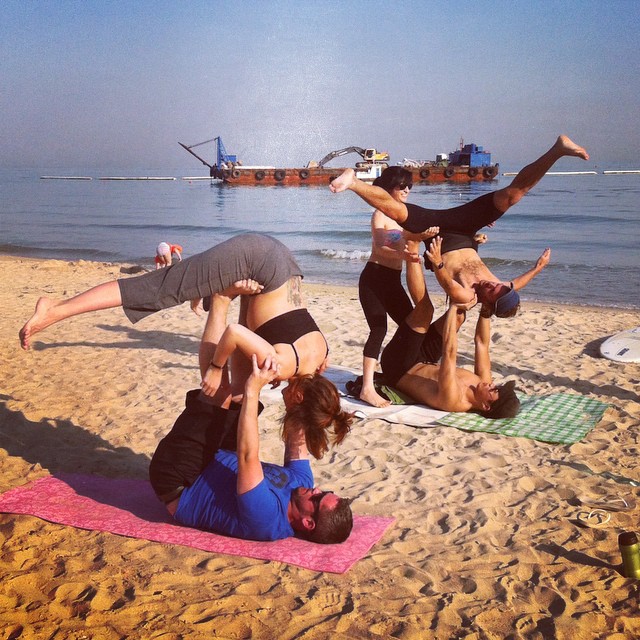
  • Importance of  a Spotter – Acro is a two person activity, but should always be considered a three person activity in actuality, when you include a spot. The spotter has a highly important job of trying their best to make sure that neither participants break their noses or crack their teeth. As a yoga teacher, I have found that practicing spotting has mirrored my yoga teaching in that I have to be very aware of others’ bodies and I feel a real sense of responsibility in both.
Spotting during some play time at the beach.

Spotting during some play time at the beach.

  • Communication – I’m fairly certain that ESP has been mostly disproven, which is unfortunate, as it would be really useful in acro, instead we must resort to speech. After working with a partner for a long time and learning the sequences it would be possible to get in a flow and feel it out, but in the beginning you must declare what you’re feeling and what you need, to help each other out.
  • Just Flow With It – Arguably my most important lesson from acro, is to let go of hesitations and worries and just flow with it. My day-to-day yoga practice can be rigid in terms of correct alignment; I sometimes play around with less traditional variations, but in general I tend to be a stickler for tradition. Attention to detail is primary in my practice – every joint must be in the right place, the gaze correct and strong. With that background, it was hard for me to just jump into an acro position, and I mean that quite literally – jump into a position! After some time and a little mental conversation with myself, I realized that it’s ok to do things less rigidly than I am used to. Had I not come to that realization, I never would have amazed myself with my acro abilities (if I do say so myself!) Similar to yoga, acro can be very empowering.

My acro yoga practice has grown leaps and bounds (and flips and turns!) in a matter of months. It took an open mind and willingness to fall into another person, but with each session of practice and play, I began to feel more comfortable in my own skin and with others. I suggest seeking out an acro workshop or jam in your area if you haven’t tried it. It’s a great activiity to do with friends, a partner, or family – heck, it’s even fun to do with strangers. There’s a high likelihood that you will learn a lot, not only about acro, but also about yourself, and an even higher chance that you’ll laugh while learning.


Information about acro sessions, classes, and workshops held at Kaizen in Busan can be found via their website at: http://www.kaizenkorea.com/ or on facebook via their page or the Busan Yoga & Meditation page.

Mindy and Simon of Kaizen, Busan.

Mindy and Simon of Kaizen, Busan.

Hosting a Beach Clean Up Event

Hosting a beach clean up event has been spinning in my mind as an idea for a while, but I was never really sure how to materialize it. It’s easy enough though to gather a few friends or a group of people and have them collect as much litter as they can, so that is exactly what I am doing.

Last month contained the American holiday of Earth Day, on April 22nd, unfortunately my event wasn’t planned in advance enough to be around Earth Day, but that really doesn’t matter. Each and every day should be a day in which we consider our constant impact on our fragile planet, and we should change our habits so that we cause less and less harm.

Together with a yoga friend, Jessica Rykert Holt, who has been leading mindful meditation gatherings in Busan, a straightforward beach clean up/yoga event has been organized at Gwangali, one of our local beaches. After a date was set for May 16th, Jessica was told of another beach clean up happening at another coastal location in our city, so we joined up to host coinciding events. The other event is through a local scuba diving group, Busan Scuba. Divers will meet and clean up Taejongdae, an island in the southern part of Busan.

Here’s what our beach clean up event will consist of at Gwangali:

  • Meet Up and Introduction – After learning some new names, I will start the event off by explaining my motivation, which is to create awareness about the harming of the oceans and lands, but more specifically, the oceans, by single use plastics such as to-go cups, straws, packaging and wrappers. Next, Jessica will speak about mindfulness and meditation and teach everyone about what they will be doing as they comb the beach cleaning up.
  • Time to Hit the Sand – After the tools are passed out (gloves and city purchased garbage bags in our case) participants will get to the cleanin’. Busan suffers from a lot of littering, both internally in the city and along the coasts and beaches. Daily I see candy wrappers, cigarette cellophane, straws and the like strewn about the beach when I walk my dog and on the streets. Not knowing the language well enough, it seems to me from observation, that people are simply ignorant of the lasting negative impact of their fluttering plastics that land on the beach and quickly find their way into the water via tides or winds.
  • A Yoga Practice, Of Course! – After all of the hard work and concentration on being mindful, everyone will reconvene at a large area on the boardwalk to lay out their mats and flow. The class will continue with the theme of mindfulness and individual impact, and will last an hour. The class will be designed for a range of students, from beginner to advanced.

It can be intimidating to put yourself out in the community and plan an event, but that should never hold you back from striking the match which lights the fire that is action. Let your little light shine! Planning a beach clean up is a great way to get some friends together and make an impact, or to make it bigger and involve locals.

This event is 5,000 won minimum donation with money going towards garbage collecting gear and the remainder being donated to http://www.projectaware.org/ an organization of divers who work towards cleaning and saving the oceans in their Marine Debris project as well as saving endangered sharks in their Sharks in Peril movement. Below is an infograph produced by Project Aware with facts about the impact of our trash.

TheUglyJourneyofTrashInfographic_PDF


Information about meditation events led by Jessica can be found the Busan Yoga & Meditation Group on Facebook.


Update on Beach Clean Up Event

Despite the fact that Saturday, May 16th started out as a dreary, cloudy, and quite frankly sort of miserable day, with temperatures much lower than they had been for a few weeks, a group of dedicated participants met me on the boardwalk for the clean up. After everyone had made their way to our meet up location, Jessica and I got things started. The event went exactly as planned and everyone did a fantastic job of filling up their garbage bags. It was unbelievable how much litter they were capable of collecting in just 40 minutes. Below is a gallery of photos.

Unfortunately, a lot more was left behind that we weren’t able to collect. The problem has to be corrected with people disposing of their waste correctly. An even better solution, in my opinion, is to drastically decrease individual waste production, by changing habits and cutting out all single use items from day to day life.

Radiant Life School YTTC Review

Radiant Life Yoga School, El Coco Loco Resort, El Manzano Uno, Nicaragua, May 2013

At this time two years ago, I would have been getting comfortable in my shared dorm room with my two new roommates in the eco-resort where we had all separately chosen to complete our yoga teacher training course from our three respective home countries. For myself personally, it was a big decision on where to do my training, in which I took largely into consideration things such as: cost, location, service, style of yoga, and class size. There is a lot I could say about my course, most of it very positive, but I’ll keep it short-ish and outline the majors.

Course Generals

Location – EL Coco Loco Resort, El Manzano Uno, northern Nicaragua El Coco Loco is an enchanting little eco resort located in the northern part of Nicaragua. Of course, I loved that the resort is eco with compost toilets and little in terms of the high energy use items like air conditioners/TVs. Accommodation included private bungalow’s and a shared dorm room (where I stayed.) There was a main, open-air dining/meet up area where meals were had and some practical learning was done. The fresh, home made food has to be mentioned as a highlight of my experience. And the staff were friendly, locals whom I was able to practice my Spanish with. The yoga platform where asana practice was done was a large, raised platform covered with a natural roof. The mostly isolated beach is only a minutes walk from the resort.

The Training For me it was important to find a yoga teacher training that focused on alignment and utilized props, as that is the sort of yoga that has always given me a lot of enjoyment and I knew I wanted to share with future students. Radiant Life Yoga School is led by Kimberly Waugh, ERYT 500, an American yoga teacher with well over a decade of experience. (It was important to me to find an instructor who was a native English teacher and related to me culturally as an American.) More about Radiant Life RYS 200 hr training that I experienced in May 2013:

The Good

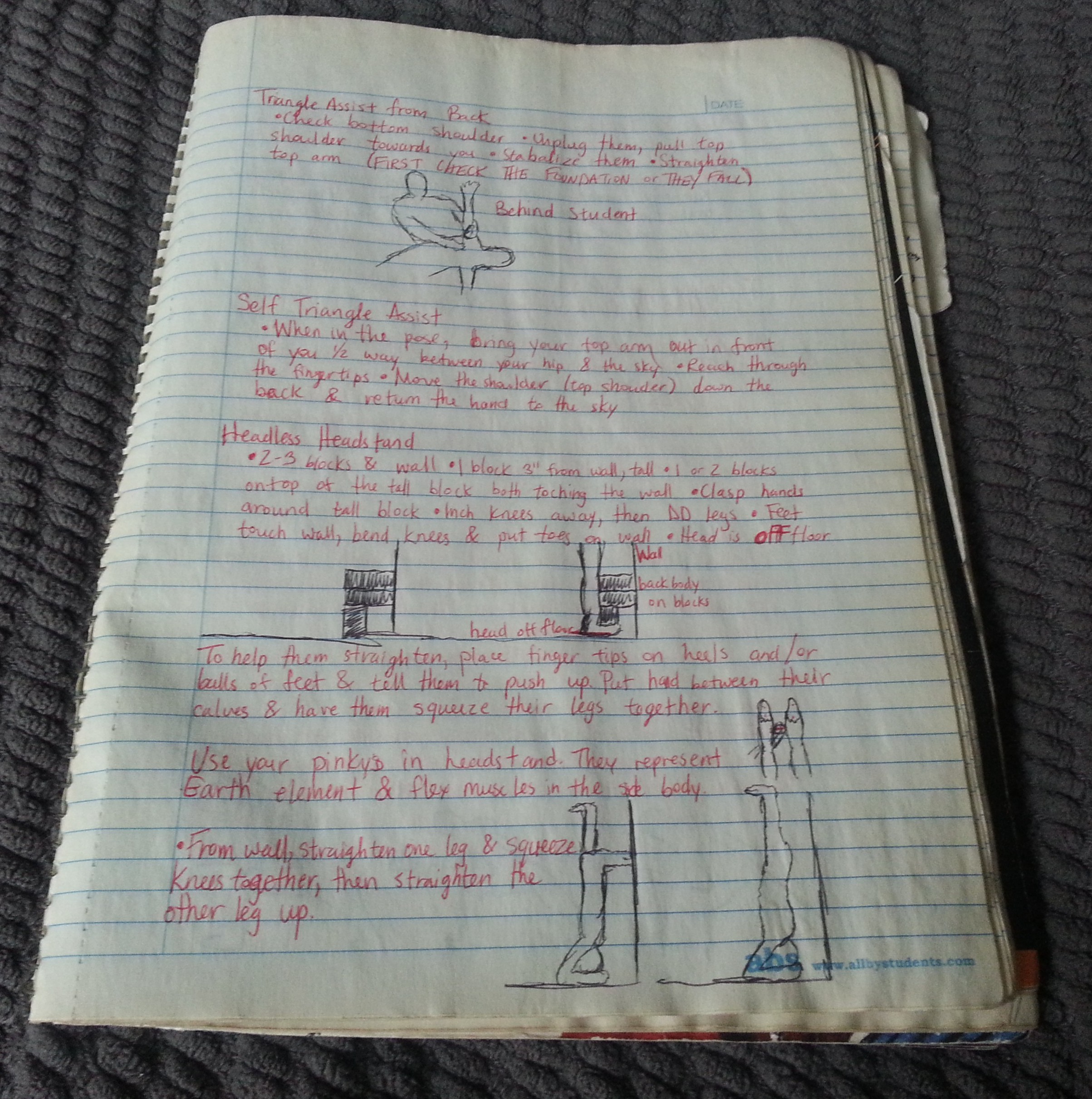
  • Lectures During my course I studied yogic philosophy and history and learned a lot of a new information which I have utilized often in my teachings. Two examples of books of study included: TheBhagavad Gita, the Yoga Sutras,  and also a well put together training manual that I have come back to time and time again. As quite a studious person, I took very detailed notes and continuously carry my training notebook with me around the world as I lesson plan.

    My notebook, complete with sketches.

    My notebook, complete with sketches.

  • Teaching/Business Knowledge Kimberly shared her vast knowledge of the industry with us and gave very practical tips and insights. Not all of the tidbits that I learned have been put to use as I have been teaching internationally and not in my home country of the U.S., but I will remember what I learned whenever I do relocate back to the U.S. I’m not sure that other training courses, especially those abroad and by instructors of other countries, would include such detailed and practical learnings.
  • This little bugger wanted to join asana practice.

    This little bugger wanted to join asana practice.

    Prop Use I love using yoga props, and although the rustic setting of the yoga platform didn’t include a plethora of props, there were the basics and I felt that I learned a lot of adjustments and modifications with the props. A word of warning, scorpions loved to nestle in the shadows of the pile of props, so be careful when you collect them for practice!

  • Workshop Study Kimberly taught multiple different and unique workshops to take away and be able to teach immediately. While learning
    Workshopping in the common area.

    Workshopping in the common area.

    these themed workshops,there was a lot of practical study, working with other trainees to practice putting students into poses and finding adjustments.

  • Focus on Seva (Service) This was the big deal breaker for me when choosing this course. I knew that I wanted some karma yoga to be included in my course and this was the right course for that. El Coco Loco Resort established and continues to run a great non-profit organization, Waves of Hope. While completing my training, I was able to get hands on and volunteer to work with local students practicing their English and get in deep and dirty by helping to build the new local high school. Find out more about Waves of Hope here.

The Not So Good

  • Anatomy There was an anatomy segment in the training course, but it was not my favorite part. Since anatomy was one of my weakest areas of knowledge going into the course, I was hoping for more of a focus on it.
  • Teaching Practicum This did happen, stepping in as the teacher to guide the other trainees in sun salutes and poses, but it didn’t happen as much as I wanted. To counter this, I took it upon myself to practice teaching the intern working at the resort at the time.

All-in-all, I highly recommend my YTTC to others. The setting couldn’t be better, the training itself was superb and left me feeling prepared to begin teaching straight away, and the food was enough to write home about.

Mmmm.

Mmmm.


Are you considering training for your 200 hr yoga teacher certification? If you are, check out my very first post, which includes great tips for doing just that.