Use Less Plastic

It’s April. This month we celebrate Earth Day, a day to recognize the beauty of nature, maybe plant a tree, spend some time outdoors, or attend a community planned event. That’s all good and great and brings nothing but smiles to my face, but ultimately, we need to spend every day as if it is Earth Day, because every day we live on and take from this planet and rarely do we take a step back and contemplate our day-to-day choices and their effects on the environment.

It has been on my mind a great deal these past few months to use less plastic. One of my resolutions for the New Year was to decrease my plastics use this year and forever more. Here are some tips of how I have been cutting back.

  • DON’T USE PLASTIC BAGS!!! These nuisances are almost unavoidable. Purchase anything and they automatically toss it in a plastic bag. This is exceptionally true here in Korea at markets and convenience stores. At least at grocery stores they charge you for the bags (here in Korea.) Give it a think, what use does that bag have to you after you bring it home and take out whatever you carried in it? Maybe you could use it as a garbage can liner, but that’s about it. I’m sure you have a larger collection of plastic bags than you do garbage cans. Replace them with reusable bags that fold up and clip onto your purse, or take an empty backpack with you to the grocery store. I’ve made it a recent habit to even take empty Tupperware with me to fill with shrimp or wet items sold fresh from the market. It works great!
  • PURCHASE WITH LESS PACKAGING Marketers wrap their products in so much unnecessary paper and plastic to make it look appealing on the shelves. Again, this is an example of a one time use by-product that has absolutely no value to you in the future. There’s no doubt that it makes its way into the garbage or recycling bin. While choosing a product at the grocery store or any other shop, compare which item has less packaging and go for that. Give preference to post consumer recycled paper board or soy printed labels. If something comes in a glass jar, then wash it out and add it to your Tupperware cupboard, or use it to store sugar or other dry goods in as opposed to in the plastic bags that they come in.
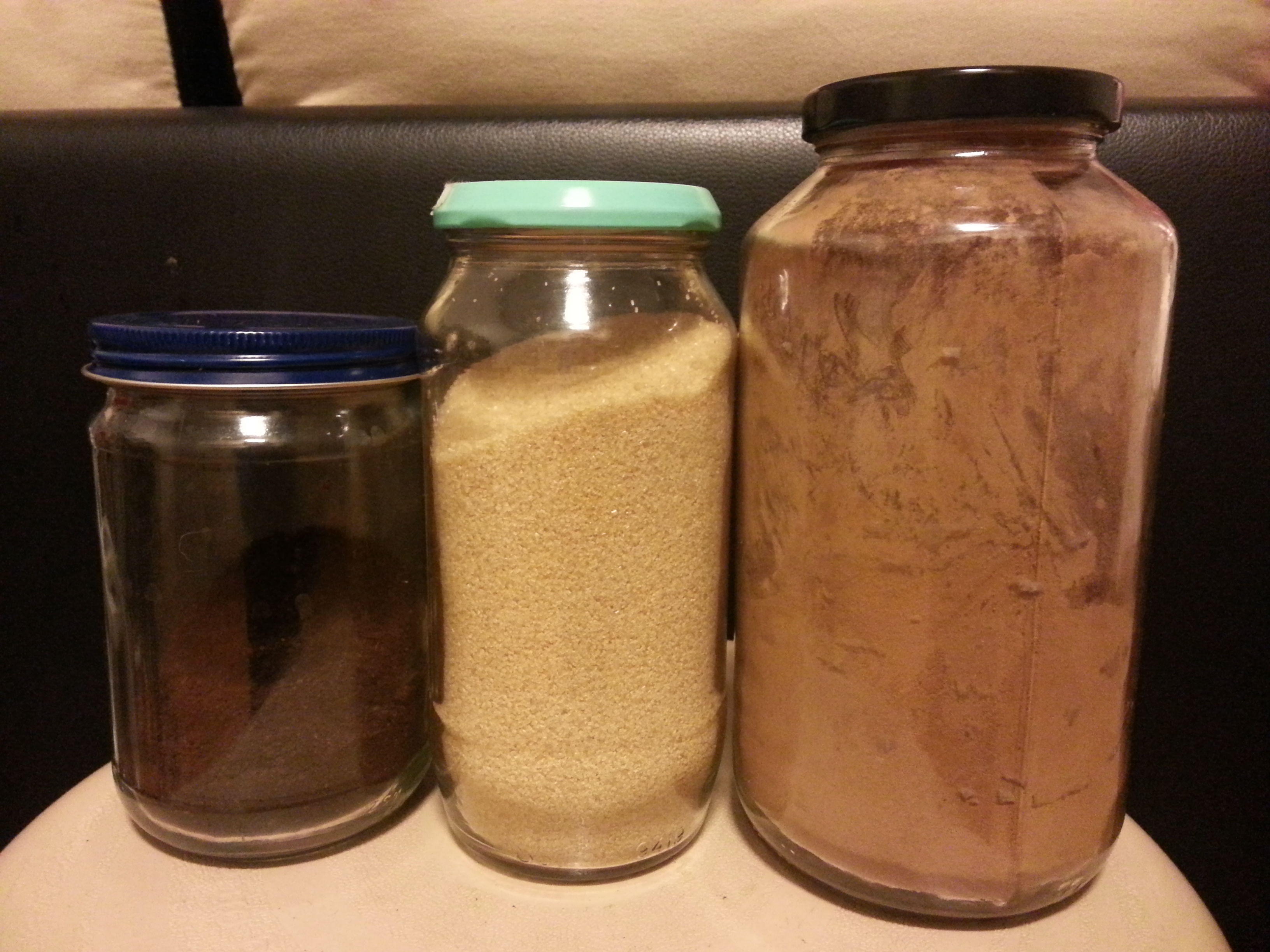
Wash and reuse glass jars after use. This way, you can store dry goods like coffee and sugar in glass rather than the original plastic.

Wash and reuse glass jars after use. This way, you can store dry goods like coffee and sugar in glass rather than the original plastic.

  • ASK FOR NO STRAW If you get an iced coffee or smoothie or even a soft drink with your meal out at a restaurant, then be sure to tell the server or barista that you do not need a straw. They are absolutely pointless utensils and cause a lot of waste. When I collect litter off of the beach a lot of the garbage is straws from drinks from the nearby cafes. Of course, be sure to bring your tumbler  along with you in your purse or bag to avoid using plastic cups and lids with that straw.
It doesn't take me long to collect straws on my morning walks,.

It doesn’t take me long to collect straws on my morning walks,.

  • NO PLASTIC WATER BOTTLES This is an obvious one, especially with my previous post on the usefulness of tumblers, which is hyperlinked just above, but I’ll say something quick as a reminder. Plastic bottled water is as unnecessary as a straw, you don’t need ’em. They have become modern-day conveniences and the norm for most, but change your habit by buying a home use water filter, purchasing a metal water bottle or tumbler to be filled with the filter or even straight out of the tap if it’s safe to do where you live.
    • Side note: Isn’t it sad that it is unsafe to drink from the tap! I was warned when I moved to Korea that it’s a big no-no. Most people create a lot of waste by buying large, plastic bottles of water.
  • CHANGE YOUR PLASTIC USE HABITS This is incorporated into all of the tips above in a way, yet deserves more explanation. In order for me to cut back on my plastics use, I have to make small decisions every day. For example, there is a bakery around the corner from me that I enjoy, but I will not allow myself to go in there unless I have a container on me to carry the bread away with. At first they looked at me funny, but after about the fourth time, they gave me a day old bread free of charge (or service as they say here) because they may have thought it was cute that I brought my own Tupperware.

Changing habits, whether it be stopping bad ones or starting good ones, takes time and effort and won’t happen overnight. It might seem, at first, like a big pain to have to cart around a metal water bottle with you everywhere you go and you might find yourself grimacing at the checkout line when you realize that you’ve left your reusable bags at home – AGAIN! If you keep at it and make little notes, place the bags near your car keys or always in your purse, then it will begin to be the way things are for you and you’ll be cutting your plastics use down bit by bit.

Get Outside! Take Your Yoga Practice into Nature

One of the best things about yoga is that you can practice it anywhere. It can be done with or without a yoga mat in nearly any space that is big enough to outstretch your arms, whether that be in your tiny Korean apartment, at an airport during a layover, or at work on a break. If you need a pick-me-up or have some tightness that you want to breathe into, then all you have to do is a few breathing exercises and simple poses. Another way to enjoy yoga is to practice in the great outdoors.

There’s something about feeling the sun on your face and listening to the birds chirp that makes it a much more enjoyable experience.

Here are my recommendations for practicing in the elements.

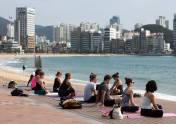
  • Find an Outdoor Class Most people like to practice yoga outside and as the weather heats up, classes begin to move from the studio to the boardwalk. Check around your community for classes held at beaches, parks, or other outdoor venues. When the weather permits, there are classes held here in Busan on the boardwalk at the beach.
  • Practice Solo If you feel experienced enough to practice without the guidance of a teacher, then take your mat along on a walk and find a nice quiet place to roll it out.
  • Location It will be more peaceful to practice somewhere that isn’t very populated. If your closest park or beach gets really busy then consider making it a priority to get up early and beat the crowds. It might be hard to answer to the alarm clock to go out for a sunrise yoga session, but you might find that it’s worth the serenity. Plus, starting your day with yoga clears your mind and opens your body up for whatever tasks lay ahead.
  • Surface In order to keep your wrists safe during chaturunga, it’s best to practice on a hard, flat, leveled surface. Avoid sand, or thick grassy lawns. Find a flat piece of ground or platform to practice on. A mat is not necessary, but will keep your hands and feet free of dirt, which could be a distraction while you practice. If you’re travelling or heading somewhere afterwards where you don’t want to be taking your mat, then consider purchasing a travel mat, yoga towel, using a beach towel, or some nifty little yoga socks and gloves which have sticky little grippy, circular, textured pads on them. Practicing a sequence of only standing poses means that you won’t even have to remove your sneakers.

    Comfy and useful.

    Comfy and useful.

  • Layer Up Wear layers for wind or clouds. Be sure to apply sunscreen to exposed skin to keep safe from sun burn or unwanted tan lines. Layering allows you to keep warm on the walk to your practice space and shed your top layer after the sun salutations that will warm you up quickly. Once it’s time for Savasana, it’s a good idea to put your layers back on and have something to shield your eyes from the sun, such as an eye pillow or just use the sleeve of your jacket.

An outdoor practice came to the forefront of my mind recently after hearing some shocking statistics on a podcast. The author being interviewed, Dr. Scott Sampson, had recently written a book titled, “How to Raise a Wild Child: The Art and Science of Falling In Love With Nature,” and the tagline of the interview was that American children on average spend only a measly FOUR TO SEVEN MINUTES A DAY PLAYING OUTDOORS!!! That finding deserves an all caps delivery; can you believe it?!?!

I have the good fortune of having an extremely handsome dog companion who comes with the responsibility of needing a walk two to three times per day, which means that I have to spend time outdoors rain or shine every day. I also live close enough to my work that I commute by bike, so that’s another 30 minutes per day during the work week that I spend outdoors by necessity. I also have a very active partner and friends that enjoy being out, so a lot of our weekend activities are outside. Even as an adult I spend my play time outside, and it’s much more than seven minutes.

When I was a child, I remember spending hours outdoors playing with my twin sister and our best friend. During the short Western New York summer months we would explore our expansive yards catching fireflies until our mothers called us in. So it’s hard for me to even fathom children of today not having that experience and it’s also really sad. I witness my Korean students live their lives indoors for the majority of the day, shuffling from school, to academy, to home where they might continue their studies well after dark meeting with tutors or doing homework.

During the interview the author made an excellent point, which boils down to this: If today’s children aren’t spending time outdoors, then they are not going to appreciate nature now or in the future, and therefore, who will be tomorrow’s environmentalists; who will fight to protect national parks, wetlands, and the environment in general in the future? Pull the plug on the screen, throw on a jacket, and get out there already, and be sure to bring the little ones along for sure.


Beach yoga classes in Busan and other outdoor seasonal events such as equinox and solstice events can be found via the Busan Yoga & Meditation page on Facebook.

Beach Yoga

Preparing to lead a beach yoga class.

Creative Back Bends

Recently, I had an opportunity to co-host a small event on a warm Sunday afternoon. The event was an art and yoga meet up through the website http://www.meetup.com. Earlier in the year I had attended an art therapy meetup event in Busan which I really enjoyed. The hostess Justina, is a Korean art therapist who lived and worked abroad for many years; she has been offering meetups in which participants create art together in a group setting. Justina and I discussed hosting an event together that involved yoga and art, which materialized just two weeks ago, and I believe that it was a success!


When I considered what I was going to teach for the event, I knew right away that I wanted the lesson to have an element of community. The reason being that I knew some group art would be made together by the participants. To create a sense of community, I started class with a chant of Om. I absolutely love the feeling that I get when I close my eyes and make the single syllabic sound with other yogis. Om creates this vibration that encircles everyone and brings the class together. It’s natural to have a sense of nervousness or roll your eyes at a room full of adults chanting together, but it’s something that should be tried. There’s no need to feel shy because all eyes are closed, just follow the lead of the teacher and ride it out.

After the opening chant, I led the six participants through a quick 30 minute yoga session. I designed a class focused on heart opening. Practicing heart opening poses, such as a simple back bend in tadasana, help to open up the upper spine and back and are good to practice to create a sense of general openness in the body. Not only did I want everyone to feel open in their bodies but also in their hearts, open to the experience and to each other, and likewise open-minded.

group art work

Example of some group art work.

After the yoga we reconvened in a small room to start the art which Justina led. We created works individually and together. It was a fun afternoon and good experience for me as a teacher. Below are some poses that you can try before activities involving creativity.


  • Back Bend in Tadasana After warming up with some sun salutes, stand at the top of your mat with feet hip distance. Check your alignment, make sure that your feet are pointing directly forward and that your knees are above your ankles, your hips over your knees, and shoulders over your hips. From there, point your fingers up to the sky behind you and place your hands on your lower back, near the top of your pants. Hug your elbows in towards each other. On an inhalation, lift your chest and press through your hands to move your hips forward. Focus on opening through the chest. Gently release your head back, but if that causes you any discomfort, then tuck your chin to your chest. A slight bend through the knees may increase comfort. Hold for a few breaths. Return to standing on an inhalation.
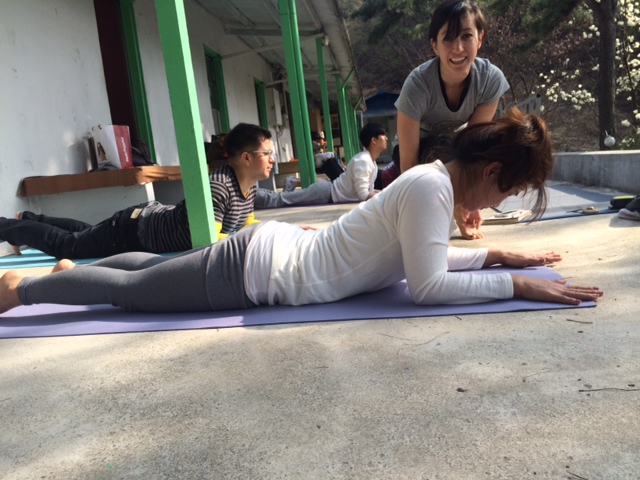
  • Sphinx Pose Also known as, SalambaBhujangasana in Sanskrit, is one of my favorite back bending postures. It’s a very subtle pose that has great effect. This pose begins on the belly. Align your elbows directly under your shoulders. You should have a 90 degree angle, if you look at your elbow and your bicep is  touching your forearm, creating a long crease, then you probably need to bring your elbows up closer to the front of the mat. Spread your fingers wide and place your palms down directly in front of your elbows. On an inhalation,isometrically pull your arms back towards the back of your mat, whilst simultaneously pulling your sternum through your arms. Your body won’t actually move much, but imagine that you’re performing these actions and you will feel your lower back working to open your chest. If you have any pain in the low back, then decrease the action. Exhale to come out.
Assisting an event participant in sphinx pose.

Assisting an event participant in sphinx pose.

  • Back Bending Tree This is a fun variation of vrksasana or, tree pose that plays with balance. It’s best to try this at a wall for support. Stand with the left side of your body at the wall. Place the sole of your right foot either somewhere on your calf, low on the thigh (just above the knee,) or reach down for your right ankle and place your foot as high as you can on your inner left thigh. Never place the foot directly on the knee to avoid knee pain. Place your hands on your hips. Once you find your balance you can try to bring your hands to prayer at the chest. If that feels good then inhale your arms up over your head, palms face in towards each other. To bring the back bend into the pose, inhale and lift your chest up towards the sky while leaning back carefully. It will be a little bit easier to do this with your hands at prayer at the chest or on the hips as opposed to arms extended, so adjust your hand placement for more stability, or keep them overhead for a challenge. Use the wall to support you if you start to fall out. Just like in tadasana, be mindful of your neck and find a placement of your head that feels comfortable for you. Inhale to bring your torso back over your hips. Exhale and release the lifted leg down. Switch sides.

    Having fun in tree pose.

    Having fun in tree pose.

Have fun trying these poses that open you up both physically and mentally. Maybe they will open you up to feel inspired to create something for yourself, whether you create art, a meal, something with your hands, or simply openness in your body.


The event was an art and yoga meet up through a group called Busan Creative Art Healing : http://www.meetup.com/justina

Spring Equinox 108 Sun Salutations – Lesson in Discipline

Yep, you read that correctly, one-hundred-and-eight Sun Salutations. That was the number that a group of us in Busan, South Korea recently performed for the Spring Equinox to mark the arrival of spring. The number has significance, which I will not go into here, what I want to touch upon is the discipline required to perform such a feat.

It might be hard to grasp how big of a number that is in terms of performing a yoga sequence and in case you are not familiar with what a Sun Salutation is, let me first explain that. There are two primary, traditional Sun Salutations, known as Sun A and Sun B, or Surya Namaskara A and B in Sanskrit. They are routines of poses performed in a quick moving pace, one breath one movement. By their name, you may have guessed that they were traditionally performed in the morning at sunrise to salute the sun, giver of all energy. In western yoga classes they are still performed, but usually long after the hours of sunrise. If you’ve attended a yoga class, chances are are that you performed either, or both A and B as a warm up that begins the class. Typically a teacher guides students through 4-6 salutes as a warm up, and boy do they do the trick to warm up the muscles, so imagine how much heat is created performing 108!!

108

For this event there were six teachers who split the teaching. Each teacher had free reign as to which salute (A and/or B) and whatever modifications they wanted to add on. The first three teachers who taught added a lot of modifications to their sequences, which was a great workout and  a good mental practice. That first section was where the practice of discipline was really honed for me. Thoughts went through my mind such as,

“This is difficult, I wish I could take a rest, but no, keep enduring with everyone else!”

It truly helped to pump through the event with a group. We were all silently working towards the same goal.

You don’t have to be participating in a long event to struggle with endurance in yoga, in any yoga class or in your home practice, you might bump into big walls that try to push you down and defeat you. I have two views on how to react to those overbearing obstacles; first, succumb to the pressure and take a rest; second, kick up some dirt and plow through that bad boy.

To expand, during any physical activity it is good to be reminded and to remind yourself, that it is not necessary to overexert yourself. Not only is it not necessary, but it is generally not safe as injuries can arise. As a teacher, I remind my students to take child’s pose whenever they need to and I enjoy when I see students doing just that because I know that they’re listening to their bodies and giving themselves the rest that they need in the moment.

Saluting the sun.

Saluting the sun.

On the other hand, it’s also good to grit your teeth and go deeper.You have to ask yourself if you really need the break, or if you can push on and complete the pose or sequence (safely.) For if you always slumped into child’s pose instead of giving it one more go, you might never discover that you can accomplish a pose. Also, you wouldn’t be building the strength that comes with those trembling quads in your 42nd warrior pose of the afternoon.

After an intermission of moving entertainment by two fellow yogis, who perfored a stunning acro yoga sequence, we moved on to the last three teachers, I should mention that I was one of the teachers in the last set! At this event I was the final one to lead and for this reason, I switched my lesson plans up a little bit by removing all chaturungs to give achy wrists a break (did anyone just get Achy Breaky Heart in their head? If you didn’t, you do now!) Personally it wasn’t my wrists that needed the break as much as burning triceps! It was very rewarding as a teacher to be able to guide everyone through the final salutes and to give the cue of “Just three more.” and “Last one, you did it!” There were smiles and sighs at the completion of the event. And I’m sure we all learned a little something about ourselves in the push through those 108.


This event was organized by Kaizen yoga studio of Busan. It is the wonderfully talented and ambitios Mindy Sisco who has made the equinox and solstice events possible that I have been so fortunate to be a part of. Mindy and her business partner Simon have regular classes at their gym. Schedule and pricing can be found here.

Mindy and Simon of Kaizen.

Mindy and Simon of Kaizen.


Simon of Kaizen is credited with all photos of the Spring Equinox event used in this post.

“I’m bad at yoga” An Untruth of the Ego

Yoga is a practice of body and mind. By synching our breath with our movement, we bring ourselves into the present moment and forget about our worries or anxieties about the past or future, if only for an exhale. To be completely aware is something that needs to be developed and practiced, it does not come easily for most of us. In fact, our minds can often wander into a dark place- our ego.

This is a topic mentioned before in a previous post; it often happens that we got to a yoga class and instead of focusing our dristi (gaze of the eyes) where it should be, we let it roam around the room to our fellow classmates. In doing so, negative comparative thoughts can creep in such as, “Wow, she’s going so much deeper than I am.” or “I wish I wasn’t right next to this insanely flexible girl, I must look terrible.” A good thing to do if you find yourself thinking like that, is to take an audible exhale through the mouth, create a sound like a sigh, and as you do so, imagine that the exhale contains that negative thought and  through the sigh it has been expelled from you.

The ego doesn’t always put you down, sometimes it lifts you up. For example, you might hear the teacher give cues to come into a pose that is new to you, and wow! success! you can do this new and impressive looking pose. In that moment a smile should come to your face and you should feel proud and empowered by your practice. That’s a very healthy feeling to have. Yoga teachers want you to have that feeling in their classes, to explore your body and your limits and progress your practice, but a place that isn’t good to let your mind go to is to compare your practice with the other students in the class in a way that lifts yourself up above them. Don’t get cocky. Try your best not to compare for better or for worse, and if you do, use that breath as a tool to bring your mind into a neutral place focusing on the present again.

Another common happening in yoga is to compare yourself to yourself. You might find frustration when today’s bakasana (crow pose) is less steady than yesterday’s. Exhale it out and remember that your body will perform differently day-to-day depending on an array of factors such as the way you slept, stresses in your life that are causing you to lose focus, if you drank alcohol, etc. You will find differences in not only your balance day-to-day but also in your strength and flexibility.

Yoga is a skill like snowboarding.

Yoga is a skill like snowboarding.

My final thought (for today) on this is to remind you that yoga is a skill. I think that most people come to the conclusion that they have the same two legs and arms as everyone else in the room, so therefore they should be able to do the same things with their bodies. Yes, most of us have the same number of limbs, but they are not “the same.” Due to gender, natural flexibility, lifestyle, other areas of practice, all bodies are totally different. In terms of yoga as a skill, while teaching a class I likened yoga to snowboarding (or insert other individual-skill-based-sport,) you wouldn’t go snowboarding for your first time and feel down about the fact that other people at the resort were pulling tricks in the half-pipe and you could not. That would be an absurd thought to have, so why do people often think that way in yoga? Come to your mat again and again, and one day, maybe years away, you might drop into that half-pipe, but if you don’t, don’t worry about it, just enjoy where your practice is today.

To have thoughts like these are utterly normal while practicing yoga. I have had students come up to me and vocalize such thoughts by asking, “How were my poses today?” or “It’s been a while, so I’m bad.” and I reply to them by saying that there is no such thing and that their practice is perfect, for them, today. I’ll come out and admit that I still have these thoughts now and again, especially as a teacher, I sometimes think, “I should be able to do that- I’ve practiced long enough.” When my pesky mind goes into that dark corner, I smile, shake my head a little, and exhale it away.

Sustainably Fill Your Closet – 6 Tips

In my last post I outlined the many negative effects of the fashion industry and how learning of them altered my shopping habits. In the past I used to shop somewhat regularly. It wasn’t often a matter of desperately needing an item, instead it was just something to do in my down time. I would check out sales and feel really excited and happy when I found what I thought was a good deal. Sometimes I would even buy something without even having any need for it, and maybe not even liking it much, therefore it might have found its way to the back of the closet, and then much later, to the thrift store.

Now I give so much more consideration to my shopping, and here’s how.

  1. Just get by: If you saw me out and about and paid attention to what I was wearing, then you would notice that my clothes are on heavy rotation. I have a relatively small amount of clothing that gets worn again and again. Specific to me, being a kindergarten ESL teacher and a yoga teacher, I am able to get away with going very casual, for example jeans and a baggy sweater. You might not have this sort of lifestyle and may find yourself requiring more variety in your wardrobe, if that’s the case, then there are ways to obtain them sustainably.
  2. Second-hand shopping: There’s still a way to have a shopping hobby, but without supporting the fashion industry, and that is to shop second-hand. Of course, second-hand shopping is more like finding a needle in a haystack at times, but when you do find that needle it feels like it’s the shiniest needle in all of the world since it probably took some time and luck to come across it. Here in Korea there are second-hand shops in most neighborhoods. This is my favorite one- The Beautiful Store. Another option would be consignment stores, which are costlier but guarantee less digging.

    Items donated for my upcoming clothing swap.

    Items donated for my upcoming clothing swap.

  3. Swap clothes with friends (and strangers): It’s common to lose interest in things that were bought long ago or that were not quite right but got purchased anyway. Instead of tossing thes things in a landfill, host or attend a clothing swap. That way you can feel satisfied with a cleaned out closet and then quickly fill it up with some fun new things.
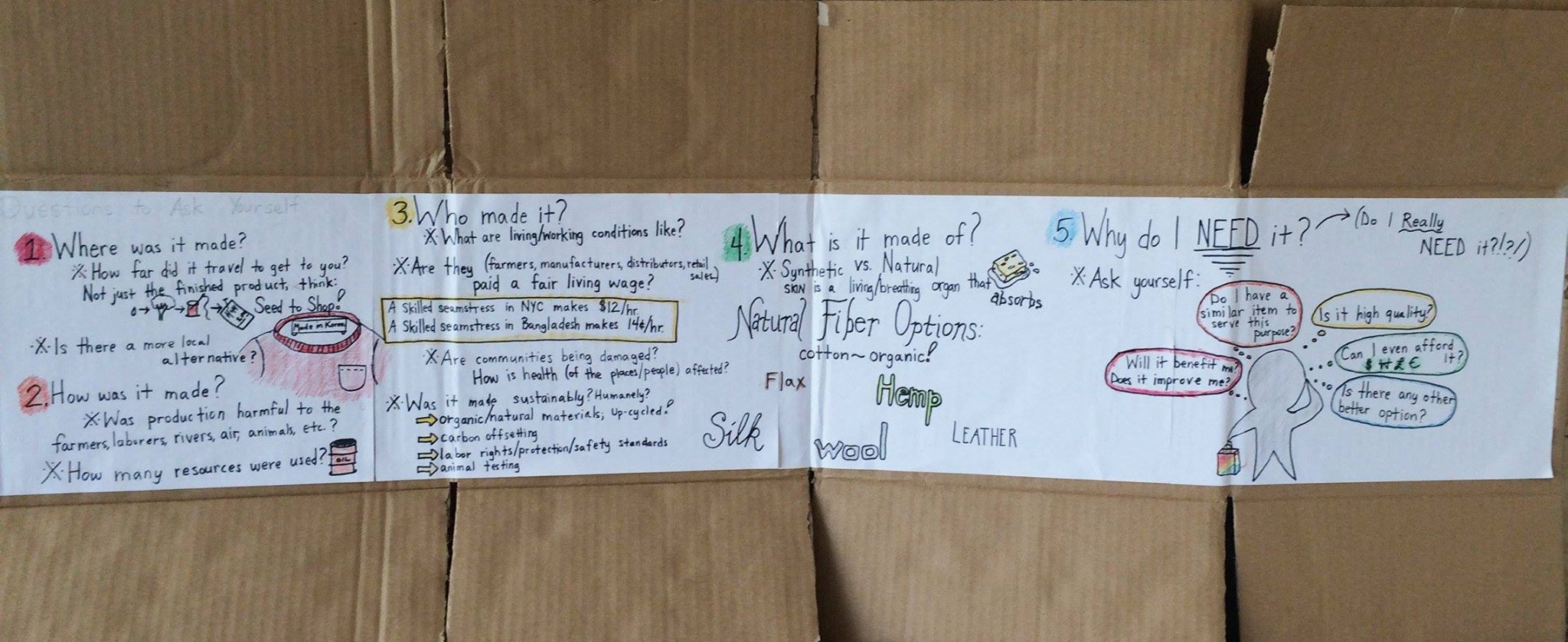
  4. Read labels: Imagine if people read clothing tags the same way that they read nutrition labels and avoided toxic fabrics as much as they avoid GMO foods. It’s become a new habit of mine to check out where things are made and what they’re made of. Shop around and choose the more sustainable option of what you’re buying. Recently I have done this when shopping for headphones and yoga pants and feel prouder of my things even if nobody knows that they’re a bit more sustainable. Choosing something that’s better for you and for the environment can give a small sense of pride.
  5. Shop locally: If possible buy items made in your area, or at least country. That’s not very common
    in the US anymore, but can be done, American Apparel comes to mind. You could also shop on Etsy for up-cycled clothes. Here in Korea it’s much easier to do, a lot of small shops sell Made in Korea.

    Merino wool, one of my favorites.

    Merino wool, one of my favorites.

  6. Buy Natural Materials: Choosing a wool knit over acrylic will definitely cost more, unless found at a thrift store, but you get what you pay for. Spending more on high quality will mean that it will actually feel nicer to the touch (and you will be wearing it on your skin,) it will look nicer, and last longer. Other natural materials to keep an eye out for are organic cottons, silk, hemp, leather and suede.

Conscious consumerism takes more time and effort, but after practice it will develop into unconscious-concious consumerism, if that makes any sense. You will begin to be more aware of the things that you bring home with you and where and how they came to be. It really is similar to watching the breath in yoga, at first it’s not easy to give the breath full attention, but after hours and years of practice, it just begins to be the new normal. Likewise, choosing to shop more sustainably can soon become your new normal, too.
A handmade poster made by yours truly for my first swap in which I gave a short talk about shopping habits.

A handmade poster made by yours truly for my first swap in which I gave a short talk about shopping habits.

Yoga off the Mat – A Mindful Closet

Yoga is much more than a physical practice. The mindfulness that is practiced during yoga starts to happen in day-to-day situations such as more healthful eating, calming the mind in times of stress, and even in the way we consume. A few years ago I became more aware of the fashion industry and have since then drastically changed my consuming habits.

We don’t often think that long about a purchase anymore. In terms of clothes, if it’s on sale, fits, and looks cute, then in the cart it goes. It could be useful at some point, right? But often times that $5.00 top gets tossed into an overcroweded closet never to be seen again. This is a common happening for a lot of (especially) women in our culture. Advertisements, Hollywood, and popular culture throw messages at us all over the place to buy more, more, more. But where are all of these clothes coming from? 

The line of production of a piece of clothing is a lot longer than we think. First, the fabric starts out as a raw material. Let’s look at that $5.00 top and assume that it’s a T-shirt. If it’s cotton then it would have started out as a seed. According to the research done by Planet Money of NPR, who followed a T-shirt throughout its entire life-cycle, 90% of all cotton seeds are GMO. Then there’s the resources needed to grow that little seed. A lot of water is needed for cotton and that water sprays off the pesticides and fertilizers that are used on the cotton, seeping into the water basin (buying organic cotton is an idea.) So already when we take a closer look at just the cotton that will eventually become a cheap T-shirt, there are quite a lot of negative effects. This is assuming that the T-shirt is 100% cotton, what if it was a blend, say made with 5% spandex to give it to some stretch. Spandex is a synthetic fabric made using more (chemical) resources in production. I attempted to do basic research into this and was scared off by all of the chemical jargon that I couldn’t even pronounce (macroglycol and diisocyanate to name just two.) Test your patience with this read.

After the cotton is harvested it gets shipped to another location, most likely in another country, to be turned into fabric. This process might include such steps as washing the cotton, spinning it into yarn, turning that yarn into fabric and dying it. The dyes are not often natural anymore and run into the local bodies of water. You can google images of rivers running all colors of the rainbow in manufacturing countries. Then the fabric gets cut and sewn into T-shirts. Most of this production no longer happens in the developed world. Thanks to globalization and outsourcing the job gets done by populations in poverty who will do it for much less.

Most clothing tags read: Vietnam, Turkey, China, or Bangladesh, just to name a few. In these countries the laborers can be paid much less and the working and environmental standards are much lower or non-existent. Chemicals and pollutants can be harmful to their health and do damage to the local environment, too. Again, according to the work done by Planet Money, some workers in Bangladesh work six days a week and make about $68/month. Here’s a link to a video series about the process made by the podcast.

Wages may be a low cost to the producers, but the long-term and often unthought-of cost of pollution and dangers to health is often overlooked. In April of 2013 there was a massive and devastating building collapse in a Bangladeshi factory. The multi-story building housed hundreds of employees put to work to produce clothing items for around 30 big names in the industry. The building was not well maintained which probably caused the collapse and took the lives of around 1,000 people. All working to produce cheap fashion for us in developed nations. When given thought, it makes that $5.00 T-shirt seem a little more expensive in terms of hidden costs- some even in human lives.

Possibly made in a similar factory as that which collapsed.

Possibly made in a similar factory as that which collapsed.

That tragic incident was the turning point for me. The event was framed by author Elizabeth Cline, in an interview on NPR’s Fresh Air. In the interview the author details the problems in the industry that she discovered through intense field research in countries like Bangladesh. 

After listening to the interview I began to realize that there was really no need for me to shop as much anymore. My closet had been full, and bursting, for most of my adult life. Shopping to me was a hobby, a way to spend an afternoon. Yes, I got that rush when I scored a great deal and even bragged about it to my sister, but that little rush and hobby had to be altered out of respect for the negative effects it had in other parts of the world. And really it wasn’t that hard to do.

Escaping from the pull towards trends and fast fashion may not be easy at first, it requires a change of behavior as well as the mindset to be happy with what you have. There are certainly days when I see something in an ad and think to myself, how cute and nice it looks and wouldn’t it be great to have? But I quickly find my way back to the core thought that, on second thought- No, I don’t NEED it, I can happily do without.

Best of luck to you on this journey of lifestyle change for the better. More blog posts in the future on specific tips and experiences.

Don’t Shop, Swap!

Clothing swaps are great alternatives to shopping, and make for excuses to have a social gathering with old friends or new. They’re very easy to put together and require very little planning. Plus, everyone will hopefully go home with something new (to them) and exciting!

I first attended a clothing swap with my boyfriend’s mom where she lives in the south of France. On a fall afternoon a large group of women gathered in a friend’s home and laid out items that no longer got much use from them, to be shared and swapped with all in attendance. It was a lot of fun and a few years later I found myself hosting a swap in my expat community of Busan, South Korea. Here’s a quick how-to on hosting a clothing swap. Details are specific to an expat community, but a swap can be held anywhere.

Browsing items :)

Browsing items 🙂

  • Invites: Social media makes planning a breeze, with a few clicks and a nice photo you’re done! For my events I made the events public, open all in the community. For your friends you could make it more intimate by inviting them by phone or even send out some nice stationary, but doing things electronically saves paper and time.
  • Choose a Time: I have had a lot of success hosting swaps when the seasons are changing. People tend to pack up their shorts and tanks and pull out the sweaters in the fall, so that’s a great time to host an event, likewise spring is another great time. I encourage people to bring summer and winter clothes as people might be vacationing to warmer places, or can store the items for later.
  • Inform Your Guests:  Some people may not know what a clothing swap is, so let them know that it’s a chance to hand in unwanted clothes for others’ lightly used items. You can have your event be for ladies only, or extend it out to men or even make it a family event for children as well, as I’m sure a lot of families may have clothes that are getting too small and equally would be in need for someone else’s larger sizes! Be sure to plan the event a few weeks in the future to give people time to go through their closets. Decide if you want to include accessories and footwear and let everyone know. Be sure to tell guests that only lightly used items are appreciated.
  • People at Table Talk English Cafe, swapping away!Chose a Venue: As a very casual event you could host a swap in your living room, or on the porch in warmer months. You could make it more fun by incorporating a potluck. For a more public event, seek out a local cafe and encourage your guests to support the cafe by purchasing a drink or food. The chosen location might not even charge you rent if you let them know guests will be buying their fare.
  • Arrange Drop Off Times: Expat communities see people come and go routinely. Plan your swap to coincide with the waves of expats coming in and out. For example, here in Korea the school year begins in March, so people leave in February and newbies arrive in March- a great time to host a swap. In order to collect off of the people who are flying out, ask the cafe if you can collect a few weeks early and store there, if that’s not an option, consider storing and collecting at your place.
  • Donate the Extras: Storing all of the left overs might not be reasonable, so search your local area for a charity shop, orphanage, or women’s shelter to take the clothes that remain. Call ahead to make sure that they’ll accept what you’ll have to bring.

Hosting a swap does not require much at all and can be such a fun event. For my first swap, I held a talk at the beginning for those interested about the sustainable aspect of the swap, which might be a good idea if you want to give your event a deeper meaning.

Here is the Facebook Event link to my upcoming Swap in Busan on March 14th. The swap is open to the public. As the host I encourage anyone to come have a look through the clothes, whether you have anything to contribute or not. The reason for this is that by taking an item off of someone rather than buying it new in the shop, you save the item from the landfill and also don’t contribute to mass consumption… but that’s a whole other blog post!


Update, here a few photos from the Swap that was held in Busan on the 14th of March. It was a success I believe, with people walking away with mounds of clothes. I learned from this event and am hopeful that next season’s will be even more successful and run more smoothly. This past event I happened to become ill during the swap and was running a fever for most of it, thankfully some good friends stepped in and helped me out so much. Thanks ladies!

Hosting Karma Yoga Classes

A karma yoga class is a class in which the payments are donated to a charity. As a teacher, they are very easy to  host and you do your part by donating the money, but also by teaching others about a charity or non-profit that has a lot of meaning to you (not to mention by giving everyone a well deserved yoga class!) Donations Only classes can be taught regularly or during special holidays or vacation times.I find that hosting karma yoga classes during holidays gives them just a little extra meaning; for example, I recently taught a class on Valentines Day, a great day to spread some love around. Here are some tips in hosting a karma yoga class.


Venue: 
Holding a donation based class outside at the beach or at a park is great, Beach Yogabecause no money gets lost to rent payments. When I first moved to Busan I hosted early morning beach yoga classes on the boardwalk and gave payments to my local non-profit of choice. Not much was raised, because not too many people are early risers, but every little bit counts!

Cost: Choose a minimum donation cost that is required, $5.00 is a good place to starDonationst. When I create my events I describe the cost as Minimum Donation of xxx, this way people might consider donating more. When class is finished and everyone is making their payments, I remind them that I have change for them if they need it, but if not their extra money is greatly appreciated by the organization. Many students will be generous.

Choose an Organization: Find a cause that means a lot to you personally and that you are knowledgeable enough about to tell others about in detail. At the beginning of the class, explain your organization of choice, where and how the money will be used, and other ways that people can help. Below is a description of the non-profit that I have been donating to.

BAPS- Busan Abandoned Pet Sanctuary

Busan Abandoned Pet Sanctuary is a privately run dog shelter in Busan, South Korea. The dedicated couple that run the shelter have rescued, medicated, and rehomed hundreds of dogs since 2008. Dogs have been saved from off the street and from the local pound; these are dogs that would have otherwise not had much of a chance at survival. BAPS is a no-kill shelter, so dogs are cared for until they are hopefully adopted for life. Money from donations goes to dog food, shelter upkeep, medications, male neutering, operations, etc.

My personal attachment to this non-profit is my love and joy, Fred, who I adopted from BAPS in 2011 with my boyfriend. He’s come a long way from his skin-diseased-street-dog-days and now lives a life of comfort, spending most of his days sleeping, curled up on my bed. He also loves to join me at beach yoga class. He takes a nice little nap in the sun while others flow.

To learn more about BAPS, visit their website or search for them on Facebook. Donations can be made within Korea by bank transfer or internationally by using Paypal. Information on how to donate is easily found on their website. There are even weekly dog walking volunteer events if you’re missing your furry loved one from back home, those can be found via Facebook.

DIY Natural Dying

I learned about using compost to make natural dyes via a podcast that my boyfriend was listening to one night, and it caught my attention. On the podcast, the woman was talking about collecting onion skins from restaurants to turn them into dye and I thought, well we go through a lot of onions, so might as well start collecting. I also asked some girlfriends to save their onion skins for me and had quite a collection. This past weekend I finally put the skins to use and the results were surprisingly nice. They will be sewn into eye pillows and cases.

How To

The Collection: I’m not sure on an amount, but if I had to guess I’d say that I used about 20 onions worth of skins. Initially I froze the skins, but I found that that’s not necessary. The skins keep well at room temperature as long as none of the flesh is on them. It’s winter now, so that might not be the case during the humid summer.

The Process: I followed this blog. Outlined below are the stepsSoaking the skins I took to dye my fabric.

  1. After collecting and storing the skins until I was ready to dye, the first step I took was to soak the onion skins. I covered the skins in water until they were all covered, but of course some were not submerged because they floated to the top. I had read that soaking over night gets the best results, so that’s what I did.
  2. The next day I boiled the skins in the water. They didn’t remain
    boiling for long. After they reached boiling, I lowered the heat to simmer. They simmered for about an hour. When I went to turn off the gas completely, I noticed that a lot of the water had boiled off and the water was colored an orange-brown. I removed the skins as much as I could.
  3. The next step is soaking the fabric in thedye. Using different types of metal creates different colors, so I used two different pots and experimented a bit. One piece of fabric was completely submerged in a cheap camping pot (I’m not sure what type of metal it is, but it’s cheap) while the other fabrics I played around with and explain how below. For the best results the blog said to soak the fabric in thedye while it is heated on the stove for about an hour.
    1. Two fabrics I tie-dyed. The first fabric I planned to use for eye pillows. The second was a shirt that I altered when I first bought my sewing machine (it has very rough hems from learning how to sew!)
    2. The other effect I daydreamed about making was an ombre effect, or fading from dark to light. I theorized that if I strategically hung the fabric above the dye only submerging the end and then lowered more into the dye every hour, then I’d end up with the part that was soaking the longest would be darker in color and that which was soaked for the least amount of time would be lighter in color. The end of the fabric wasn’t submerged at all and stayed the original cream color (minus some staining from the steam of the dye.
  1. After the fabrics were in the heated dye, I turned off the heat and let them cool in as they were. For better results it was recommended to have them sit in the dye overnight which is what I did. The following day (3 days into the process now) I took them out of the dye and rinsed them in cold water until they stopped running.

The results of this process came out great, I thought. I hope to play around with other natural dyes in the future. A student recommended dying with turmeric and fruit skins. Have you had any success with natural dyes?