The beauty industry is ginormous. In the U.S. in 2016 industry sales reached 16.2 billion dollars and globally was 244.8 billion dollars in 2012. We spend a lot of money on products that we powder, smear, rub, and brush on to our faces and bodies every day. We use products literally from head to toe. Men aren’t immune either; in Asia, or at least in Korea, the male beauty industry is one in and of itself, and men worldwide at the very least wash their hands, their hair, and their bodies.
Specific to the U.S., the beauty industry has very little regulation by the government. Manufacturers can put almost whatever they wish into a product to make it shine, lather, or sparkle, and nobody will ask whether the chemicals are safe, chemicals that we apply to our body, on to our skin – our largest living and breathing organ. The skin has pores that absorb what is on and around it, and although only small amounts of product are applied at one time, those applications add up to a large amount, day after day, throughout a lifetime.

Many chemicals in beauty products (and in the plastic bottles that they come in) are endocrine disruptors, which means that they disrupt the endocrine system, the system of the body that produces hormones. Overtime, exposure to harmful chemicals can cause fertility problems and cancer. As mentioned previously, there is very little regulation over the American beauty industry. The food and drug industries are highly regulated compared to cosmetics and toiletry items, as found on http://www.fda.gov, “cosmetic products and ingredients do not need FDA premarket approval, with the exception of color additives.” When shopping for beauty products it is fair to say that we all assume that companies and the government have our safety as their number one priority, but that is not the case. Beauty products are primarily made up of harmful chemicals, often times without clear labeling. Up until 2013, there were two dangerous chemicals in Johnson & Johnson’s “No More Tears” baby shampoo. Read that sentence again, harmful, cancer causing chemicals were in products used for the vulnerable and pure. And that massive change of re-figuring the chemical make up of the shampoo came only after years of hard work by activists, all the while they were manufacturing a formaldehyde free version for their other markets around the world. In fact, other governments have been doing a much better job at protecting their citizens against harmful chemicals than the U.S. does, for example, the EU and Canada have out-rightly banned carcinogenic chemicals from being used in beauty products.
Some chemicals are released by preservatives (as was the case with “No More Tears,” so are not technically added to the product, but do occur. Companies when pushed will often state that it’s ok to have chemicals, such as formaldehyde and the like in products because the level is low enough so as not to be harmful. Sure that might technically be true to be said of the small amount used in one wash, but years and years of use add up.
Chemicals to look out for when making purchases are dyes, “fragrances,” parabens, and triclosan, to name a few. Being aware of just these four chemicals, you’re likely to put back every single bottle and tube that you pick up at your local grocery or box store. I recently went in to a big box store thinking that they are so large that they must carry a shampoo without parabens and made with more natural ingredients, but even with a large aisle-full of products, I could not find a single shampoo that met my requirements. I instead had to go to TJ Maxx where I had had previous luck finding organic shampoos and soaps at discounted prices. I eventually went with a shampoo that was made in the U.S. and lacked a lot of the harmful chemicals that I try to avoid. Yes, I paid more than I would have at the big box 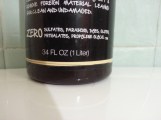 store, but not all that much more because I bought a large bottle, so it will last months. When opting to pay more for organic food and products over cheap, chemical-laden foods and products I remind myself that paying more now is a lot cheaper than paying for health care treatment down the road.
Another option is to do some research and DIY your beauty products. This is something that I have had interest in, but never made the time to do. Fortunately for me, I have thoughtful and loving friends. One of my friends organized and prepared natural, organic, DIY face wash and toner for my girlfriends and I to make during my Bachelorette party (we did this activity early in the night before getting too wild, more posts about having a DIY, sustainable, waste-free wedding to follow!)
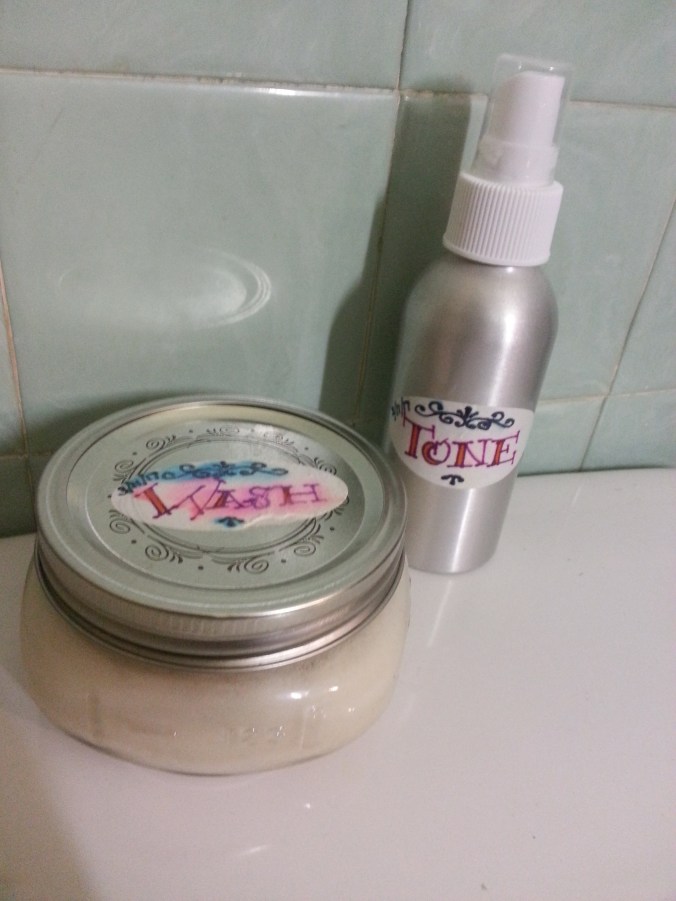
The face was contained just two ingredients in the recipe – coconut oil and raw honey. We added jajoba oil since it was winter and skin is dry at that time of year, but I think that the recipe would be fine without it since the coconut oil acts as a hydration component. For the face wash you simply melt down the coconut oil and honey, if they are solidified, mix and combine the two together, pour into your glass container (do not use plastic!) and let harden again. While the mixture is melted you can add in essential oils of your liking for scent, but this is not necessary.
If you have never used an oil based wash before then it may feel weird to smear oil on your face – but it works! I suggest not wetting your face before applying the wash. Simply get a small portion on your fingers, rub between your hands to warm it back into a melted consistency, and apply to your face. Massage onto your skin for 20-30 seconds then rinse with water. Oil and water don’t mix, so it will feel as if there is still some residue on your skin, but that’s fine, simply dry your face with a towel and you’ll feel fresh as a daisy.
The toner was a mixture of chamomile tea, honey, and apple cider vinegar. You can find the recipe here, which was a little more complicated being as it has three ingredients instead of two, there’s some friendly sarcasm in there – pick up your face wash and try to count the ingredients, far more than two I’d think! The toner has a strong sent of the apple cider vinegar which is very recognizable, we tried to mask it with essential oils, but it still comes through; I’d much rather smell AVC than spray potentially dangerous chemicals onto my face, though.
The next time you find yourself adding beauty products to your grocery list, I hope that you will note to buy organic and natural alternatives to the cheaper, mainstream options. If you have the time and desire, try making your own. It will feel satisfactory to create something for yourself and you’ll save a lot of money overall, plus waste since most products come in plastic containers. On your path to purifying your home and body, starting with what you apply directly to your skin is a good place to begin.


 cross-legged, a position that is more comfortable on my back – I’m able to align my spine and ground through my sit bones in the chair (you can find detailed instructions on how to sit and stand safely in the Deskbound book.) Without even noticing it, only three months into the big adjustment, I was standing up the entire 7 hour day, spare a 30 minute break to eat lunch seated and 30 minutes of my lunch break that I use to take a walk outside. I’ll point out again that it took about three months for me to get to the point of standing at my desk for the full day without discomfort, so do not despair if you try a standing desk and find it difficult, give your body time to adjust.
 expressing love to pets in one of the yoga classes as a relationship that isn’t romantic. Say your dog loves walks but you show love with cuddles, that’s nice for you because you get strong positive emotions from the cuddles, and your dog may too, but that dog just wants to walk! And sniff! Make your dog the happiest dog she can be by making time to walk her. Give her a life full of love and walks. And don’t pull her if she lingers on a scent, let her sniff, because she may love walks mostly for the scents and not for physical activity, but the physical activity is a bonus for you both.
 existence as a concentration and death camp, the largest death camp of Nazi Europe. It is recorded that around 1.1 million people lost their lives at Auschwitz, people whom were sent from countries all over Europe, mostly Jews, many Poles.
 English tour, we received headphones which is how the tour guide communicated to our group throughout the day, necessary since hundreds of people were touring that day, all in different languages, we then followed our Polish tour guide from harrowing landmark to harrowing landmark. Our guide stopped us outside the buildings and told us how the S.S. made the prisoners stand outside in freezing winter temperatures while they called roll, at times making them stand and wait for up to 24 hours straight, no food, no rest.
 photographs of prisoners, the last image of many them to ever be preserved in history. There were exhibitions of belongings that had been taken from the prisoners. The volume of the items piled up high on top of each other put into perspective just how many innocent men, women, and children were sent to the camp and perished there. On our tour I learned of unspeakable atrocities, of unthinkable “living” conditions, if you can call the labor-prison-death camp existence “living.” The masses of people who were thought of in by the Nazis as fit enough to work, or too weak to live. The disabled or injured were sent straight to the gas chambers while the young and healthy were put to tiresome, endless work, producing for Germany. The gate at the entrance of reads: “Arbeit Macht Frei – Work Sets You Free.”


 The heavy theme of creating community is something longed for by many during this tumultuous time of political transition in the U. S. The studio is located in the center of D.C., a city that is smack-dab in the center of the White House transition, or rather the White House transition is smack-dab in the city. The 2016 American presidential election was an emotional event for many because the country is extremely polarized politically, with Washington D.C. being no exception. An NBC Washington news poll claims that












 Pre-brewed, cold, highly sugared with high fructose corn syrup, sat in a cooler at a convenience store, packaged in plastic with a long shelf life; or grounds sat in a plastic (non-recyclable might I add!) K-cup; or coffee grounds bought in bulk at the grocery store that has a use by date of one year after roasting. These examples all processed more than the freshly roasted beans above and therefore have lost prana along the way.
 karabemisyoga