Leave No Trace – Litter on Korean Mountains

Surrounding myself by nature is a wonderful luxury that I try to make part of my life as much as I can. Living smack in the middle of a city, it is not always easy to feel totally engulfed by the beauty of the natural world. Don’t get me wrong, Busan has great hiking and of course beaches, but often reminders of being in a city are there – noise pollution, light pollution, and straight up litter. Recently though, I was able to get out of Busan for a little trip up north over the Chuseok holiday to visit Seoraksan National Park.

Years back when I made my first trip to Seoraksan, a fellow American expat taught me about the idea of Leave No Trace, it’s as simple as it sounds, take with you whatever you brought up when you go, leaving no trace of your visit. This means clean up after yourself, that simple rule we learn in kindergarten. Don’t leave any wrappers, single use utensils, or even fruit peels (as they are more than likely tarnished with pesticides and are probably not native of the land so therefore might cause disruption to the ecosystem.) This is a rule that I strictly follow whenever I get up into the mountains (or parks, beach, etc.)

Admittedly though, I am not an avid hiker. When given the choice I much prefer to stay near sea level as opposed to climbing up a big ‘ol mountain, but once I have been dragged along on a hike I always love that I’ve done it. It feels rewarding and the views are fantastic.

Seoraksan

Unfortunately, not all of the views are beautiful. On my most recent hike I couldn’t help but be upset by all of the litter left behind by fellow hikers. Feeling affected, I collected as much of the litter as I could and stuff it in the side mesh pocket of my backpack, by the time I finished the hike the trash was spilling over the sides.
Water bottles were a common sight

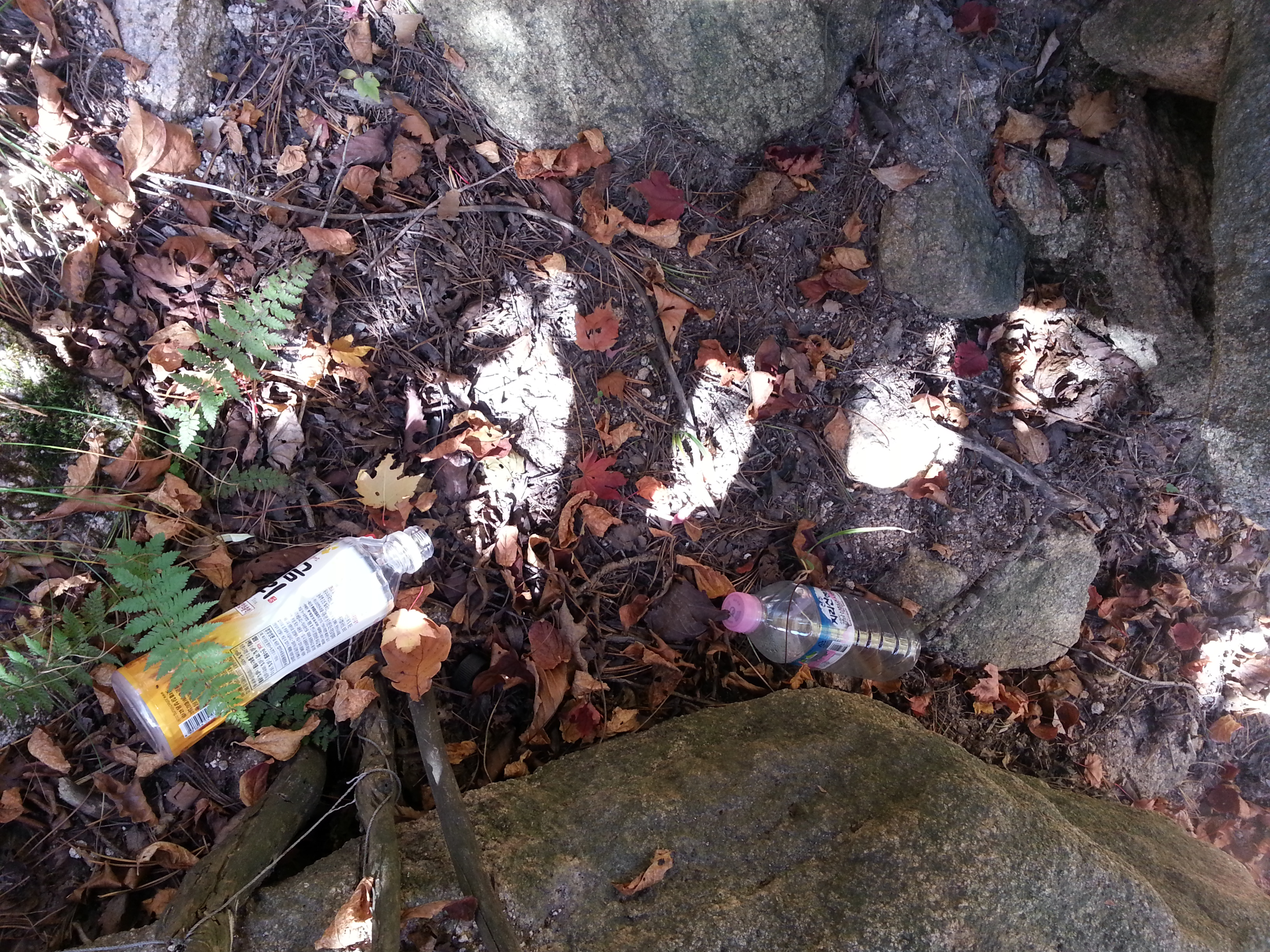
Water bottles were a common sight

When I returned to my hotel I emptied it all out and arranged it to have a closer look. It seems that most of the trash was individually wrapped candies. (Candy wrappers are also one of the most frequently littered items on my local beach.) If only the sweet-toothed, nature “lovers” loved nature enough to leave no trace. Other items I took notice of were bits of gear that had apparently fallen off mid-hike, a reminder to buy quality when you shop so that you don’t have the problem of your backpack or footwear falling apart during use, and if it does, please take it with you and dispose of it properly.

It is so important to Leave No Trace; I can’t imagine how long all of this might have stayed on the gorgeous Seoraksan floor. Sure, there are probably teams that go up and clean, but wouldn’t it be nice if everybody took their own responsibility and left places as beautiful as they found them, with no traces?
Conscious Dining – Boycott Single Use Plastics at Restaurants

I’ve written before about the importance of switching from a plastic to-go-cup to bringing your own tumbler whenever you get an iced coffee out at a cafe or restaurant to save landfills and energy of recycling hundreds of plastic cups, lids, and straws. I am really proud of the plastic that was not used by me in the past five years since I’ve been using my tumbler daily. There’s really no need to create all that waste – either bring your own or ask for a mug in the cafe. Recently I have expanded my actions of decreasing my single use plastics, I now pay attention to the restaurants and cafes that I visit and have made conscious decisions to boycott  places that regularly serve with plastic utensils or cups.

Waste behind a local cafe, these bags are filled mostly with plastic cups/lids/straws.

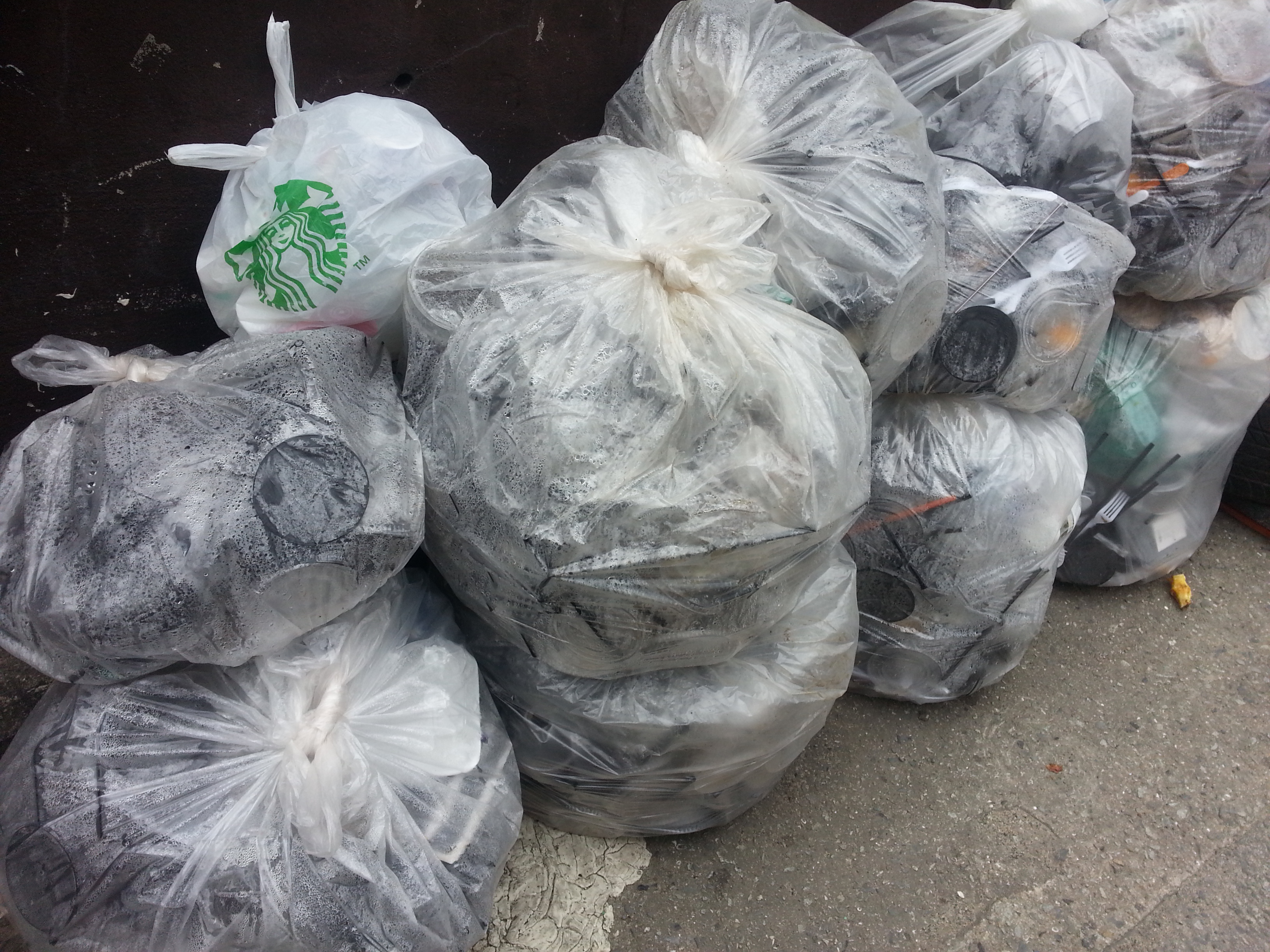
Waste behind a local cafe, these bags are filled mostly with plastic cups/lids/straws.

There are of course times when plastic silverware has its benefits, say for a picnic, but even then there are alternatives such as metal or single use wooden utensils. But at a sit down restaurant, I see no logic in it. It was over a year ago that I went to an expensive restaurant here in Busan that sits on a marina, has modern interior design, and caters to wealthy customers. Their fare follows their aquatic theme, concentrating on deep-fried seafood baskets with french fries – fish ‘n chips basically. At this “nice” establishment the food comes out in a cardboard box with a wax paper lining, to eat they supply plastic forks and knives, and condiments are given in 2oz plastic dishes with lids (With lids! With lids to sit down and dip your fish into and then immediately throw away.) That is a lot of waste from one meal. And is it just me, or doesn’t using disposables cheapen the image of a restaurant?

Lids! To dine in! Madness

During my first visit there I sulked as I ate, trying not to ruin the vibe for my friends, and I vowed to never go there again. Over a year later the place was suggested to eat at for a friend’s birthday and I had to speak up and be the Debbie Downer that often makes an appearance as an environmentalist and say that I could not eat there based on the waste. It was uncomfortable to vocalize and certainly put a damper on the issue, but I had to say it. In the end, plans changed and we didn’t go there, but I am glad I spoke up none-the-less.

I also once ate at a pizza place that serves by the slice. They served that slice of pizza on a nice wooden board but also lined that board with a piece of paper – totally unnecessary. Plates were of course paper as well. The utensils were plastic so I opted to just use my hands. Even the draught beer, which was from a local brewery, was served in plastic cups. I really enjoy that local beer but couldn’t bring myself to order it.

Side note on the beer cups; there are times when they are required, say a crowded concert floor where glass could be a danger, or at an outdoor event where again it’s a hazard to have glass. In that case, breweries and restaurants could serve their beer in a compostable, corn-based cup, which is what I found back home in the U.S. at my favorite local brewery – Southern Tier Brewery of Lakewood, NY. I was sad to have to switch to plastic in order to follow my friends onto their stones course*, but was relieved when I saw that it was a compostable plastic cup. (I heard from a friend that there is a cafe in Busan that serves their to-go coffees in a similar cup, it’s on my to-do list to check it out and of course there shall be a post.)

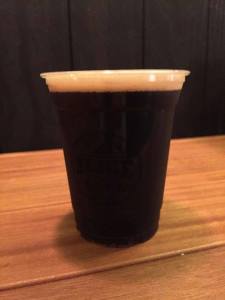
Compostable Corn Cup, Made in U.S.A - dream product

Compostable Corn Cup, Made in U.S.A – dream product

It really might seem crazy to most people that I am so affected by this issue (I once described how it feels as if I’m strangling a kitten, or some other such heinous crime, whenever I use plastic, or worse still, don’t have the option to recycle it) but since I have been living by the sea and witness the amounts of litter and waste that makes its way into the water, I have been more and more adamant about limiting my contribution to our dying oceans.

Bring Your Own EVERYTHING!

Bring Your Own EVERYTHING!

So, what to do about this? After I realize what’s going on, I decide not to visit the restaurants again. Another option could be to go but to bring my own utensils and tumbler. I have even gone so far as to bring my own dishes along to an event that I knew would be using single use. Sure, I got a few weird stares, but I also got some compliments and hopefully inspired at least one or two people to be more aware. I wouldn’t suggest lugging your picnic basket around with you everywhere you dine, but sticking some silverware in your purse at all times might be a good middle ground. They’re not big and you can even find compact camping style ones. One of my next projects is to sew a little fabric carrier to keep my chopsticks and spoon clean when I carry them around. Post on that when I get around to it. Until then, I shall simply be boycotting single use plastics at restaurants.

How do you avoid it?


100% recycled apparel

*Footnote: Stones is a cool new game which from my understanding was invented in my region of south-western New York State. It’s a game similar to bocce ball that requires a grass and sand course. I noticed it was gaining a lot of popularity at Southern Tier, they even had T-shirts, which to my delighted surprise were made from 100% post-consumer recycle material. High five!

Detoxify Your Home – Natural Soaps

As I have become more and more mindful of chemical ingredients found in the average cleaning supply, toiletry item, beauty product, or almost anything else that lines my cupboards and sink – I have made conscious efforts to detoxify those items. The shower is a primary area where I think that it’s important to kick the chemicals to the curb. Think about it – those very unnatural products, full of chemicals and dyes are applied directly to the skin (body washes, face wash, lotions, make up, the list goes on,) sometimes applied multiple times a day. And our skin is our largest organ, which is porous and absorbent.

For over a year now I have made the switch from cheap, packaged grocery aisle soaps to handmade soaps. Fortunately, artisan soaps are prevalent and easy to find. Many small boutiques often sell beautiful handmade soaps, made of few ingredients which are non-toxic. You can search online to find suppliers as well, whether you search large scale with Amazon or find a small producer on Etsy. Make your way to a farmers market or craft show and I’m sure someone there will have some soaps. You could also go for a big brand  name, such as Dr. Bronner’s.

Back in 2013 I found my natural soap supplier while browsing a foreigner market in my former Korean city of Ulsan. A lovely market had been organized in which mostly foreigners set up tables and sold their handmade items. Amongst those tables was a well-stocked soaps table by Mama’s Binoo (binoo is soap in Korean.)

Mama’s Binoo is an artisanal soaps producer run by Stacey Fells, originally of Canada, but now living in Korea. A short list of her products are: soaps, massage oils, lotions, bug spray, shampoo bars, candles etc. You can find the full list directly on her Facebook page, or visit her table at one of the foreigner markets that has since been started up here in Busan.

Mama's Binoo Logo

Stacey is extremely knowledgable about her products and their benefits and she freely shares that knowledge with her customers in order to keep them clean and satisfied. Some of her most popular products are: zinc cream, shampoo bars and Bug Off, a natural bug spray that smells amazing. Stacey began making homemade products a few years back for her son who suffered from eczema. As she explains, “Even though I could speak Korean well it was hard deciphering the ingredients on the labels here sooo… I decided if I couldn’t find what I needed that I’d make it myself.” I can relate to that feeling of helplessness as an expat who doesn’t know the native language, but I’d challenge anyone to pull their body wash out of their showers and try to read those ingredients, even in their native language: sodium lauryl sulfate, toluene, propylene glycol anyone?

“Even though I could speak Korean well it was hard deciphering the ingredients on the labels here sooo… I decided if I couldn’t find what I needed that I’d make it myself.” – Stacey of Mama’s Binoo

The main reason that I made the switch from chemical to natural was because I was weary of what I had been applying to my skin day after day and what sort of long term effect that might have been having on my health. My boyfriend and I have a simple rule that we try to stick to when it comes to what we keep in our house – If we can’t eat it, then it doesn’t belong. Of course, we’re not going to be having our soaps with dinner, but you get the point. The products we buy and the companies we support are as natural as we can find and afford.

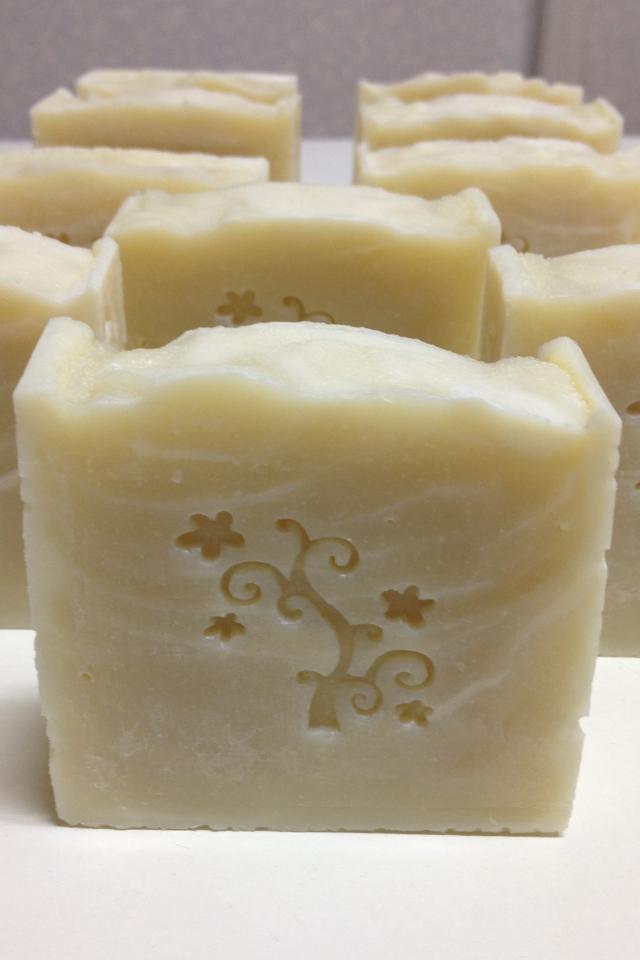
Mama's Binoo Soap

By buying and using handmade, natural soaps I not only make my home a little less toxic, but I am also supporting those making the soaps. Another benefit is decreasing the amount of packaging that comes home with me from the shop.You could go the next step and take a class on soap making and provide for yourself, I however, will just continue to shop local and use the wonderful products of Mama’s Binoo. Who’s your favorite local soaps producer?

Third Clothing Swap Success!

This past weekend I hosted my third community clothing swap here in Busan. The idea was exactly the same as the last two that I’ve hosted, all are welcome, donate what you can or come empty handed, walk away with as much as you like. The reasons why I don’t require donations by all are: 1. There’s an excess of clothing left behind by expat teachers whom have moved on from Korea and 2. My hope is that people will find clothing through this sustainable manner rather than by supporting Fast Fashion.

Although this swap was very similar to my past two, there were a few minor differences I made after learning some lessons from the previous ones. Here’s what was different.

  • More Strict Donation Requirements –
    About half of what was left over from the swap.

    About half of what was left over from the swap.

    At the last swap I got swamped with left over donations. A handful of friends and I took hours to sort through the piles and piles of clothes, placing them in either a massive garbage bag (we filled three,) a bag to be taken to a second hand shop (there were about 10,) or a pile to be sold at a market. This time I asked that people bring only high quality, no stains, no intimates. Initially I had faith that an outline like that wouldn’t be needed, but I turned out to be wrong. At this swap the clothes were in nicer condition and there weren’t as many to sort through in the end.

  • Change of Venue – The cafe where my first two swaps were held has sadly since shut down, so I moved location to a foreign-run bar in Gwangan – HQ. It was fun to have the swap at a bar. When I contacted them I referenced having a girls brunch day and they complied with a mimosa special during the time of the swap. Just like the last two swaps, purchase of a drink was suggested in lieu of an entrance fee.
  • Sneak Attack Ethics Lecture – Ok, so that might be misleading, but I did give a short five minute talk about my reasons for hosting swaps. At the very first swap I incorporated a talk about the fashion industry and sustainability (or rather lack of sustainability) which was scheduled to happen right before the swap began. A few people attended and were interested, but a lot of people didn’t come early for it, so this time I didn’t tell anyone I was going to do it, I just requested a mic from the bar and stood on my soap box at the height of the swap. I’m not sure how well received it was, but I hope that I reached a few people.

Swaps are really fun and easy to organize. I received a lot of feedback from attendees that they enjoy them and look forward to the next one. I hope they realize that they don’t have to wait for a large community swap to be organized; it would be super easy to host seasonal swaps with friends in your home. All you need to do is set a date, inform others, dig a bit through your closet, and swap till you drop.

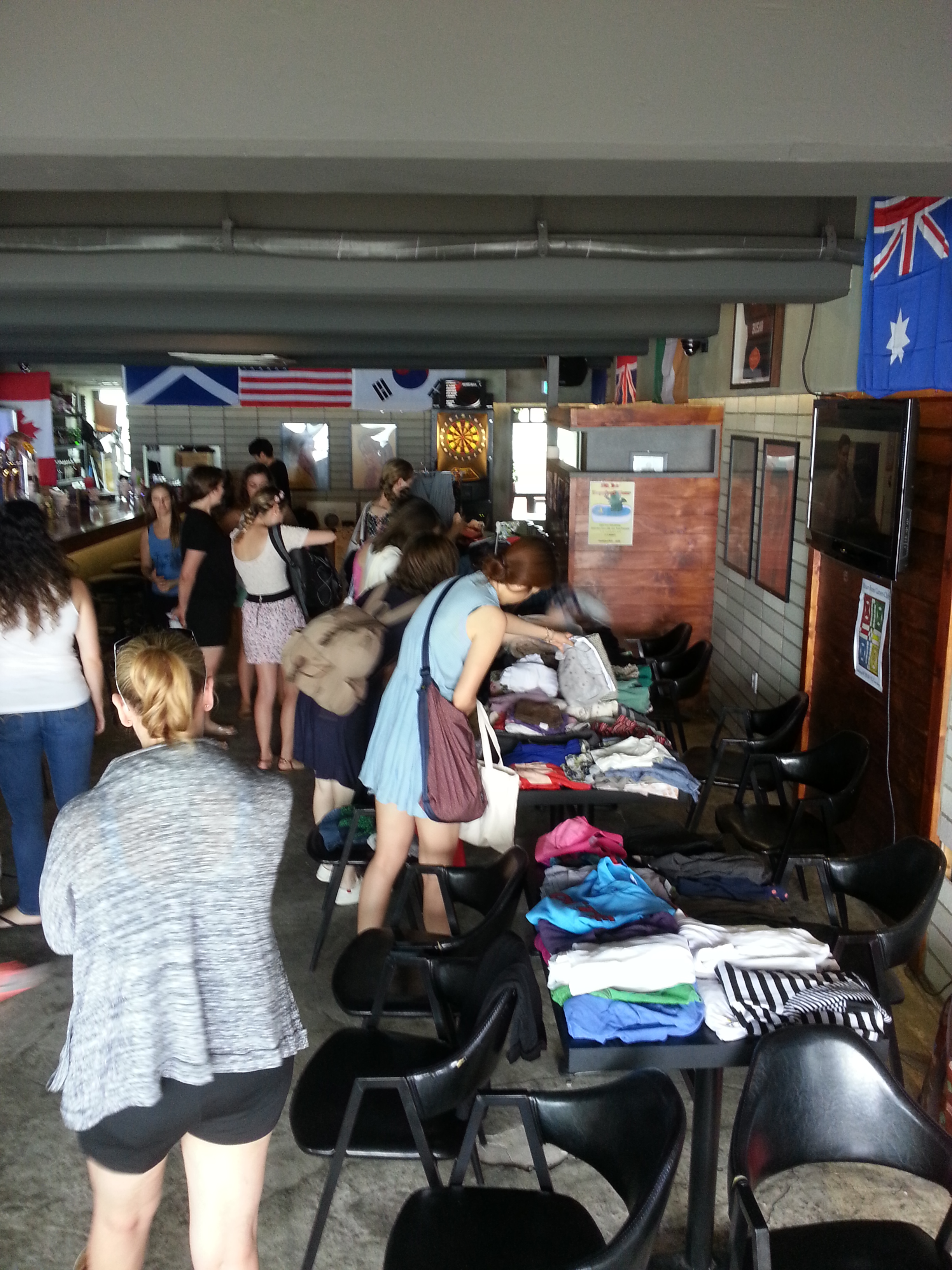
Swap in full Swing

3rd Busan Clothing Swap

Join me in less than two weeks time, on August 29th from 2-4pm, for the third Busan clothing swap. I am excited to host this event, the past two were hugely successful, not only for those who attended, but in my eyes they were a success because they stopped people from buying fast fashion as well as kept some clothes out of landfills.

Below are the details for the upcoming event. See you at the swap!


Start going through your wardrobes! Coming Saturday, August 29th – Busan’s third clothing swap event. I’m excited to move locations to HQ Gwangan after the sad closing of Table Talk.

What’s a Swap? A clothing swap is a fun gathering of people looking to get rid of their gently used, undesired items in exchange for someone else’s gently used, undesired items. There is no requirement to donate clothes (I understand that some people are new and didn’t come with much,) just come and have a search through and hopefully go home with something new. This is also a good opportunity for those leaving us to get their extra pieces to other expats or Koreans.

What to Bring? **Please Read** This event is all volunteer run almost solely by myself, Kara Bemis, thankfully I have been fortunate enough to have some friends volunteer to help me on the day of the swaps to sort through clothes, with that being said- it is hard work. We must go through all the left over clothes and get them to the correct location: garbage or thrift store. Please be very selective of what to donate.

**NOTHING WITH STAINS, HOLES, NO INTIMATES.**

Use this simple rule, if you wouldn’t re-buy it like new, then it doesn’t pass the test. All seasons permitted, summer to winter. Also, by being selective, please limit the amount that you bring, if you have a suitcase full of high quality items – great! If you have two suitcases full of low quality items that saw better days, then please leave those at home (again, due to the fact that it’s hard work to sort through the left overs.)

Moving from a cafe to a bar, HQ and I are happy to announce that there shall be drink specials! Details to follow.

Make an afternoon of it, bring some friends, grab a drink, and swap till you drop. Just as before, this is a free event with a drink purchase your entrance fee, let’s support HQ who is letting us hold the event at their waterfront spot.


Directions to hq gwangan
  • Take the green subway (Line 2) to Gwangan, stop 209.
  • Take Exit 3.
  • U-turn towards Gwangali Beach, walk straight towards the beach until you reach the main road that runs along the beach. You will be in front of Lotteria/Baskin Robins.
  • Turn left at Lotteria and walk a few yards. HQ is on the fourth floor of the building with a chicken restaurant on the first floor and Cross Fit in the basement.
  • If you reached Starbucks then you went too far.

Tropical Storm Brings Trash to Gwangan Beach

Last Sunday, July 12, 2015, was a turbulent day of wind and rain brought to Busan by tropical storm Chan-hom. There had been talk of a typhoon making it’s way to us, but it settled down into a tropical storm. Winds were high and the rain went from heavy to light throughout the day. This article on weather.com, states that winds were recorded as high as 47mph here in Korea.

Although it was not an ideal day for a bike ride, that’s exactly what I did during a period when the rain wasn’t so heavy. We took the boardwalk path on the way back to my apartment and were shocked by how much trash had washed up on the beach from the winds and surf. I snapped a few pictures, but most of the photos in this post are from early Monday morning, the following day. This amount of trash on the beach is extreme; there is always litter, casually dropped by beach walkers (cigarette cellophane, lighters, candy wrappers, straws, coffee cups, etc.) but the storm brought a whole array of trash.

Things that I noticed were shoes, balls, a lot of plastic drain filters, plastic beverage containers (water, soju, makgoli,) styrofoam and so on. There were great big styrofoam buoys, corners and bits from styrofoam coolers, and tiny pieces that had been broken down by the ocean. These little pieces are the ones that threaten the life of birds and fish because they resemble fish eggs so are consumed as food.

I noticed that there were still tourists snapping pictures at Gwangali Monday morning, however they were ignoring the length of beach covered in trash and instead aimed their phones at the bridge. I suppose to most people when they see a sight like that they think about how ugly it is and feel no responsibility to it so simply ignore it, but when I saw it, I wondered where was it coming from, how do we stop it, and how many innocent wildlife will die from our waste?

As I was taking pictures Monday morning, about half of the beach had already been cleaned up. Busan is great about getting crews out there every morning to make the (tourist) beaches look pristine. While the beautifying of the beach seems beneficial to us all, I can’t help but wonder if habits would change if people’s litter and trash stayed on the beach instead of miraculously disappearing every dawn.

Witnessing the debris that was washed up on the shore was depressing but also inspiring for me to question how I can decrease my impact on this finite planet even more. This month there has been a campaign online – Plastic Fee July, take a look at the link of their facebook page where you can get ideas about how to decrease your plastic use. Here’s a previous blog post of mine with tips. We can all do our small bit by carrying reusable bags, refusing bottled water, creating and using DIY cleaning/beauty products and most importantly sharing and inspiring others with our efforts.

How are you having a Plastic Free July and Plastic Free Life?


Better quality photos taken by Ben Lear.

Hosting a Beach Clean Up Event

Hosting a beach clean up event has been spinning in my mind as an idea for a while, but I was never really sure how to materialize it. It’s easy enough though to gather a few friends or a group of people and have them collect as much litter as they can, so that is exactly what I am doing.

Last month contained the American holiday of Earth Day, on April 22nd, unfortunately my event wasn’t planned in advance enough to be around Earth Day, but that really doesn’t matter. Each and every day should be a day in which we consider our constant impact on our fragile planet, and we should change our habits so that we cause less and less harm.

Together with a yoga friend, Jessica Rykert Holt, who has been leading mindful meditation gatherings in Busan, a straightforward beach clean up/yoga event has been organized at Gwangali, one of our local beaches. After a date was set for May 16th, Jessica was told of another beach clean up happening at another coastal location in our city, so we joined up to host coinciding events. The other event is through a local scuba diving group, Busan Scuba. Divers will meet and clean up Taejongdae, an island in the southern part of Busan.

Here’s what our beach clean up event will consist of at Gwangali:

  • Meet Up and Introduction – After learning some new names, I will start the event off by explaining my motivation, which is to create awareness about the harming of the oceans and lands, but more specifically, the oceans, by single use plastics such as to-go cups, straws, packaging and wrappers. Next, Jessica will speak about mindfulness and meditation and teach everyone about what they will be doing as they comb the beach cleaning up.
  • Time to Hit the Sand – After the tools are passed out (gloves and city purchased garbage bags in our case) participants will get to the cleanin’. Busan suffers from a lot of littering, both internally in the city and along the coasts and beaches. Daily I see candy wrappers, cigarette cellophane, straws and the like strewn about the beach when I walk my dog and on the streets. Not knowing the language well enough, it seems to me from observation, that people are simply ignorant of the lasting negative impact of their fluttering plastics that land on the beach and quickly find their way into the water via tides or winds.
  • A Yoga Practice, Of Course! – After all of the hard work and concentration on being mindful, everyone will reconvene at a large area on the boardwalk to lay out their mats and flow. The class will continue with the theme of mindfulness and individual impact, and will last an hour. The class will be designed for a range of students, from beginner to advanced.

It can be intimidating to put yourself out in the community and plan an event, but that should never hold you back from striking the match which lights the fire that is action. Let your little light shine! Planning a beach clean up is a great way to get some friends together and make an impact, or to make it bigger and involve locals.

This event is 5,000 won minimum donation with money going towards garbage collecting gear and the remainder being donated to http://www.projectaware.org/ an organization of divers who work towards cleaning and saving the oceans in their Marine Debris project as well as saving endangered sharks in their Sharks in Peril movement. Below is an infograph produced by Project Aware with facts about the impact of our trash.

TheUglyJourneyofTrashInfographic_PDF


Information about meditation events led by Jessica can be found the Busan Yoga & Meditation Group on Facebook.


Update on Beach Clean Up Event

Despite the fact that Saturday, May 16th started out as a dreary, cloudy, and quite frankly sort of miserable day, with temperatures much lower than they had been for a few weeks, a group of dedicated participants met me on the boardwalk for the clean up. After everyone had made their way to our meet up location, Jessica and I got things started. The event went exactly as planned and everyone did a fantastic job of filling up their garbage bags. It was unbelievable how much litter they were capable of collecting in just 40 minutes. Below is a gallery of photos.

Unfortunately, a lot more was left behind that we weren’t able to collect. The problem has to be corrected with people disposing of their waste correctly. An even better solution, in my opinion, is to drastically decrease individual waste production, by changing habits and cutting out all single use items from day to day life.

Use Less Plastic

It’s April. This month we celebrate Earth Day, a day to recognize the beauty of nature, maybe plant a tree, spend some time outdoors, or attend a community planned event. That’s all good and great and brings nothing but smiles to my face, but ultimately, we need to spend every day as if it is Earth Day, because every day we live on and take from this planet and rarely do we take a step back and contemplate our day-to-day choices and their effects on the environment.

It has been on my mind a great deal these past few months to use less plastic. One of my resolutions for the New Year was to decrease my plastics use this year and forever more. Here are some tips of how I have been cutting back.

  • DON’T USE PLASTIC BAGS!!! These nuisances are almost unavoidable. Purchase anything and they automatically toss it in a plastic bag. This is exceptionally true here in Korea at markets and convenience stores. At least at grocery stores they charge you for the bags (here in Korea.) Give it a think, what use does that bag have to you after you bring it home and take out whatever you carried in it? Maybe you could use it as a garbage can liner, but that’s about it. I’m sure you have a larger collection of plastic bags than you do garbage cans. Replace them with reusable bags that fold up and clip onto your purse, or take an empty backpack with you to the grocery store. I’ve made it a recent habit to even take empty Tupperware with me to fill with shrimp or wet items sold fresh from the market. It works great!
  • PURCHASE WITH LESS PACKAGING Marketers wrap their products in so much unnecessary paper and plastic to make it look appealing on the shelves. Again, this is an example of a one time use by-product that has absolutely no value to you in the future. There’s no doubt that it makes its way into the garbage or recycling bin. While choosing a product at the grocery store or any other shop, compare which item has less packaging and go for that. Give preference to post consumer recycled paper board or soy printed labels. If something comes in a glass jar, then wash it out and add it to your Tupperware cupboard, or use it to store sugar or other dry goods in as opposed to in the plastic bags that they come in.
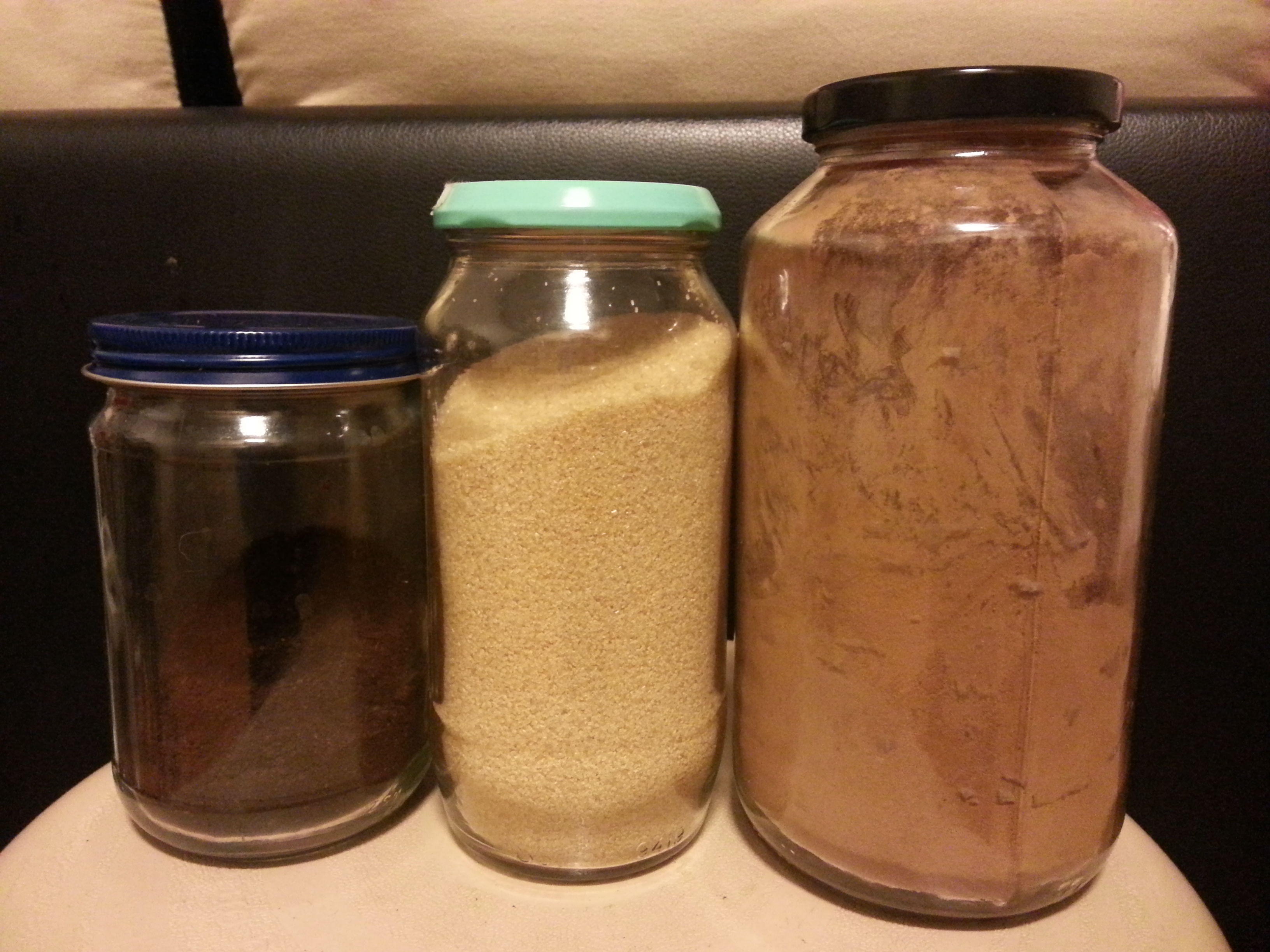
Wash and reuse glass jars after use. This way, you can store dry goods like coffee and sugar in glass rather than the original plastic.

Wash and reuse glass jars after use. This way, you can store dry goods like coffee and sugar in glass rather than the original plastic.

  • ASK FOR NO STRAW If you get an iced coffee or smoothie or even a soft drink with your meal out at a restaurant, then be sure to tell the server or barista that you do not need a straw. They are absolutely pointless utensils and cause a lot of waste. When I collect litter off of the beach a lot of the garbage is straws from drinks from the nearby cafes. Of course, be sure to bring your tumbler  along with you in your purse or bag to avoid using plastic cups and lids with that straw.
It doesn't take me long to collect straws on my morning walks,.

It doesn’t take me long to collect straws on my morning walks,.

  • NO PLASTIC WATER BOTTLES This is an obvious one, especially with my previous post on the usefulness of tumblers, which is hyperlinked just above, but I’ll say something quick as a reminder. Plastic bottled water is as unnecessary as a straw, you don’t need ’em. They have become modern-day conveniences and the norm for most, but change your habit by buying a home use water filter, purchasing a metal water bottle or tumbler to be filled with the filter or even straight out of the tap if it’s safe to do where you live.
    • Side note: Isn’t it sad that it is unsafe to drink from the tap! I was warned when I moved to Korea that it’s a big no-no. Most people create a lot of waste by buying large, plastic bottles of water.
  • CHANGE YOUR PLASTIC USE HABITS This is incorporated into all of the tips above in a way, yet deserves more explanation. In order for me to cut back on my plastics use, I have to make small decisions every day. For example, there is a bakery around the corner from me that I enjoy, but I will not allow myself to go in there unless I have a container on me to carry the bread away with. At first they looked at me funny, but after about the fourth time, they gave me a day old bread free of charge (or service as they say here) because they may have thought it was cute that I brought my own Tupperware.

Changing habits, whether it be stopping bad ones or starting good ones, takes time and effort and won’t happen overnight. It might seem, at first, like a big pain to have to cart around a metal water bottle with you everywhere you go and you might find yourself grimacing at the checkout line when you realize that you’ve left your reusable bags at home – AGAIN! If you keep at it and make little notes, place the bags near your car keys or always in your purse, then it will begin to be the way things are for you and you’ll be cutting your plastics use down bit by bit.

Sustainably Fill Your Closet – 6 Tips

In my last post I outlined the many negative effects of the fashion industry and how learning of them altered my shopping habits. In the past I used to shop somewhat regularly. It wasn’t often a matter of desperately needing an item, instead it was just something to do in my down time. I would check out sales and feel really excited and happy when I found what I thought was a good deal. Sometimes I would even buy something without even having any need for it, and maybe not even liking it much, therefore it might have found its way to the back of the closet, and then much later, to the thrift store.

Now I give so much more consideration to my shopping, and here’s how.

  1. Just get by: If you saw me out and about and paid attention to what I was wearing, then you would notice that my clothes are on heavy rotation. I have a relatively small amount of clothing that gets worn again and again. Specific to me, being a kindergarten ESL teacher and a yoga teacher, I am able to get away with going very casual, for example jeans and a baggy sweater. You might not have this sort of lifestyle and may find yourself requiring more variety in your wardrobe, if that’s the case, then there are ways to obtain them sustainably.
  2. Second-hand shopping: There’s still a way to have a shopping hobby, but without supporting the fashion industry, and that is to shop second-hand. Of course, second-hand shopping is more like finding a needle in a haystack at times, but when you do find that needle it feels like it’s the shiniest needle in all of the world since it probably took some time and luck to come across it. Here in Korea there are second-hand shops in most neighborhoods. This is my favorite one- The Beautiful Store. Another option would be consignment stores, which are costlier but guarantee less digging.

    Items donated for my upcoming clothing swap.

    Items donated for my upcoming clothing swap.

  3. Swap clothes with friends (and strangers): It’s common to lose interest in things that were bought long ago or that were not quite right but got purchased anyway. Instead of tossing thes things in a landfill, host or attend a clothing swap. That way you can feel satisfied with a cleaned out closet and then quickly fill it up with some fun new things.
  4. Read labels: Imagine if people read clothing tags the same way that they read nutrition labels and avoided toxic fabrics as much as they avoid GMO foods. It’s become a new habit of mine to check out where things are made and what they’re made of. Shop around and choose the more sustainable option of what you’re buying. Recently I have done this when shopping for headphones and yoga pants and feel prouder of my things even if nobody knows that they’re a bit more sustainable. Choosing something that’s better for you and for the environment can give a small sense of pride.
  5. Shop locally: If possible buy items made in your area, or at least country. That’s not very common
    in the US anymore, but can be done, American Apparel comes to mind. You could also shop on Etsy for up-cycled clothes. Here in Korea it’s much easier to do, a lot of small shops sell Made in Korea.

    Merino wool, one of my favorites.

    Merino wool, one of my favorites.

  6. Buy Natural Materials: Choosing a wool knit over acrylic will definitely cost more, unless found at a thrift store, but you get what you pay for. Spending more on high quality will mean that it will actually feel nicer to the touch (and you will be wearing it on your skin,) it will look nicer, and last longer. Other natural materials to keep an eye out for are organic cottons, silk, hemp, leather and suede.

Conscious consumerism takes more time and effort, but after practice it will develop into unconscious-concious consumerism, if that makes any sense. You will begin to be more aware of the things that you bring home with you and where and how they came to be. It really is similar to watching the breath in yoga, at first it’s not easy to give the breath full attention, but after hours and years of practice, it just begins to be the new normal. Likewise, choosing to shop more sustainably can soon become your new normal, too.
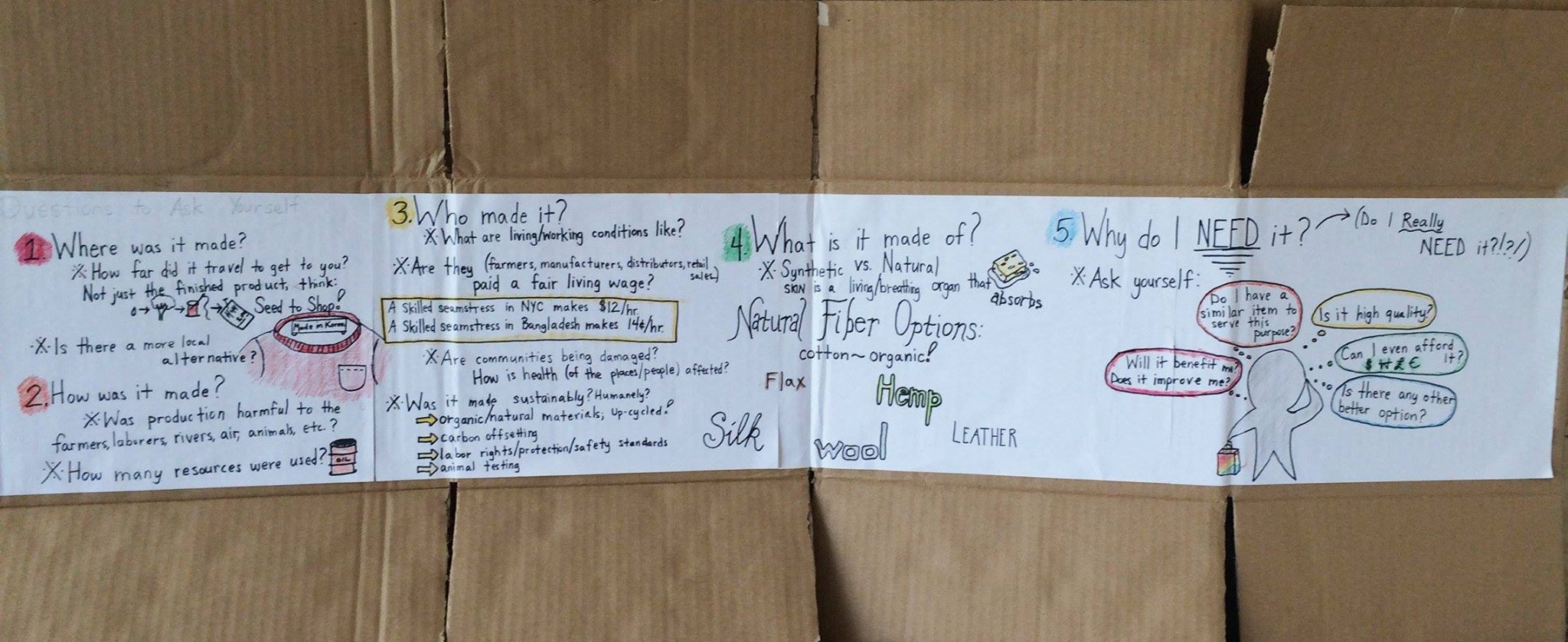
A handmade poster made by yours truly for my first swap in which I gave a short talk about shopping habits.

A handmade poster made by yours truly for my first swap in which I gave a short talk about shopping habits.

Yoga off the Mat – A Mindful Closet

Yoga is much more than a physical practice. The mindfulness that is practiced during yoga starts to happen in day-to-day situations such as more healthful eating, calming the mind in times of stress, and even in the way we consume. A few years ago I became more aware of the fashion industry and have since then drastically changed my consuming habits.

We don’t often think that long about a purchase anymore. In terms of clothes, if it’s on sale, fits, and looks cute, then in the cart it goes. It could be useful at some point, right? But often times that $5.00 top gets tossed into an overcroweded closet never to be seen again. This is a common happening for a lot of (especially) women in our culture. Advertisements, Hollywood, and popular culture throw messages at us all over the place to buy more, more, more. But where are all of these clothes coming from? 

The line of production of a piece of clothing is a lot longer than we think. First, the fabric starts out as a raw material. Let’s look at that $5.00 top and assume that it’s a T-shirt. If it’s cotton then it would have started out as a seed. According to the research done by Planet Money of NPR, who followed a T-shirt throughout its entire life-cycle, 90% of all cotton seeds are GMO. Then there’s the resources needed to grow that little seed. A lot of water is needed for cotton and that water sprays off the pesticides and fertilizers that are used on the cotton, seeping into the water basin (buying organic cotton is an idea.) So already when we take a closer look at just the cotton that will eventually become a cheap T-shirt, there are quite a lot of negative effects. This is assuming that the T-shirt is 100% cotton, what if it was a blend, say made with 5% spandex to give it to some stretch. Spandex is a synthetic fabric made using more (chemical) resources in production. I attempted to do basic research into this and was scared off by all of the chemical jargon that I couldn’t even pronounce (macroglycol and diisocyanate to name just two.) Test your patience with this read.

After the cotton is harvested it gets shipped to another location, most likely in another country, to be turned into fabric. This process might include such steps as washing the cotton, spinning it into yarn, turning that yarn into fabric and dying it. The dyes are not often natural anymore and run into the local bodies of water. You can google images of rivers running all colors of the rainbow in manufacturing countries. Then the fabric gets cut and sewn into T-shirts. Most of this production no longer happens in the developed world. Thanks to globalization and outsourcing the job gets done by populations in poverty who will do it for much less.

Most clothing tags read: Vietnam, Turkey, China, or Bangladesh, just to name a few. In these countries the laborers can be paid much less and the working and environmental standards are much lower or non-existent. Chemicals and pollutants can be harmful to their health and do damage to the local environment, too. Again, according to the work done by Planet Money, some workers in Bangladesh work six days a week and make about $68/month. Here’s a link to a video series about the process made by the podcast.

Wages may be a low cost to the producers, but the long-term and often unthought-of cost of pollution and dangers to health is often overlooked. In April of 2013 there was a massive and devastating building collapse in a Bangladeshi factory. The multi-story building housed hundreds of employees put to work to produce clothing items for around 30 big names in the industry. The building was not well maintained which probably caused the collapse and took the lives of around 1,000 people. All working to produce cheap fashion for us in developed nations. When given thought, it makes that $5.00 T-shirt seem a little more expensive in terms of hidden costs- some even in human lives.

Possibly made in a similar factory as that which collapsed.

Possibly made in a similar factory as that which collapsed.

That tragic incident was the turning point for me. The event was framed by author Elizabeth Cline, in an interview on NPR’s Fresh Air. In the interview the author details the problems in the industry that she discovered through intense field research in countries like Bangladesh. 

After listening to the interview I began to realize that there was really no need for me to shop as much anymore. My closet had been full, and bursting, for most of my adult life. Shopping to me was a hobby, a way to spend an afternoon. Yes, I got that rush when I scored a great deal and even bragged about it to my sister, but that little rush and hobby had to be altered out of respect for the negative effects it had in other parts of the world. And really it wasn’t that hard to do.

Escaping from the pull towards trends and fast fashion may not be easy at first, it requires a change of behavior as well as the mindset to be happy with what you have. There are certainly days when I see something in an ad and think to myself, how cute and nice it looks and wouldn’t it be great to have? But I quickly find my way back to the core thought that, on second thought- No, I don’t NEED it, I can happily do without.

Best of luck to you on this journey of lifestyle change for the better. More blog posts in the future on specific tips and experiences.