Top 4 Yoga Study Tips

So much more than being a yoga teacher, I am a yoga student. There is so much to learn about yoga, and you don’t have to be a yoga teacher to delve in. There are thousands of years of yogic history, philosophy and knowledge that cannot all be learned in any YTTC.

As a teacher, I strive to learn more and more about the human body and it’s movements and interweaving, working systems. This means studying human anatomy. Muscles, bones, and the like.

On top of the physical aspect of yoga there is a whole new language to learn – Sanskrit.

The list could go on, so to aid your study of yoga, here are four of my top yoga resources that I use to increase my understanding of yoga.

  • TIP ONE – ANATOMY COLORING BOOK – My trainer, Kimberly Waugh of Radiant Life Yoga School, had recommended that I get a coloring anatomy book during my YTTC exit interview back in 2013 when I asked her for advice on how to self-study anatomy. I don’t know why I didn’t take her advice right away, instead I only just recently purchased my coloring book and instantly fell in love. It’s stress reducing and educational at the same time! Grab your own and get to coloring… just one tip – get the big box of coloring pencils, minimum 24 pack.
img_20151007_190442.jpg

Netter’s Anatomy Coloring Book, 2nd Ed

  • TIP TWO – LEARN THROUGH YOUR EARS – I. Love. Podcasts. Many of my conversations begin like this, “I was listening to this podcast about (fill in the blank) and …” I subscribe to an array of them and am open to expanding my list. My favorite all time yoga podcast though is Yoga Body – The Yoga Talk Show by Lucas Rockwood. Episodes include interesting interviewees not only from the yoga world but from all areas of the health and wellness industries. Every show also includes a questions and answers segment with Lucas and a Nutritional Tip of the Week. Get this app.

ybn2


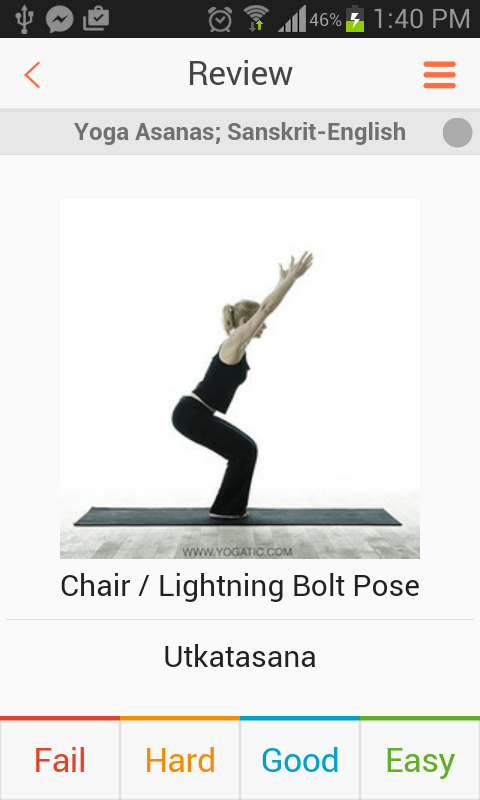
  • TIP THREE – FLASH CARDS – Be traditional and make your own, or try this flash cards app: AnkiApp. This app is new to me but I’ve already studied with it quite a lot. You search topics, choose a deck you like, download it to your app and start flipping. They even have flash cards specific to yoga.
screenshot_2015-12-20-13-40-43.png

AnkiApp, English/Sanskrit Pose Names

  • TIP FOUR – CREATE A STUDY GROUP – Ask fellow yoga students and/or teachers to study with you. Share resources and help commit each other to study dates and times. Claim a large table at a cafe, spread it all, sip some herbal tea and study.

img_20151121_125110.jpg

Changing your perspective of yoga from just a practice to a study of yoga will deepen your experience. Once you open that portal you’ll realize that there’s so much to learn and with that learning your practice will evolve.


*If your studying is taking you to a retreat or teacher training, then check out one of my first blog posts full of how to start the process of choosing the right YTTC for you.

Hygge Yoga

Hygge (hooga) is popping up everywhere this winter season, but if you’re looking at that mashup of consonants with a furrowed brow let me explain it a bit. The word is Danish and expresses an idea of warm & cozy during the winter months. Take a moment, close your eyes, and think of what makes you feel warm & cozy on a dark, cold winter night. Candles? Christmas lights? Hot chocolate? Reading in sweatpants under a blanket? That’s hygge.

As someone who generally dislikes winter and would much rather be on a hot beach than on the slopes I received the idea of hygge with big open arms. I’m comfortable self diagnosing that I suffer slightly from SAD – seasonally affective disorder, or in my case – being grumpy and mopey in the winter.  So when I recently learned of the idea of hygge, I embraced it completely and began to prominently incorporate it into my yoga classes.

Here’s how to have a fantastically hygge yoga:

  • small talk – It can be common to go to a yoga class as a student and not speak with anyone the majority of the time that you’re there. A major part of warding off the winter blues is to create a sense of community, so make an effort to talk with some fellow students or the teacher. Learn people’s names and small talk for a while. Chances are you’ll be seeing the same people at the next class, so there’s potential for building a friendship. If you primarily have a home practice, invite a friend over to practice with you and have some tea afterwards.
  • blanket bundle – Starting class seated cross-legged or in Sukasana is the general way I do things. From here I chat with students, give my intention, and bring them into their breath. To have a hygge experience, suggest to students that they wrap a blanket around their shoulders. Dim the lights or have only soft lighting on for an added touch.
  • vinyasa flow – Yin or restorative yoga might come to mind when thinking about a winter yoga class, and they have their own place, but to feel heated and warm from the inside out, it’s important to flow. Warming up and continuing to vinyasa flow will keep your muscles warm and open and allow you to go to your deepest edge in your practice. The body heat of the class will warm the room up and have everyone feeling hygge in no time.

Flow

  • slow it down – During the cool down of your practice light candles or dim the lights. If you like to practice with music, make sure that your playlist includes some mellow, sleepier tunes to put on during cool down and Savasana. Be careful if practicing alone, opt for Christmas lights over a candle if there’s a chance you might accidentally fall asleep.

If in Busan, come to my yoga classes to delight in the experience of hygge yoga! Class information can be found in the events section of the Busan Yoga & Meditation page.

Yoga Warm Up for Bouldering & Climbing

Bouldering is a challenging activity. It requires openness, strength, and concentration. Bouldering differs from climbing in that no ropes or harnesses are required, and because of that climbers often do more horizontal than vertical courses (uh-hem, especially if they have a fear of heights.) Yoga is a perfect complement to bouldering and climbing as it opens the joints, stretches out the muscles, builds strength, and calms the mind.

Here are some yoga poses to incorporate into your next bouldering or climbing session.

Warm Up Simple Sun Salutations will get those hamstrings and glutes warm. If you’re not familiar with Sun Salutations then do your own little warm up, if you’re ready to get on the wall quickly, then be mindful not to go beyond your limit in these warm up stretches.

SHOULDERS You want to be sure to warm up your shoulders before a shoulder intense activity like bouldering, this is especially true if you have tight or previously injured shoulders (I’m looking at you, dislocators!) While doing Sun Salutes, focus on drawing your shoulder blades down and in towards each other as you raise your hands overhead. Here are more shoulder openers:

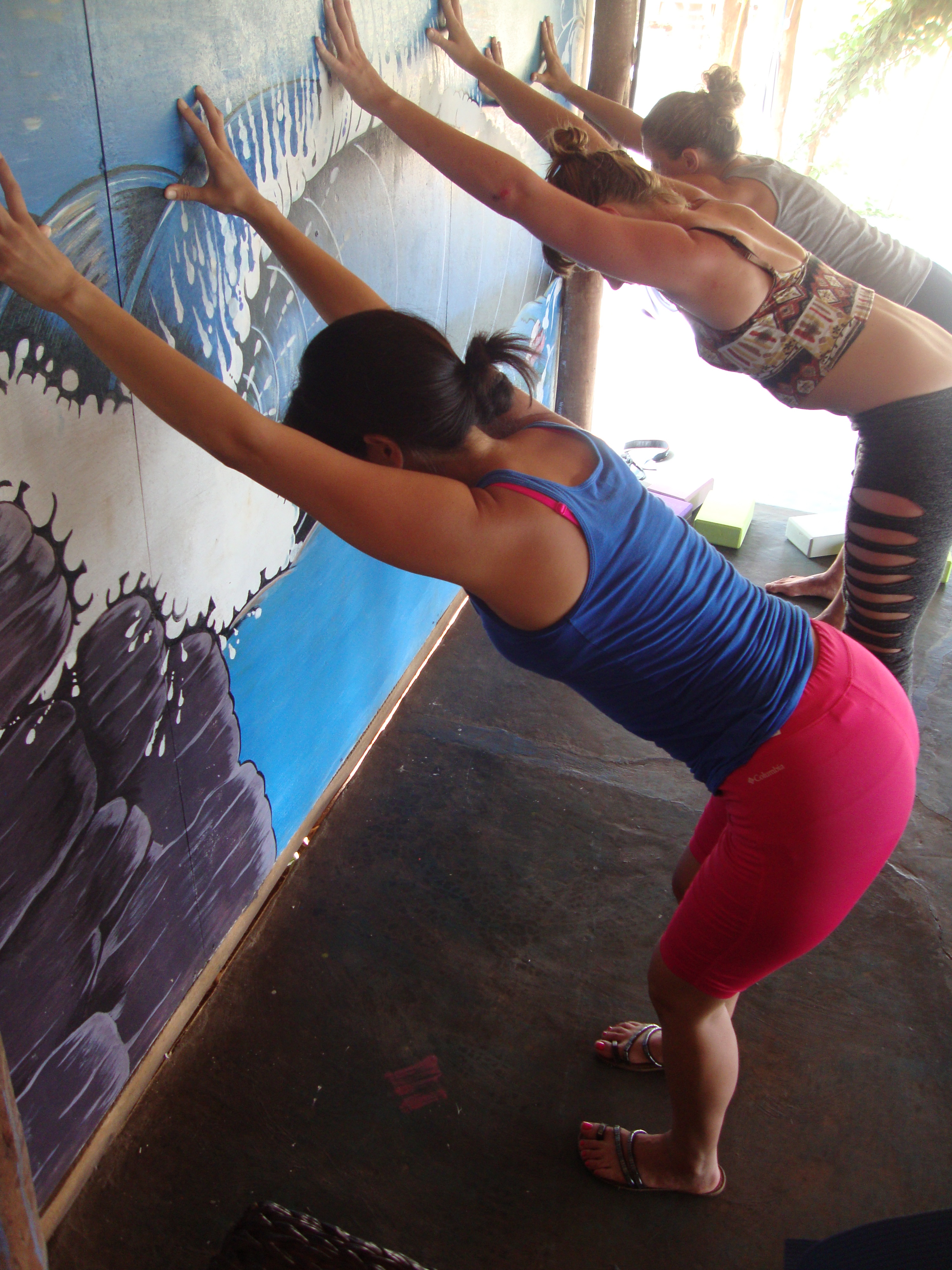
  • Down Dog at the Wall With feet hip-distance and a slight bend in your knees, raise your arms overhead and place the palms flat on the wall. As you exhale, sit back like your going to sit into a chair, but don’t go so far that your hands come off the wall – keep contact. Go until your hamstrings say to stop and focus on pulling your shoulder blades down and in towards the middle of the back. Hold and breathe for five breaths or longer before inhaling up.
Downdog at the wall

Downdog at the wall

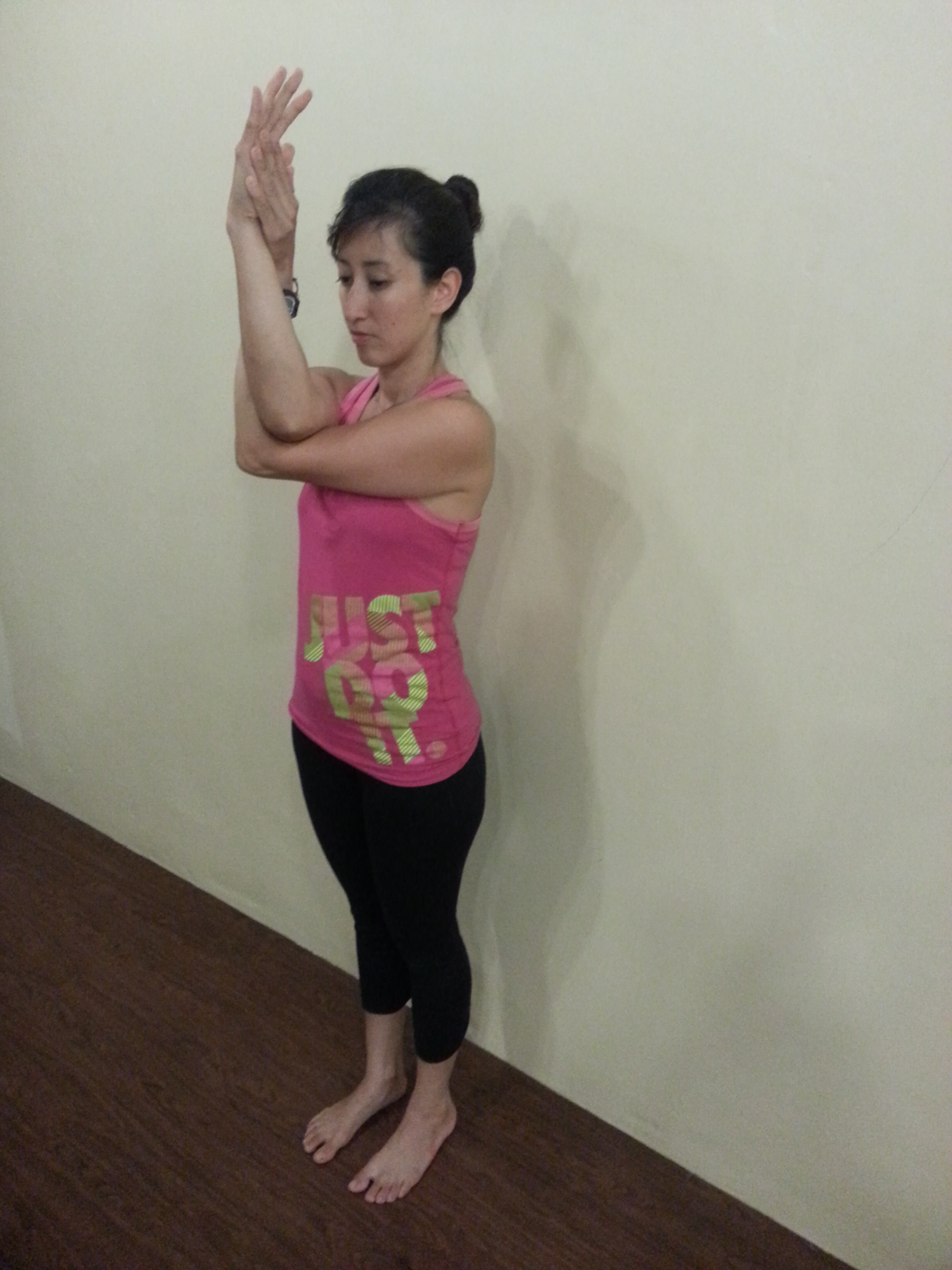
  • Garudasana/Eagle Arms  Start with the arms, bring them to a T, palms facing down. Exhale and cross the right arm over left. Bend at the elbows and touch either back of the hands or wrap until the palms touch. Hold and breathe deeply, release on an inhale and switch the arm that was on top.

Eagle Arms

  • Gomukasana Arms While standing with feet hip-distance, inhale the right arm next to the right ear, palm facing forwards, exhale and bend at the elbow so that the right palm slides down the back. The left arm stays by the left leg, bend at the left elbow, palm facing back behind you, and as much as you can bring the two hands to touch (use a towel or hold your t-shirt if need be.) Hold and breathe five breaths. Inhale release, and switch sides.

HIPS Often times while bouldering you will take a stance which requires really open inner-hips. The knee and toes will face away from the core as the front body is almost totally flush flat against the wall. The outer hips and glutes help push off from the legs to find the next hold. Warm up with these inner-hip openers:

  • Utthan Pristhasana/Lizard Pose Come to a low lunge with the front foot to the outside of both hands. Point the front foot and knee at a 45 degree angle, bend deep into the back hip, bringing it forward to get a stretch in the psoas. Hug the front knee in towards the front shoulder to get into the inner hip.To make the pose more intense, lower down onto your forearms, bent at the elbows. Hold for a few breaths and switch sides. To make the pose more intense, lower down onto your forearms, bent at the elbows.

Lizard

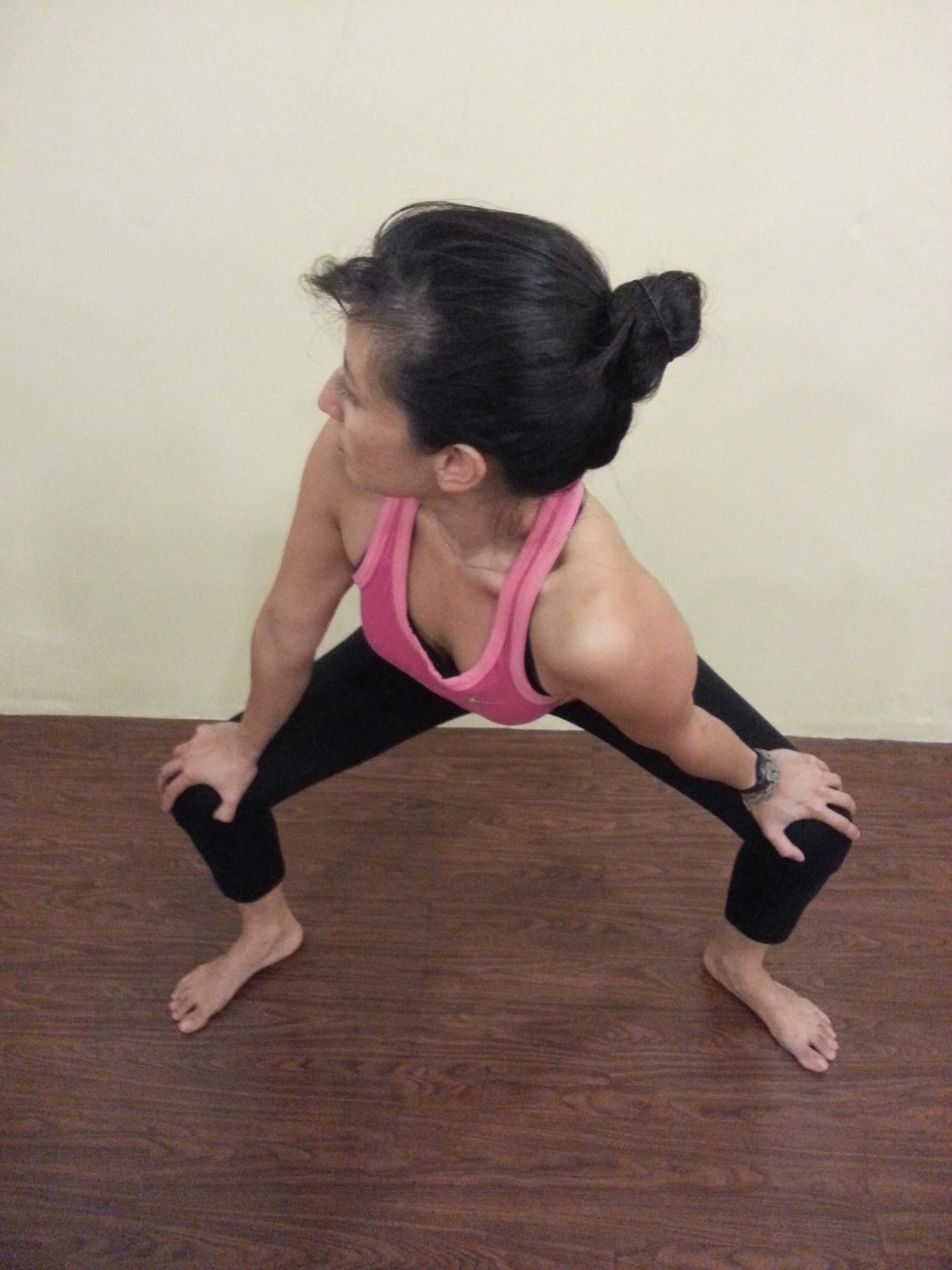
  • Utkata Konasna/Goddess Pose Stand with feet wider than hip-distance, knees and toes point out at a slight angle. Bend at the knees until you feel a good burn in your quads or glutes. Keep your torso upright, shoulders over hips, hold and breathe. Straighten knees and rest. Then go into again and place the hands on the top of the thighs. On an exhale, push into your right thigh with your right hand as you gently gaze over your left shoulder. Switch sides after holding five breaths. 

Goddess Pose

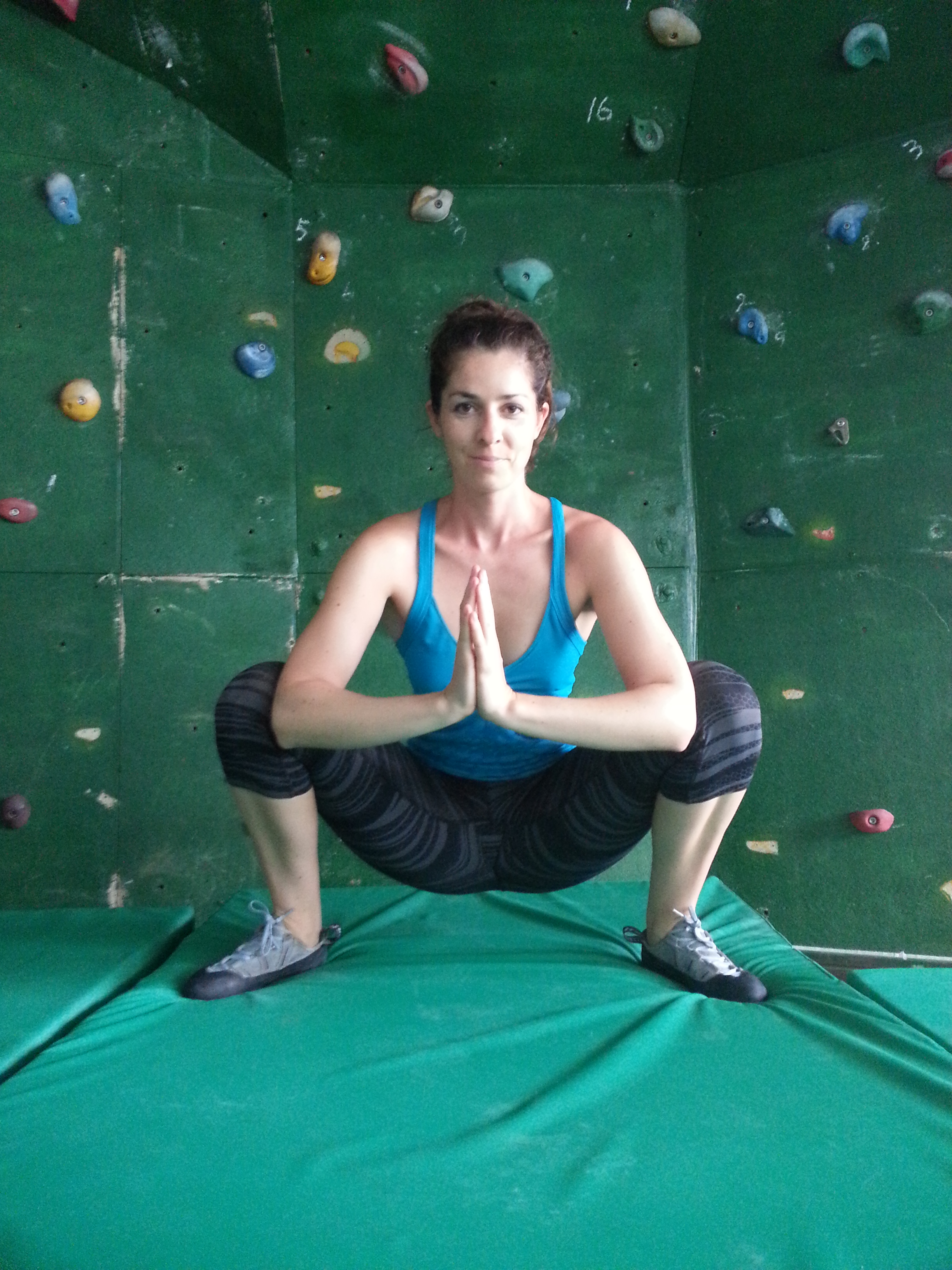
  • Malasana/Deep Squat Stay with your feet pointing out and knees following in the same direction just as you just did in goddess pose. Bend at the knees and allow your hips to sink towards the floor. If this isn’t possible for you, then lower only as low as is possible (meaning your bum might be in the air a bit.) Place your elbows inside your knees and press into them to open up the inner-hips. Palms come to prayer. Be aware of your spine and try to keep it erect as opposed to rounding. Stay and hold, straighten the legs to release.

Malasana

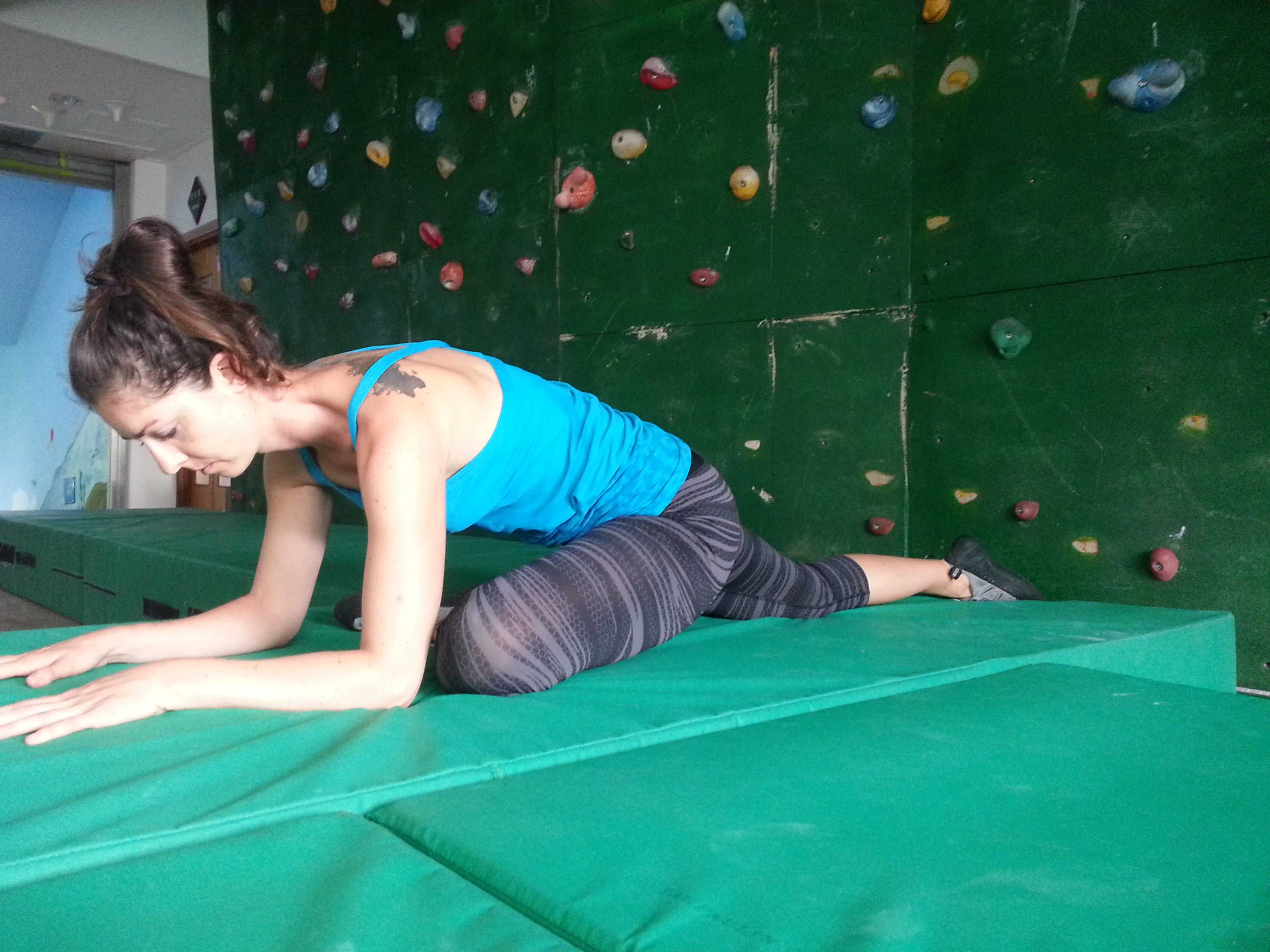
  • Kapotasona/Pigeon Prep Bring your right knee to your right wrist, right foot to left wrist. Left leg shoots straight back behind you on the floor. Stay upright with weight in your hands, or forward fold, being sure there is no pain in the right knee. Switch sides.

Pigeon

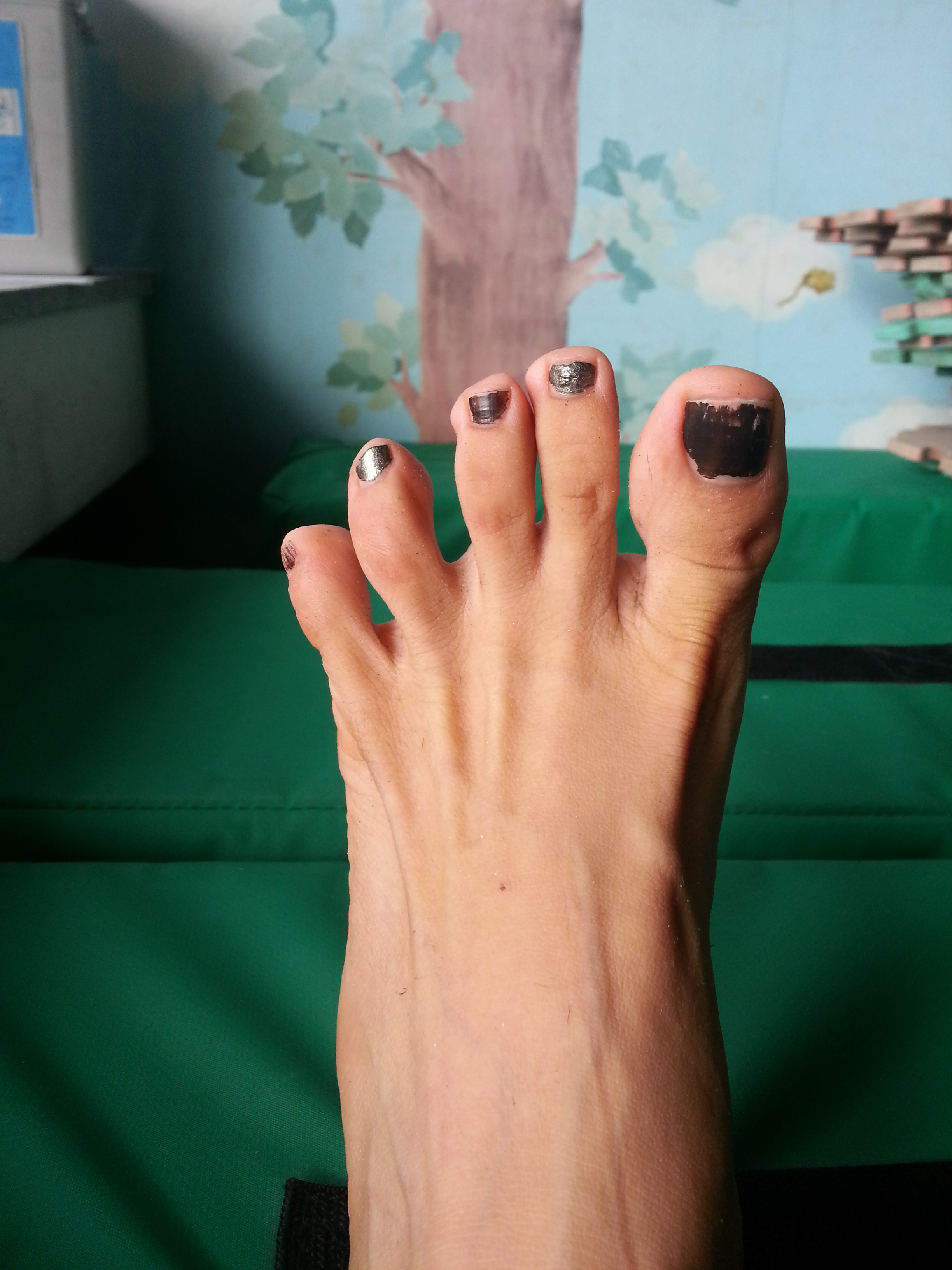
TOES Climbing shoes are small and sometimes pinch the toes together to enable more control in standing and pushing off of placements or juts of rock. Crimping toes together is very anti-yoga and doesn’t feel nice, so as soon as you pull your feet out of your climbing shoes I suggest giving the toes a big stretch. You can reach down and do this manually, sticking one of your fingers in between each toe and giving it a wiggle, or if you have the bodily awareness and control, you can simply find yogi toes.

Yogi Toes

Enjoy your climbing or boulder session with openness and awareness!

Autumn Equinox Event – Busan 2015

A few weeks ago I was fortunate enough to be part of another seasonal, community event. Our local Busan community really came together for the Autumn Equinox with organizers working together from the cycle, yoga, and food communities, all for the local foreign involved environmental group – BCA, Busan Climate Action.

An already active community member and activist, Sunny, has been organizing Critical Mass rides in Busan to bring awareness to cycle safety on the road. I know first hand how dangerous it is to cycle here as a commuting cyclist due to inconsistent cycle paths and drivers who don’t always accept or appreciate me being on “their road.” It’s true that Busan has great cycle paths along rivers and the coast, but the city is lacking in areas of the inner city and less touristy neighborhoods. Critical Mass brings together other concerned cyclists whom ride the streets of a certain route, as a big community, to feel safe from drivers and to make those drivers aware that they share the road (whether they like it or not) with bicycles. Critical Mass is held most third Sundays of the months, so it worked out perfectly to combine the yoga equinox event with the cycle ride.

The route ended early in Gwangan so that I could lead an hour-long yoga class. Many regular students joined the cyclists and we practiced a root chakra class, to ground ourselves in the changing times of the seasons. After the yoga class there was some playtime of acro and then we made our way towards a rooftop restaurant for a vegan-family-style dinner.

Donations from the events went towards the upcoming BCA Film Festival. This is the second film festival held by the group and will be on November 6 & 7th at the Busan Community Media Center. The film festival aspires to make the community aware of the dangers of our changing climate, causes of global warming, and changes that can be made to decrease an individuals carbon footprint.

I had a wonderful time being apart of another seasonal event and look forward to participating  again in winter when that comes around. How have you been recognizing the changing of the seasons?

Root Chakra and the Autumnal Equinox

Today, September 23, 2015 is the Autumn Equinox. It marks one of two days of the year when the length of day and night are about equal. It also marks the end of summer and beginning of autumn here in the northern hemisphere.

With the theme of equality in mind, it is a good time to reflect on how to find more balance in your life. For our local Busan event which happened on Sunday the 20th, I taught a special root chakra class to find balance in the first chakra – muladhara chakra. I felt inspired by the colors of the changing leaves focusing on the color red.

Root chakra is the first chakra and is characterized by the element of earth, and represents security, its color is red. Living abroad as expats, it can be common to have feelings of uncertainty about the next step. Most of us here in Korea come on a short-one-year visa that is either extended or left behind for travel or settlement elsewhere. It’s figuring out which choice to make that can leave us feeling uncertain about the future, which can equate to an imbalance in the root chakra. No matter what your situation is, times of feeling ungrounded are sure to arise here and there.

Yoga poses to help ground you are poses that are quite simply near to the ground – seated postures. Muladhara chakra is located at the base of the pelvic floor, focusing on that area during your practice is helpful, as well as grounding through the feet in standing poses. Here are a few poses to practice if you feel you need to dig your roots in a bit deeper.

  • Sukhasana Start seated in a simple cross-legged position. Shift around until you find a comfortable position. If you have tight hips, then lift your sit bones up onto something to give yourself a little more height, such as a yoga block, blanket, or pillow. However, sitting directly on the floor will give you a better sense of grounding. Use your hands to feel heavier on the mat, with the thumbs inside and just below the hip bones, apply pressure with the palms to the top of the thigh to push yourself deeper into the mat. Close your eyes and breathe.

Sukhasana

  • Vrksasana Ok, so this one’s a standing balancing pose, but it makes total sense to do when focusing on the root chakra, I mean of course you have to do Tree Pose when balancing the root chakra! Stand firmly in your standing foot and raise your other foot with control to a comfortable position for you. Keep rooting through the standing foot as you allow your torso to lift, if it feels good, lift your arms towards the sky.
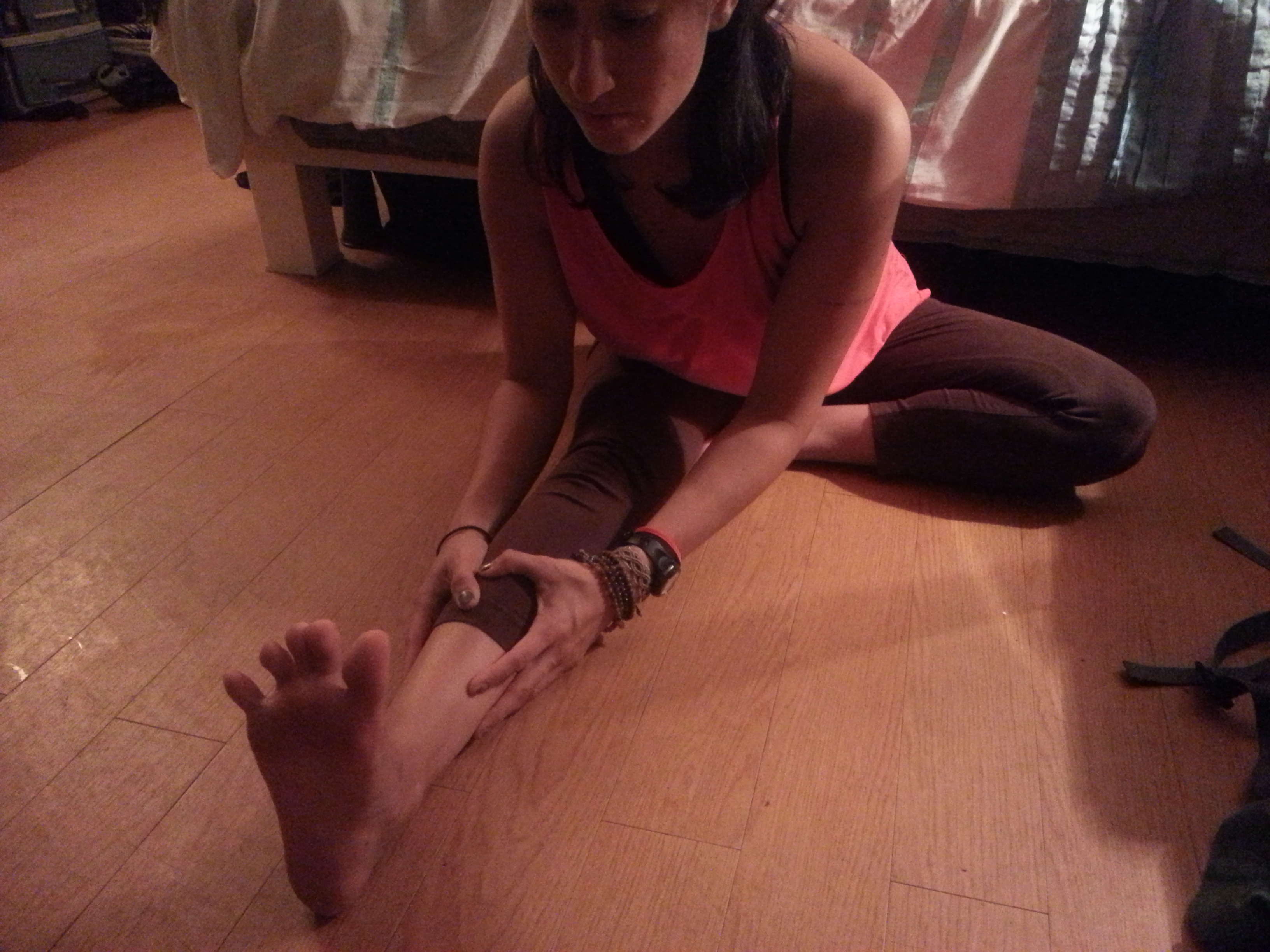
  • Janu Sirsasana After performing a standing sequence to warm up, or a few sun salutations, bring yourself back to the floor for more seated postures. Just as the temperature drops with the season change, so too might your yoga practice, moving from more of a yang to a yin. Sit on the mat with both legs extended long in front of you, draw your right foot into the left inner thigh and let the right knee fall over to the right. Use your finger tips to lift your chest, then on an exhale begin to fold over your extended left leg. Place your hands where you can reach (it is totally not necessary to hold the foot) and breathe as you let the head relax. Come up on an inhale and perform on the second side for balance.

Janusirsasana

  • Upavisthakonasana From the last pose, splay your legs wide out in front of you. Flex through your heels to keep your leg muscles engaged. Be sure that the toes and knees always point up to the sky together. If your hamstrings are tight, you might find relief by placing two small, rolled towels or blankets under each knee. Again, find length through the torso by lifting into your fingertips behind you. Stay there, while feeling completely supported and grounded in the mat, or begin to fold forward. Stay on the hands, go to the forearms, or release onto your belly. Stay and breathe. Come up slowly on an inhalation when ready.

Seated wide leg forward fold

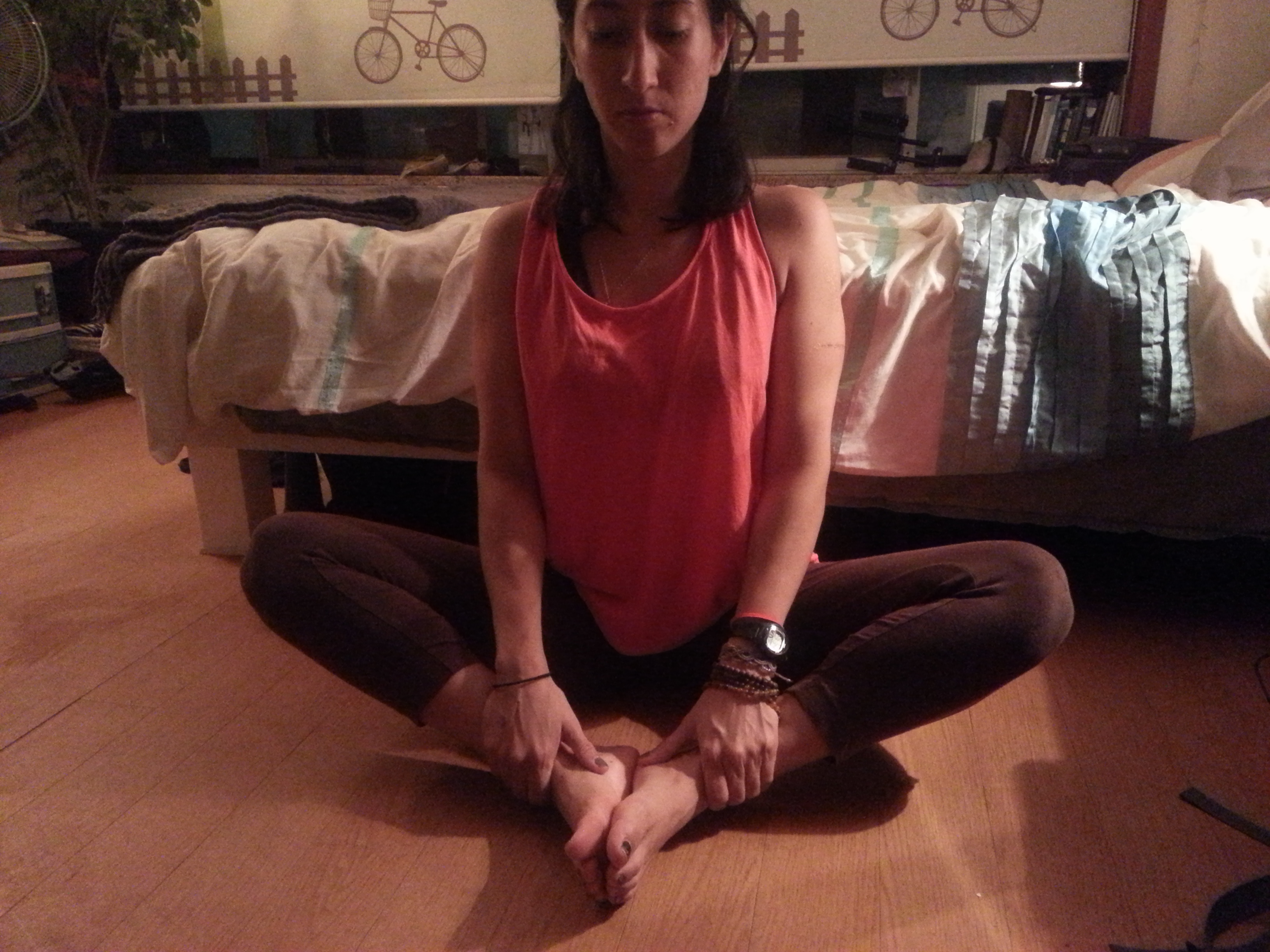
  • Baddha Konasana From the wide leg fold, pull the soles of your feet together for bound angle pose. Let your knees fall apart. With your feet away from you in a diamond shape (tight hips) or heels drawn in close to the body (open hips,) find your open chest and stay or fold. Breathe into the pose focusing on the pelvic floor.

Bound angle pose

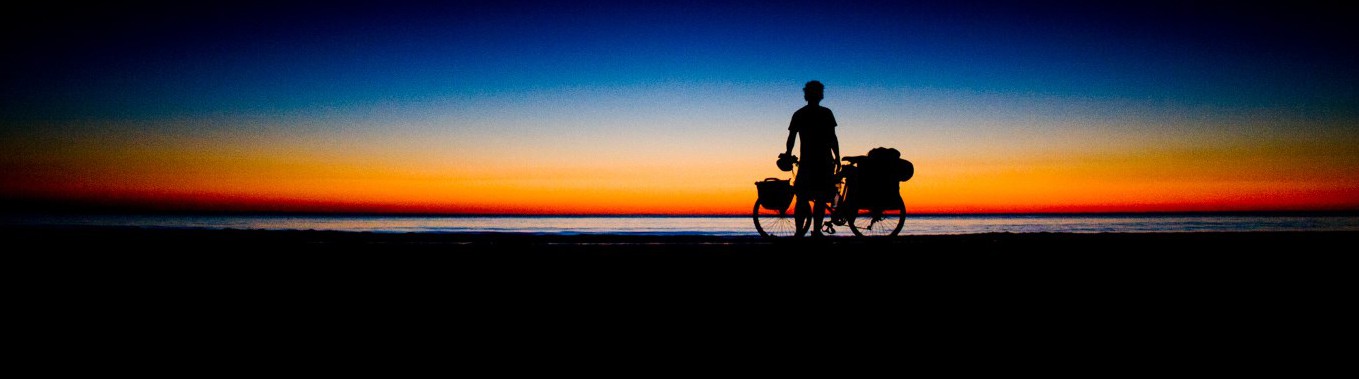
My final thought on the root chakra is to get into nature. The element of earth is associated with the root chakra, so spending more time in nature can help you rebalance. After your yoga practice you might choose to take a short meditation focusing on the color red, a strong tree rooted securely in the ground, or with eyes closed envision a glowing red sunset or the changing colored leaves, as I asked my students to do in Savasana at the recent Autumn Equinox Event.

Warm colors of sunset

Ride the Wind – Therapeutic Flying

This past weekend I performed with my Kaizen Acro Yoga Crew at a university festival.  We made the five hour bus trip up to Seoul to perform our two, four minute songs which we rehearsed for weeks prior. Indeed it was a lot of work, but it was well worth it.

For this performance we had a little less time to prepare than we did for the first one, maybe three or four weeks to create, choreograph, and rehearse which meant that we practiced a lot. Our high-flying group met 4-5 times a week and practiced for 2-4 hours each time. I was bruised up and my muscles have been achy, but in that way that I love, the rewarding soreness that tells me that I’ve been working hard.

No pain, no gain.

No pain, no gain.

But with everything in yoga a balance needs to be found. My well trained body was yearning for some relaxation and rest, which is why I was allowing myself frequent naps these past few weeks, a luxury that doesn’t usually make it into my schedule. I knew that my body needed to recuperate, so I hit the pillow for 10-20 minutes before training.

Last week on a Wednesday was one of those long training nights, we met at 6:30 to warm up, ran our routines over and over again, tweaking as we went, and then it was class time. From 8-10pm was the Big Birds class at Kaizen, the studio run by my very good friends Mindy and Simon. The class is usually really intense and forces me to push myself to my physical limits. Last week’s class however, was a little more on the chill side which was exactly what my body had been desiring.

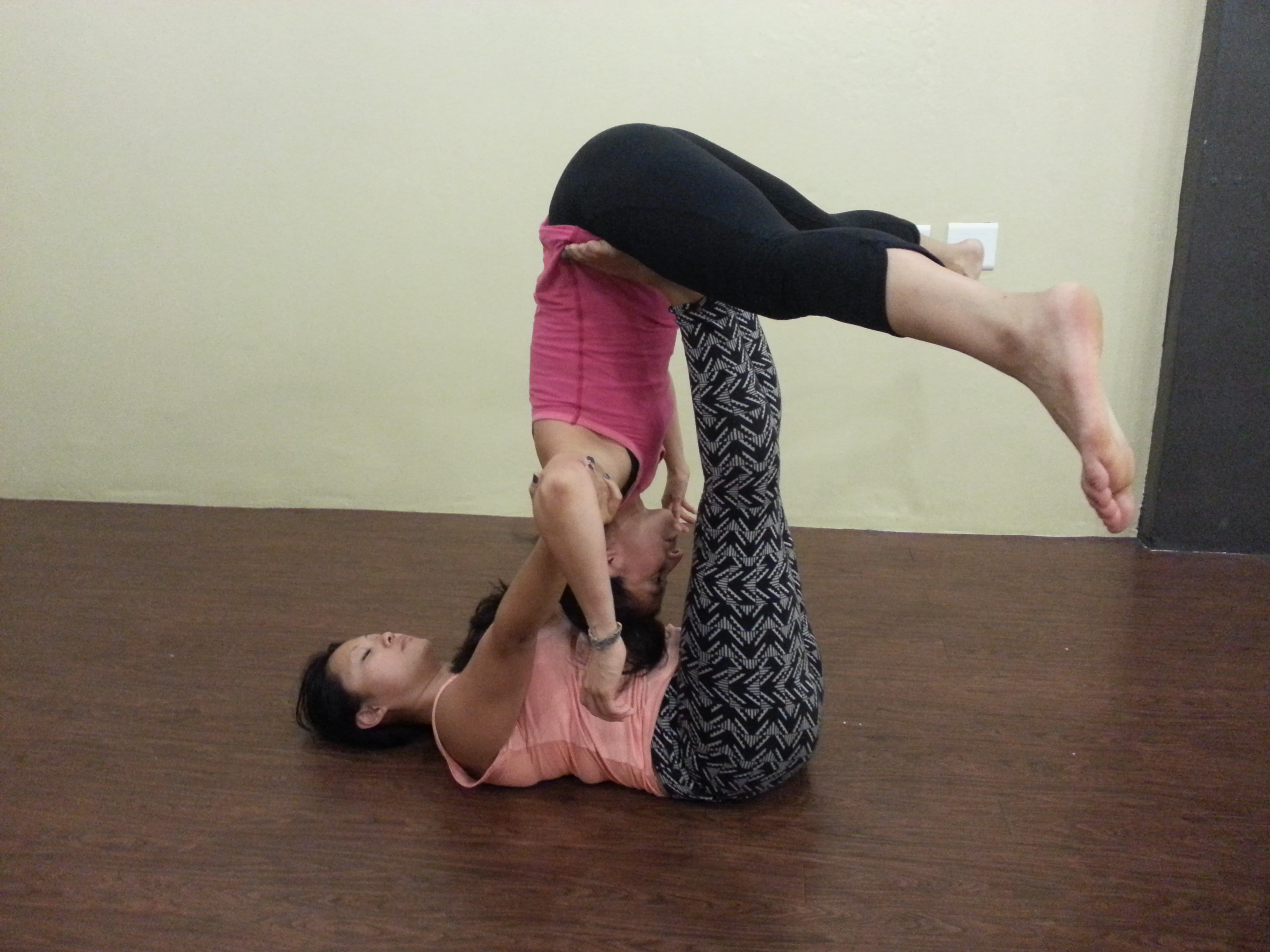
In the middle of class Mindy asked us to switch it up a bit, so instead of drilling press ups (her new favorite activity,) she had us partner up and (thank the lord!) do therapeutic flying. You can think of therapeutic flying as receiving a massage in the air by your acro partner. The base is the masseuse and the flyer is the very passive, limp, receiver of the massage. It is the yin to the yang of the high powered washing machines in acro yoga.

At last week’s class we were instructed to focus on the shoulders, so my partner put me in folded leaf and started massaging my traps and neck. Folded LeafIt.was.wonderful! I also played masseuse and based her in folded leaf. Having those 10 minutes of therapeutics was so very welcomed by my tired body; I wasn’t actually sure that I was going to be able to push through an intense traditional acro class, and was pleasantly surprised when class ended up being gentler than normal. Also, I slept so well that night, which isn’t the norm; usually after finishing class at 10 and cycling home from the studio, I am up and wired for a few hours, finding it difficult to quite my body and mind for bed, but last night I had no problem sleeping – maybe partially due to the therapeutics.

If you get the chance to attend a class or workshop which includes therapeutic flying, then I suggest going. It can be done with a stranger or friend, or it can be practiced with a partner to create more intimacy and give you a skill that will keep on giving.


Acro yoga classes can be found here in Busan at Kaizen. Classes are offered for beginners, intermediate, and advanced students. Every Friday there is an acro jam, free for all to attend and play. Check their website for times and pricing.
Three Ingredient DIY Yoga Mat Cleaner

A friend of my shared this “recipe” for a DIY yoga mat cleaner that I’ve been making and using for a few years now. It’s a really easy mix to make and is made up of just three ingredients: water, vinegar, and peppermint essential oil. The vinegar acts as the cleaning agent, the water is to water it down and makes up the bulk of the mix, and the peppermint oil is added to make it smell a bit nicer. Here’s how to make it.

  1. Find an empty spray bottle. Buy one at a dollar store or box store or be green and reuse an old one that’s contents have recently been used up. Be sure to properly wash it if it’s been used before.
  2. Fill the bottle 1/4 of the way with your choice of vinegar. I suggest using either an unscented, mild vinegar like simple white vinegar, or try using a lemon vinegar which gives an extra clean smell.
  3. Fill the remainder 3/4 of the bottle with water.
  4. Add  5-10 drops of your choice of essential oil. I use peppermint because I like the combo of lemon and mint. The two scents together have a crisp, clean smell.
  5. Put the top of the spray bottle in place, secure tightly, and swirl the bottle to combine all ingredients together. It’s ready!

This is a great little spray to have around. It’s nontoxic, easy to make, and very versatile. It works on most yoga mats and is even safe for my pure rubber travel mat. Off the mat, I use the spray as a general cleaning spray in both my kitchen and bathroom. It works great on mirrors; which brings me to another green tip, to clean mirrors: spray your DIY mat cleaner and wipe clean with old newspapers. It leaves mirrors streak free and is a way to give a second life to the sports section.

I hope you enjoy this easy peasy mat cleaner – Namaste!

Busan Beach Yoga

This is my third summer leading yoga on the boardwalk at Busan’s Gwangali beach and each year gets better and better. Sure, our beach may not be a white sandy one with palm trees galore; it’s more of the man-made type with neon lights, but there is still a lot of beauty to be seen during the practice. Here are a few specifics to Busan’s beach yoga scene that I’ve observed in the past three years.

  • Boardwalk vs. Sand – It is my experience that practicing on the boardwalk is more beneficial than on the sand. One reason is pretty obvious – keep those grains of sand off of you. But if you have no problem being one with nature and getting sand in all your nooks’n’crannies, then by all means, give it a go! The second reason, and more importantly, is that the boardwalk provides a flat, even surface that is needed for balancing poses. Actually, in any and all circumstances, I would suggest practicing yoga on a flat and even surface because it allows for the best support for the wrists and ankles. It may seem idyllic to plop down into Downard Facing Dog on the sand, but you’ll be brushing the sand away endlessly and you might even be straining your wrists.

Boardwalk Yoga

  • Accept Your Performance – Practicing yoga in public is not a time for you to feel as if you’re being judged, really at no time should you feel as if you’re being judged, other students are more concerned about their own practice than seeing what’s going on over on your mat. There is no judgement in my classes, but for sure in Busan at beach yoga, there are pedestrian observers. Here is why: There is a different sense (or lack of?) of personal space here than we are used to in many of our home countries, people brush up right next to you, stand uncomfortably close in lines, on buses, and almost everywhere. Practicing yoga is no exception, people will stop and watch, try the poses with you, and many even take out their phones and take pictures. At first I tried to protect my students’ privacy by shooing them away, but I have come to accept it now as a major cultural difference. It’s not harmful, just different. As a student practicing on Gwangan’s boardwalk, I hope that you can remember that by practicing in a public space you may be subject to what we in many other countries consider an invasion of privacy, but try to see it from the eyes of the country that you are in and know that things are just different here. People are curious. And as for taking photos of a group of strangers practicing yoga, well their kakao story has to be updated with something today!
  • Prepare for the Elements – The sun has left it’s mark on me even through a cotton shirt, so I try to wear screen when I practice on the beach. It helps as well to have sunglasses and/or a hat. These days I’ve been wearing a baseball cap to shield my eyes yet still make it possible to look students in the eyes without being weird in my sunglasses. I look a bit like a yoga camp counselor, but it saves me from early-onset-crows feet!
  • Practice with the Sun – The best times to practice are when the rays aren’t so strong. Early morning, around 7AM and sunset, at 6PM are good times here in Busan. My 10:30AM class is also a good time slot and has been much more popular than the sunrise class – understandably, it’s not easy to wake with the sun for most of us! Sunday Sunset classes have been well attended as well, a great way to end the weekend and start the week.

Wherever you are located, I hope that you can seek out a yoga class in the elements. Beach, park, riverside, your own backyard – they’re all great locations. If you are here in Busan and would like to join a class, then please follow below.


Beach yoga classes led by Kara are held most weekends in Busan. Follow the Busan Yoga & Meditation group on Facebook and check out the group’s events to find out more.

Sunset Yoga at Gwangan.

Sunset Yoga at Gwangan.

Savasana- Not to be Skipped!

Lying on your back on the floor with eyes closed might not seem like an advanced yoga pose, but it is, and it should not be ignored. Savasana, or corpse pose in English, is how most classes end, and what a good ending it is. Dim lights, bundle up, and get comfy, cover the eyes, and just be. Students have asked me if it’s ok to skip Savasana and just jump back into their day; my answer to this question is no.

Here’s why Savasana should not be skipped:

  • Absorb All the Goodness – After the challenging work of a vinyasa flow class, or after long holds in a restorative class, Savasana gives your body and mind the opportunity to soak it all in.
  • You Deserve a Rest – Nap time ended long ago for most of us and we rarely allow ourselves the gift of just taking a break. A yoga class might seem like the only break you need, so why not just get on with they day, right? Wrong – let yourself have a few minutes of quiet before rolling up your mat.
  • Still Your Mind – During a yoga practice the goal is to focus on the breath and movement, but how many of us find our minds wandering to thoughts of dinner, wondering how our poses look, or to the song playing in the car that’s driving by, “Wait, is that Miley Cyrus? I like Miley Cyrus.” Focusing, in other words not being distracted, is a little bit easier in Savasana, since by closing your eyes you shut out the outside world; you let your body lie still as can be, and you let go of even the controlled breath, of the practice. Don’t fidget and try not to sleep. Be sure to be as comfortable as can be before totally letting go. It will be hard at first and maybe for a long time to follow (it took me years to relax in Savasana fully, and there are days when I still struggle,) but try your best to still your mind along with the body. Thoughts will come, but just let them go, do not hold on.

How  To Do Savasna:

  • Make your way to seated. Bring your feet in front of you, firmly planted to the mat with your knees pointing up to the sky. Hold behind your knees for support  raise your arms out in front of you, palms face each other. Slowly, roll back onto your back one vertebrae at a time. If this is difficult for you, then lower one elbow at a time down next to, and slightly behind you, to begin the rolling of your spine on your mat. Then gently lower your entire back onto the mat behind you.
  • Extend your legs out in front of your body down onto your mat. Allow your feet to splay to either side of the mat naturally, toes, feet and ankles relaxed. If you feel any tension in your low back, place your feet flat on the mat (knees point up to the sky,) apply gentle pressure through the feet, and lift your bottom up and off of the floor, think of rolling your pelvis out and down towards your feet. Place your lower body back onto the mat. This should give you more length in the low back.
  • Rest your arms out by your side at an angle, not right next to your body, but a bit away. Flip your palms up to the ceiling; this rolls your shoulder blades down your back. Be very relaxed and let your fingers curl ever so slightly inward towards your palms. Adjust the shoulders until you are perfectly comfortable. There should be no fidgeting after you have found your perfect pose. Keep your eyes closed through the entirety of the pose and keep them closed as the teacher brings you to the end of the class until instructed to open them. Placing an eye pillow on your eyes will block any and all light and is a relaxing touch.

Savasana

It seems like Savasana should be an easy pose, but easy it is not. We are so used to multitasking and filling our schedules that we constantly think about what did or didn’t get done and what has yet to be accomplished. All of this thinking can get overwhelming and lead to anxiety, worry, or stress. By calming the mind we give ourselves a little break. It is inevitable that when you first begin to practice Savasana that you will either A) fall asleep – that’s ok, your body might really need it! or B) continue to think, but keep practicing and it will get easier. Savasana is a yoga pose that requires practice to improve.

May you delight in your practice and destress in your Savasana.

Namaste.

Acro Yoga – A Performance

Recently I was approached by my friend and studio owner, Mindy Sisco, to represent her studio along with three others in an acro yoga performance. Mindy is away, traveling and training in the US so cannot perform herself, so instead the line up is: her business partner, Simon, two other talented local acro yogis, and myself. An event in Seoul celebrating International Yoga Day on June 21, 2015 is where  we will show off our work.

It is because of this upcoming performance that I have been doing less and less yoga and more and more acro yoga these days.UNWorldYogaDay As mentioned in a previous post, I am fairly new to acro and do not have a solid and disciplined practice like I do with my traditional yoga. Therefore, I must admit that I was hesitant to agree to join the group when first asked. I didn’t feel that I was good enough or well-practiced enough. I also struggled with the idea of “performing” when it comes to yoga. I’m aware that there are such things as yoga asana competitions in which men and women push their bodies’ to the limit in order to demonstrate advanced postures in front of judges who then chose a winner. Odd, right? To me yoga is about the body and mind; it is a personal and mental practice of leaving your ego off of the mat. Competing with others to see who can do a balancing pose the best seems to me to be the antithesis of yoga. Logically then, I should have politely declined the opportunity, of myself performing yoga in front of people at a big event, right? Well, maybe, but there are a few reasons why I went against my beliefs.

First of all, acro yoga and traditional yoga are similar, yet different. Acro is generally done not only for the enjoyment of working with a partner and pushing individual/partner limits, but also to be watched and appreciated by others. Often groups of friends or strangers get together in public spaces to practice and play. I am sure that the majority of acro yogis do not practice in public simply to boost their ego, but more likely it is to share their art and skill.

It would be a sad, sad world if artists and musicians practiced and played mostly behind closed doors; I think it is the same for acro yoga.

Secondly, I knew that pushing myself and having a clear deadline to perfect a performance piece with others would be good for me. There is never an endsight with an asana yoga practice, it always continues, it is unlikely that someone will practice for years on end and then one day – “poof!” cross the finish line and complete their yoga practice. Yes, it is common to use a certain pose as motivation, for example trying to hold headstand (Salambasana) in the middle of the room is a common goal, but once that is achieved there are other variations of it to try and so many other challenging postures to work towards. It is exciting and rewarding to push the limits, which is how I look at this performance.

The final, reason why I am practicing 5-6 days a week, 2-3 hours at a time is because I hope that our final product will act as inspiration to others. I know I am not the only one who searches for images or videos of yoga or acro yoga. I enjoy finding new yoga-eye-candy online to watch in awe and admire the feats of the human body. I am a humble person, but I do hope that the audiance at the event, as well as those who view a video of our practices or performance will take something away from it that tickles their acro or yoga fancy and inspires them to jump back into bird after repeatedly falling on their face.