I’ve written before about the importance of switching from a plastic to-go-cup to bringing your own tumbler whenever you get an iced coffee out at a cafe or restaurant to save landfills and energy of recycling hundreds of plastic cups, lids, and straws. I am really proud of the plastic that was not used by me in the past five years since I’ve been using my tumbler daily. There’s really no need to create all that waste – either bring your own or ask for a mug in the cafe. Recently I have expanded my actions of decreasing my single use plastics, I now pay attention to the restaurants and cafes that I visit and have made conscious decisions to boycott  places that regularly serve with plastic utensils or cups.
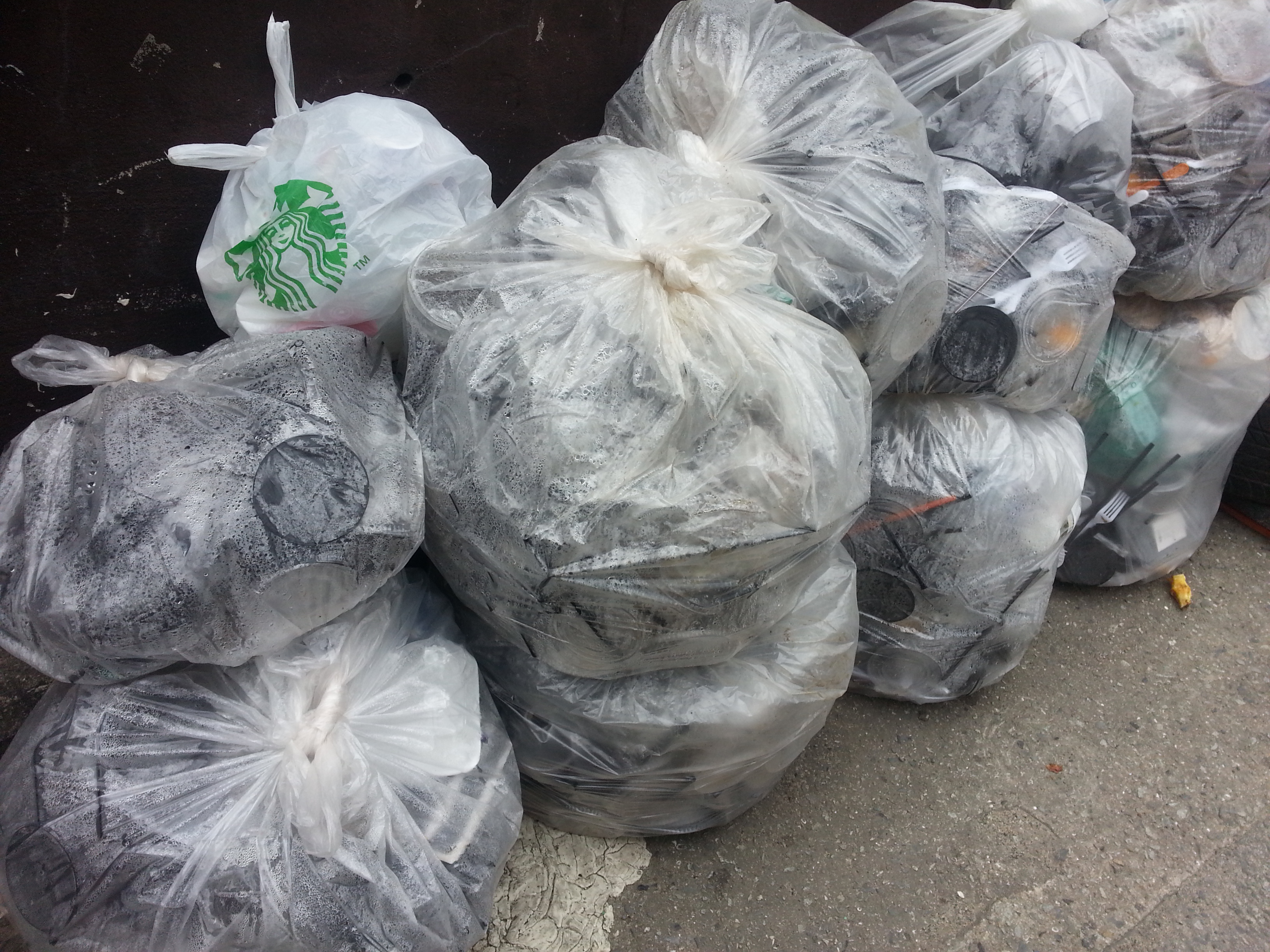
Waste behind a local cafe, these bags are filled mostly with plastic cups/lids/straws.

Waste behind a local cafe, these bags are filled mostly with plastic cups/lids/straws.

There are of course times when plastic silverware has its benefits, say for a picnic, but even then there are alternatives such as metal or single use wooden utensils. But at a sit down restaurant, I see no logic in it. It was over a year ago that I went to an expensive restaurant here in Busan that sits on a marina, has modern interior design, and caters to wealthy customers. Their fare follows their aquatic theme, concentrating on deep-fried seafood baskets with french fries – fish ‘n chips basically. At this “nice” establishment the food comes out in a cardboard box with a wax paper lining, to eat they supply plastic forks and knives, and condiments are given in 2oz plastic dishes with lids (With lids! With lids to sit down and dip your fish into and then immediately throw away.) That is a lot of waste from one meal. And is it just me, or doesn’t using disposables cheapen the image of a restaurant?

Lids! To dine in! Madness

During my first visit there I sulked as I ate, trying not to ruin the vibe for my friends, and I vowed to never go there again. Over a year later the place was suggested to eat at for a friend’s birthday and I had to speak up and be the Debbie Downer that often makes an appearance as an environmentalist and say that I could not eat there based on the waste. It was uncomfortable to vocalize and certainly put a damper on the issue, but I had to say it. In the end, plans changed and we didn’t go there, but I am glad I spoke up none-the-less.

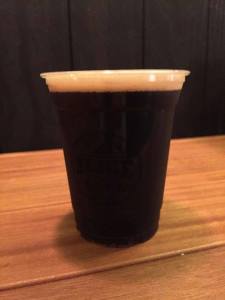
I also once ate at a pizza place that serves by the slice. They served that slice of pizza on a nice wooden board but also lined that board with a piece of paper – totally unnecessary. Plates were of course paper as well. The utensils were plastic so I opted to just use my hands. Even the draught beer, which was from a local brewery, was served in plastic cups. I really enjoy that local beer but couldn’t bring myself to order it.

Side note on the beer cups; there are times when they are required, say a crowded concert floor where glass could be a danger, or at an outdoor event where again it’s a hazard to have glass. In that case, breweries and restaurants could serve their beer in a compostable, corn-based cup, which is what I found back home in the U.S. at my favorite local brewery – Southern Tier Brewery of Lakewood, NY. I was sad to have to switch to plastic in order to follow my friends onto their stones course*, but was relieved when I saw that it was a compostable plastic cup. (I heard from a friend that there is a cafe in Busan that serves their to-go coffees in a similar cup, it’s on my to-do list to check it out and of course there shall be a post.)

Compostable Corn Cup, Made in U.S.A - dream product

Compostable Corn Cup, Made in U.S.A – dream product

It really might seem crazy to most people that I am so affected by this issue (I once described how it feels as if I’m strangling a kitten, or some other such heinous crime, whenever I use plastic, or worse still, don’t have the option to recycle it) but since I have been living by the sea and witness the amounts of litter and waste that makes its way into the water, I have been more and more adamant about limiting my contribution to our dying oceans.

Bring Your Own EVERYTHING!

Bring Your Own EVERYTHING!

So, what to do about this? After I realize what’s going on, I decide not to visit the restaurants again. Another option could be to go but to bring my own utensils and tumbler. I have even gone so far as to bring my own dishes along to an event that I knew would be using single use. Sure, I got a few weird stares, but I also got some compliments and hopefully inspired at least one or two people to be more aware. I wouldn’t suggest lugging your picnic basket around with you everywhere you dine, but sticking some silverware in your purse at all times might be a good middle ground. They’re not big and you can even find compact camping style ones. One of my next projects is to sew a little fabric carrier to keep my chopsticks and spoon clean when I carry them around. Post on that when I get around to it. Until then, I shall simply be boycotting single use plastics at restaurants.

How do you avoid it?


100% recycled apparel

*Footnote: Stones is a cool new game which from my understanding was invented in my region of south-western New York State. It’s a game similar to bocce ball that requires a grass and sand course. I noticed it was gaining a lot of popularity at Southern Tier, they even had T-shirts, which to my delighted surprise were made from 100% post-consumer recycle material. High five!

Conscious Dining – Boycott Single Use Plastics at Restaurants

Ride the Wind – Therapeutic Flying

This past weekend I performed with my Kaizen Acro Yoga Crew at a university festival.  We made the five hour bus trip up to Seoul to perform our two, four minute songs which we rehearsed for weeks prior. Indeed it was a lot of work, but it was well worth it.

For this performance we had a little less time to prepare than we did for the first one, maybe three or four weeks to create, choreograph, and rehearse which meant that we practiced a lot. Our high-flying group met 4-5 times a week and practiced for 2-4 hours each time. I was bruised up and my muscles have been achy, but in that way that I love, the rewarding soreness that tells me that I’ve been working hard.

No pain, no gain.

No pain, no gain.

But with everything in yoga a balance needs to be found. My well trained body was yearning for some relaxation and rest, which is why I was allowing myself frequent naps these past few weeks, a luxury that doesn’t usually make it into my schedule. I knew that my body needed to recuperate, so I hit the pillow for 10-20 minutes before training.

Last week on a Wednesday was one of those long training nights, we met at 6:30 to warm up, ran our routines over and over again, tweaking as we went, and then it was class time. From 8-10pm was the Big Birds class at Kaizen, the studio run by my very good friends Mindy and Simon. The class is usually really intense and forces me to push myself to my physical limits. Last week’s class however, was a little more on the chill side which was exactly what my body had been desiring.

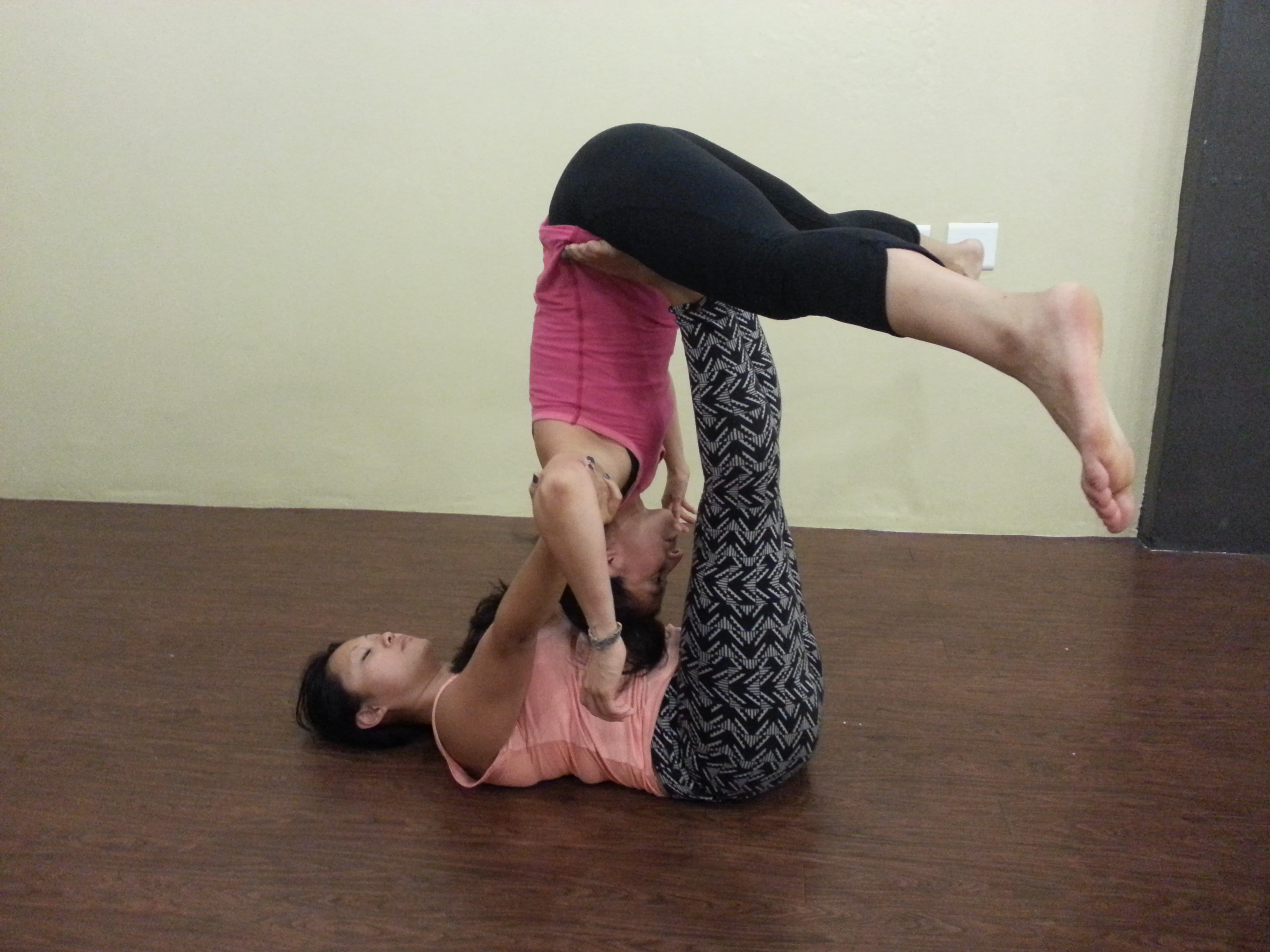
In the middle of class Mindy asked us to switch it up a bit, so instead of drilling press ups (her new favorite activity,) she had us partner up and (thank the lord!) do therapeutic flying. You can think of therapeutic flying as receiving a massage in the air by your acro partner. The base is the masseuse and the flyer is the very passive, limp, receiver of the massage. It is the yin to the yang of the high powered washing machines in acro yoga.

At last week’s class we were instructed to focus on the shoulders, so my partner put me in folded leaf and started massaging my traps and neck. Folded LeafIt.was.wonderful! I also played masseuse and based her in folded leaf. Having those 10 minutes of therapeutics was so very welcomed by my tired body; I wasn’t actually sure that I was going to be able to push through an intense traditional acro class, and was pleasantly surprised when class ended up being gentler than normal. Also, I slept so well that night, which isn’t the norm; usually after finishing class at 10 and cycling home from the studio, I am up and wired for a few hours, finding it difficult to quite my body and mind for bed, but last night I had no problem sleeping – maybe partially due to the therapeutics.

If you get the chance to attend a class or workshop which includes therapeutic flying, then I suggest going. It can be done with a stranger or friend, or it can be practiced with a partner to create more intimacy and give you a skill that will keep on giving.


Acro yoga classes can be found here in Busan at Kaizen. Classes are offered for beginners, intermediate, and advanced students. Every Friday there is an acro jam, free for all to attend and play. Check their website for times and pricing.

Detoxify Your Home – Natural Soaps

As I have become more and more mindful of chemical ingredients found in the average cleaning supply, toiletry item, beauty product, or almost anything else that lines my cupboards and sink – I have made conscious efforts to detoxify those items. The shower is a primary area where I think that it’s important to kick the chemicals to the curb. Think about it – those very unnatural products, full of chemicals and dyes are applied directly to the skin (body washes, face wash, lotions, make up, the list goes on,) sometimes applied multiple times a day. And our skin is our largest organ, which is porous and absorbent.

For over a year now I have made the switch from cheap, packaged grocery aisle soaps to handmade soaps. Fortunately, artisan soaps are prevalent and easy to find. Many small boutiques often sell beautiful handmade soaps, made of few ingredients which are non-toxic. You can search online to find suppliers as well, whether you search large scale with Amazon or find a small producer on Etsy. Make your way to a farmers market or craft show and I’m sure someone there will have some soaps. You could also go for a big brand  name, such as Dr. Bronner’s.

Back in 2013 I found my natural soap supplier while browsing a foreigner market in my former Korean city of Ulsan. A lovely market had been organized in which mostly foreigners set up tables and sold their handmade items. Amongst those tables was a well-stocked soaps table by Mama’s Binoo (binoo is soap in Korean.)

Mama’s Binoo is an artisanal soaps producer run by Stacey Fells, originally of Canada, but now living in Korea. A short list of her products are: soaps, massage oils, lotions, bug spray, shampoo bars, candles etc. You can find the full list directly on her Facebook page, or visit her table at one of the foreigner markets that has since been started up here in Busan.

Mama's Binoo Logo

Stacey is extremely knowledgable about her products and their benefits and she freely shares that knowledge with her customers in order to keep them clean and satisfied. Some of her most popular products are: zinc cream, shampoo bars and Bug Off, a natural bug spray that smells amazing. Stacey began making homemade products a few years back for her son who suffered from eczema. As she explains, “Even though I could speak Korean well it was hard deciphering the ingredients on the labels here sooo… I decided if I couldn’t find what I needed that I’d make it myself.” I can relate to that feeling of helplessness as an expat who doesn’t know the native language, but I’d challenge anyone to pull their body wash out of their showers and try to read those ingredients, even in their native language: sodium lauryl sulfate, toluene, propylene glycol anyone?

“Even though I could speak Korean well it was hard deciphering the ingredients on the labels here sooo… I decided if I couldn’t find what I needed that I’d make it myself.” – Stacey of Mama’s Binoo

The main reason that I made the switch from chemical to natural was because I was weary of what I had been applying to my skin day after day and what sort of long term effect that might have been having on my health. My boyfriend and I have a simple rule that we try to stick to when it comes to what we keep in our house – If we can’t eat it, then it doesn’t belong. Of course, we’re not going to be having our soaps with dinner, but you get the point. The products we buy and the companies we support are as natural as we can find and afford.

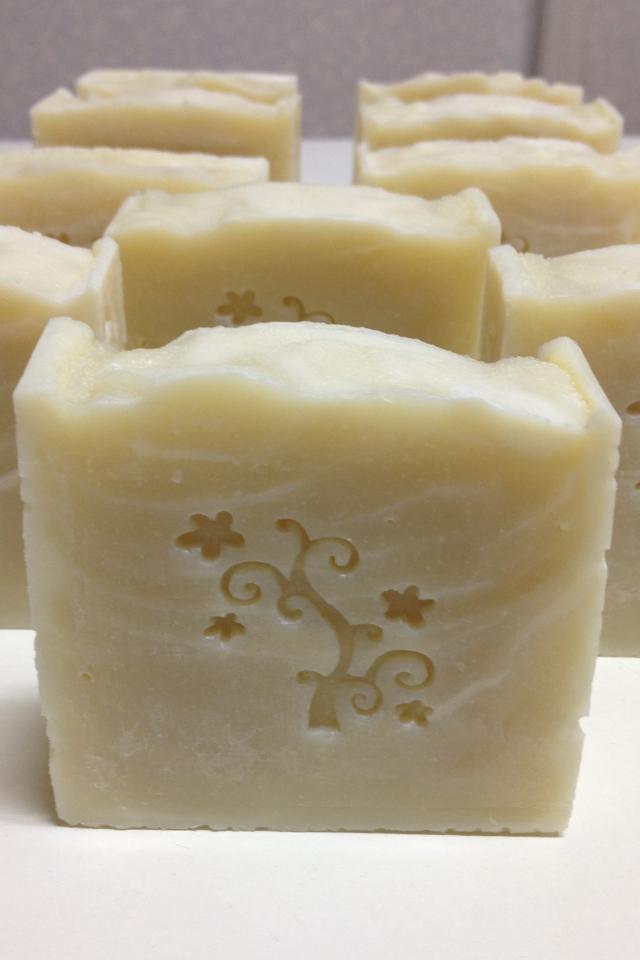
Mama's Binoo Soap

By buying and using handmade, natural soaps I not only make my home a little less toxic, but I am also supporting those making the soaps. Another benefit is decreasing the amount of packaging that comes home with me from the shop.You could go the next step and take a class on soap making and provide for yourself, I however, will just continue to shop local and use the wonderful products of Mama’s Binoo. Who’s your favorite local soaps producer?

Korean Templestay – Lessons from a Monastic Meal

One of the highlights from my recent Korean templestay was definitely the monastic meal experience. I wasn’t sure what to expect when I saw it listed on the itinerary, well, actually I envisioned a beyond simple bowl of the smallest portion rice, which would leave me immensely hungry for the rest of the night, but that wasn’t the reality.

The meal was actually quite filling and was made up of typical Korean fare. There was the ubiquitous kimchi and rice, as well as a soup and some bancheon (side dishes.) It was of course vegetarian. The contents of the meal are not what stuck with me the most though, it was the strict ritual of how to properly serve, accept, eat, and clean up after the meal that I found memorable.

The head monk that guided us through our templestay, sat at the head of the rest of us and taught us how to perform the ritual. We all sat on cushions on the floor with a bundle of dishes wrapped up tightly in a fabric bundle. We were instructed very carefully on how to unwrap the fabric, remove the four bowls of varying sizes, and how to display them in front of us. Each bowl served a purpose. One for water to be used to do the washing after the meal, one for the soup, one for the rice, and one for the side dishes.

As volunteers began to offer the rice to each participant we were strictly instructed to take only what we could consume entirely. Other volunteers served the soup and side dishes, beginning always with the head monk. There was to be absolutely no talking during the process which made it meditative and mindful. Only non-verbal communication was allowed.

The head monk said again and again not to waste any food. Every last grain of rice was to be eaten, and she was going to check at the end of the meal. When we were done eating we used the water in the water bowl to rinse all of the bowls out. During the middle of the meal she instructed us to save one of our half moons of yellow, pickled radish. The reason was that it was to serve as our scrubber for the dishes. We used our chopsticks to control the radish as we swiped it around every surface space, moving from bowl to bowl in the directed order, and then we ate the radish. The washing water we were to drink, ending up with absolutely no left over food or even any residue of our meal.

I loved it. No waste! Even the scrubber and wash water was consumed by us. Our translator expressed that although it might seem “dirty” to drink the wash water, it really wasn’t, because it only contained tiny bits of the food we had just been eating (no soap was used.)

After we drank the water our water bowl was filled with some scorched rice water which was to act as the final rinse. We poured the water from bowl to bowl and when we were finished we dumped the scorched rice water into a community collection pot. I volunteered do the collecting. If all had done their eating and washing correctly, then the community water at the end should have been crystal clear, lacking a single particle of food. As I collected I witnessed our failed attempted; as expected – we did not clear our bowls as efficiently as monks. Fortunately though, the head monk did not make us drink the community scorched rice water as a group, which is what real monks are made to do if they waste any food. Not a very delicious punishment, but an effective threat.

Eating just one meal as mindfully and thoroughly as a Korean monk has had a lasting impact on the way that I consume my daily meals. My daytime job is an English ESL teacher at a private kindergarten which feeds me lunch every day. Just as the children are taught, and as was reinforced at the templestay, I try every day to take only what I can eat completely, ending with no waste. I haven’t gone so far as to transfer the radish method into my school lunches, but I remember it as a lesson in sustainability and not wasting.

Unfortunately I did not take a single photo during the monastic meal as I didn’t want to interrupt the atmosphere and learning experience. Below is a gallery of photos from Hongbeopsa Temple where I did my stay.

Third Clothing Swap Success!

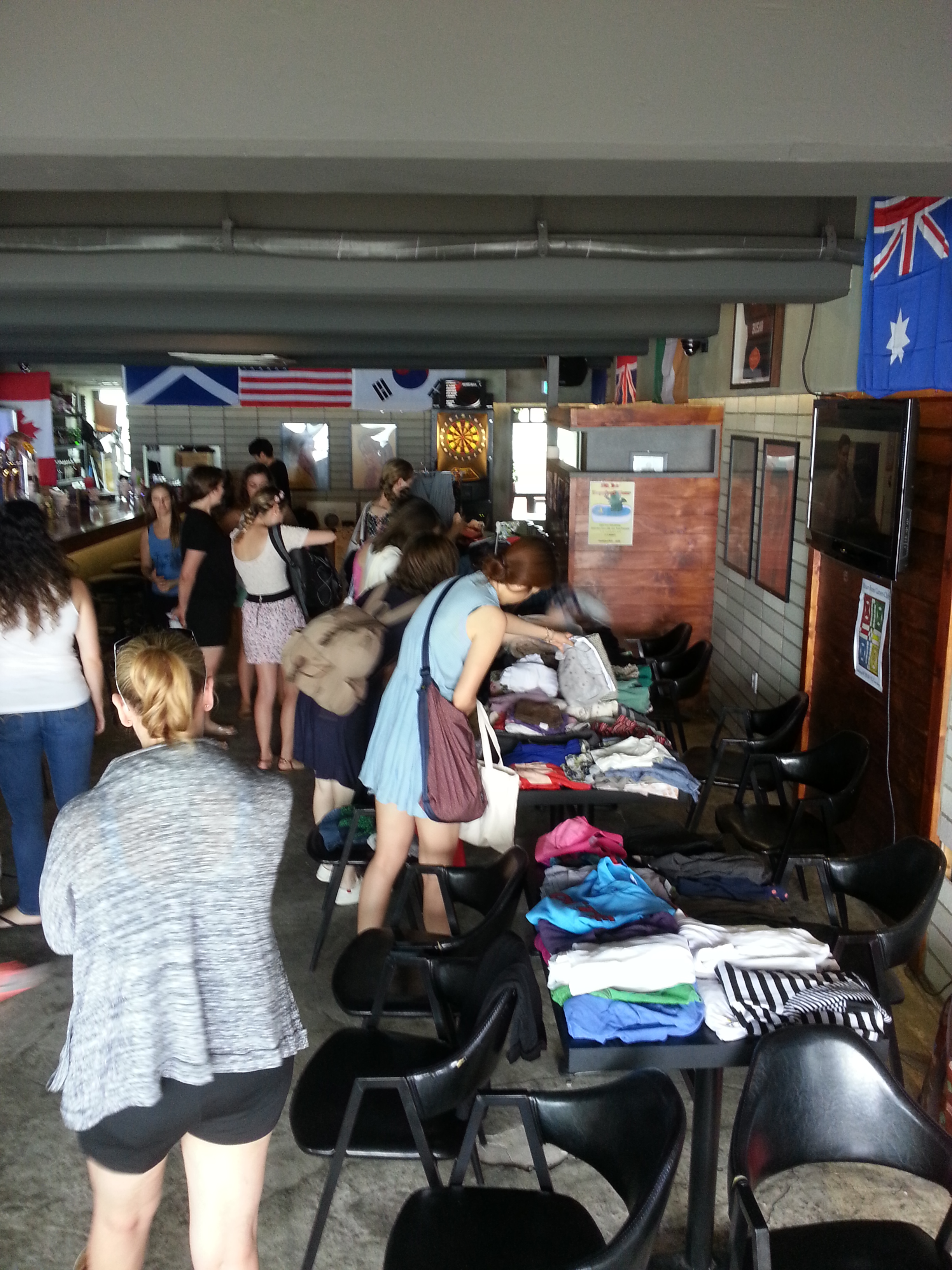
This past weekend I hosted my third community clothing swap here in Busan. The idea was exactly the same as the last two that I’ve hosted, all are welcome, donate what you can or come empty handed, walk away with as much as you like. The reasons why I don’t require donations by all are: 1. There’s an excess of clothing left behind by expat teachers whom have moved on from Korea and 2. My hope is that people will find clothing through this sustainable manner rather than by supporting Fast Fashion.

Although this swap was very similar to my past two, there were a few minor differences I made after learning some lessons from the previous ones. Here’s what was different.

  • More Strict Donation Requirements –
    About half of what was left over from the swap.

    About half of what was left over from the swap.

    At the last swap I got swamped with left over donations. A handful of friends and I took hours to sort through the piles and piles of clothes, placing them in either a massive garbage bag (we filled three,) a bag to be taken to a second hand shop (there were about 10,) or a pile to be sold at a market. This time I asked that people bring only high quality, no stains, no intimates. Initially I had faith that an outline like that wouldn’t be needed, but I turned out to be wrong. At this swap the clothes were in nicer condition and there weren’t as many to sort through in the end.

  • Change of Venue – The cafe where my first two swaps were held has sadly since shut down, so I moved location to a foreign-run bar in Gwangan – HQ. It was fun to have the swap at a bar. When I contacted them I referenced having a girls brunch day and they complied with a mimosa special during the time of the swap. Just like the last two swaps, purchase of a drink was suggested in lieu of an entrance fee.
  • Sneak Attack Ethics Lecture – Ok, so that might be misleading, but I did give a short five minute talk about my reasons for hosting swaps. At the very first swap I incorporated a talk about the fashion industry and sustainability (or rather lack of sustainability) which was scheduled to happen right before the swap began. A few people attended and were interested, but a lot of people didn’t come early for it, so this time I didn’t tell anyone I was going to do it, I just requested a mic from the bar and stood on my soap box at the height of the swap. I’m not sure how well received it was, but I hope that I reached a few people.

Swaps are really fun and easy to organize. I received a lot of feedback from attendees that they enjoy them and look forward to the next one. I hope they realize that they don’t have to wait for a large community swap to be organized; it would be super easy to host seasonal swaps with friends in your home. All you need to do is set a date, inform others, dig a bit through your closet, and swap till you drop.

Swap in full Swing

Three Ingredient DIY Yoga Mat Cleaner

A friend of my shared this “recipe” for a DIY yoga mat cleaner that I’ve been making and using for a few years now. It’s a really easy mix to make and is made up of just three ingredients: water, vinegar, and peppermint essential oil. The vinegar acts as the cleaning agent, the water is to water it down and makes up the bulk of the mix, and the peppermint oil is added to make it smell a bit nicer. Here’s how to make it.

  1. Find an empty spray bottle. Buy one at a dollar store or box store or be green and reuse an old one that’s contents have recently been used up. Be sure to properly wash it if it’s been used before.
  2. Fill the bottle 1/4 of the way with your choice of vinegar. I suggest using either an unscented, mild vinegar like simple white vinegar, or try using a lemon vinegar which gives an extra clean smell.
  3. Fill the remainder 3/4 of the bottle with water.
  4. Add  5-10 drops of your choice of essential oil. I use peppermint because I like the combo of lemon and mint. The two scents together have a crisp, clean smell.
  5. Put the top of the spray bottle in place, secure tightly, and swirl the bottle to combine all ingredients together. It’s ready!

This is a great little spray to have around. It’s nontoxic, easy to make, and very versatile. It works on most yoga mats and is even safe for my pure rubber travel mat. Off the mat, I use the spray as a general cleaning spray in both my kitchen and bathroom. It works great on mirrors; which brings me to another green tip, to clean mirrors: spray your DIY mat cleaner and wipe clean with old newspapers. It leaves mirrors streak free and is a way to give a second life to the sports section.

I hope you enjoy this easy peasy mat cleaner – Namaste!

3rd Busan Clothing Swap

Join me in less than two weeks time, on August 29th from 2-4pm, for the third Busan clothing swap. I am excited to host this event, the past two were hugely successful, not only for those who attended, but in my eyes they were a success because they stopped people from buying fast fashion as well as kept some clothes out of landfills.

Below are the details for the upcoming event. See you at the swap!


Start going through your wardrobes! Coming Saturday, August 29th – Busan’s third clothing swap event. I’m excited to move locations to HQ Gwangan after the sad closing of Table Talk.

What’s a Swap? A clothing swap is a fun gathering of people looking to get rid of their gently used, undesired items in exchange for someone else’s gently used, undesired items. There is no requirement to donate clothes (I understand that some people are new and didn’t come with much,) just come and have a search through and hopefully go home with something new. This is also a good opportunity for those leaving us to get their extra pieces to other expats or Koreans.

What to Bring? **Please Read** This event is all volunteer run almost solely by myself, Kara Bemis, thankfully I have been fortunate enough to have some friends volunteer to help me on the day of the swaps to sort through clothes, with that being said- it is hard work. We must go through all the left over clothes and get them to the correct location: garbage or thrift store. Please be very selective of what to donate.

**NOTHING WITH STAINS, HOLES, NO INTIMATES.**

Use this simple rule, if you wouldn’t re-buy it like new, then it doesn’t pass the test. All seasons permitted, summer to winter. Also, by being selective, please limit the amount that you bring, if you have a suitcase full of high quality items – great! If you have two suitcases full of low quality items that saw better days, then please leave those at home (again, due to the fact that it’s hard work to sort through the left overs.)

Moving from a cafe to a bar, HQ and I are happy to announce that there shall be drink specials! Details to follow.

Make an afternoon of it, bring some friends, grab a drink, and swap till you drop. Just as before, this is a free event with a drink purchase your entrance fee, let’s support HQ who is letting us hold the event at their waterfront spot.


Directions to hq gwangan
  • Take the green subway (Line 2) to Gwangan, stop 209.
  • Take Exit 3.
  • U-turn towards Gwangali Beach, walk straight towards the beach until you reach the main road that runs along the beach. You will be in front of Lotteria/Baskin Robins.
  • Turn left at Lotteria and walk a few yards. HQ is on the fourth floor of the building with a chicken restaurant on the first floor and Cross Fit in the basement.
  • If you reached Starbucks then you went too far.

Korean Templestay – 108 Prostrations

In the past I have been invited to teach for yoga mala’s which are events where participants do 108 Sun Salutations (Surya Namaskar.) Teachers guide students through traditional Sun A and/or B, or through variations of both. It is both challenging and rewarding to push yourself to perform all of the sequences and as a teacher it has been fun to be creative and come up with variations. Although I have taught and participated in a few yoga malas, I never really knew what that number 108 was all about.

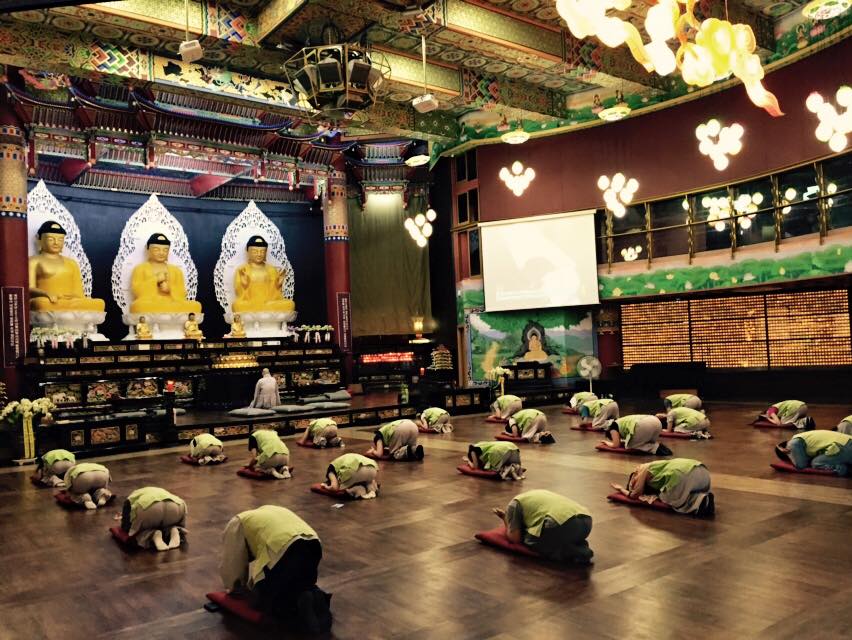
Recently, I took the opportunity to participate in a Korean Templestay. Templestays are little nightly or weekend getaways to a Korean temple. They are geared towards foreigners visiting or living in the country. During the stay, participants experience a brief monastic 24 hours (give or take.) At my templestay I wore simple cotton pants and a vest (worn over a T-shirt as showing shoulders is a big no-no at Korean temples,) ate and experienced the process of eating a monastic meal, attended two Buddhist ceremonies, made a strand of mala beads, and did 108 prostrations.

The Beads

Making the mala strand of beads felt a little bit like a summer camp activity. The other 20 or so participants and myself gathered in a beautifully painted room, sat upon meditation cushions, and were given little kits which included rough wooden beads, thick string, and a small metal tool that was to be used to push a better hole into the bead if it hadn’t been properly punched out.

While we made the malas our guide asked questions of us about Buddhism, such as what are the six offerings people bring to temple (I remember four of the six – rice, incense, flowers, fruit.) The guide/translator also explained that the beads were made of cedar which gave them a strong scent. According to her the scent is offensive to mosquitos and helps ward them off – bonus!

The number 108 was also explained, but in a mathematical-windy way reminiscent of conspiracy theories that add, subtract, and multiply to find their way to a meaningful number that supports their case. I’m not good with numbers in any sense, so unfortunately those numbers went in one ear and out the other. The following morning after stringing the beads we performed the 108 prostrations in the main hall and that’s where the magic happened.

108 Prostrations

After an opening ceremony of tycho drum, chant, and a few introductory bows, we began the 108. As I mentioned, the event was for foreigners; none of us were Korean speakers and the monks didn’t speak English, so during the bows they played a youtube video that gave a meaning to each bow. At first the video was offputting because the anouncer had a very cultish, deep, monotone voice, but what was being said by him was actually quite moving.

Reasons for bows came in groups. For example, for six or so bows there would be reasons about repenting. This is a rough memory, but a few  that I remember went something like this: “I prostrate in repentance for ever having taken my family for granted.” Then it continued with the same, “I prostrate in repentance for ever having taken my friends/nature/teachers for granted.” Another theme I remember was gratitude for similar topics: “I prostrate in gratitude for all the teachers that have touched my life,” for example. Having the sound of the video going, which visually displayed monks in monk like settings, helped the bows go by more quickly and gave them meaning.

Physically I didn’t find the bowing to be taxing, minus the speed. We bowed to the count of the youtube video which runs around 25 minutes, about 20 of those minutes being the actual bows. Doing 108 bows in 20 minutes is quick. The bows were similar to Sun Salutations and were performed by bending at the knees, hands at prayer at the chest (Namaskar,) lowering the knees down onto a meditation cushion, placing the forehead on the cushion, and then going to standing again. I overheard other participants complaining of the difficulty of it; it might be that my consistent yoga practice made the act easier for me.

Full bow.

Full bow.

Here is the link to the video to listen to while performing 108 bows, or while you do your dishes, give it a listen.  The intro of the video is a child giving a little background to the number 108 and then it gets right into the creepy voice reading of the 108 prostrations. As much as that description is not enticing, I encourage you to listen, it honestly moved me into conscious reflection.

If you ever get the opportunity to attend a Yoga Mala or a Korean Templestay, take the opportunity. Through both you can learn a lot about yourself while participating in events that lie outside of your comfort zone. Coming soon will be a write-up of the monastic meal that was the highlight of the first evening at the temple.

The templestay that I participated in was at a temple named Hongbeopsa. It is north west of Busan and can be reached by shuttle bus or taxi from Nopodong Bus Termanl. Hongbeopsa generally hosts monthly cultural events for foreigners such as lantern making, tea ceremonies, and kimichi making. To find out more about their events follow them on facebook here.

Observations of an Environmental, Yogini Traveler

I recently took my summer vacation to visit my family in Western New York. It’s a long, taxing trip from Busan to Buffalo and totaled roughly 26 hours door to door. As usual, my mind was observant of waste created in airports on planes. Here is a short list of what I saw as well as some tips for having comfortable travel.

  • Plastic on Planes – Thankfully, airlines feed travelers on longer flights and I’m always grateful for some grub before attempting rest on a flight. Of course airlines have strict health and safety guidelines to follow when serving so many people in a short time frame, so a lot of plastic is used for sterility. I saw plenty of plastic cups for all those beverage stops, saran wrap on fruit cups, and plastic utensils. Sadly, I also noticed that pop cans, utensils, napkins, and all other waste was jumbled together in the same garbage collecting, leading me to believe that nothing was recycled.
    • My Tip! Bring your reusable water bottle or tumbler with you on the flight and have the attendants fill that up with water or your choice of drink rather than getting a plastic cup every time. I estimate that I saved the disposal of at least 10 plastic cups on my recent flights this way. Having a water bottle handy also saves a few bucks at the airport as there are usually drinking fountains found near bathrooms. At New York’s JFK I saw this nice little reminder of a drinking fountain, and smiled.
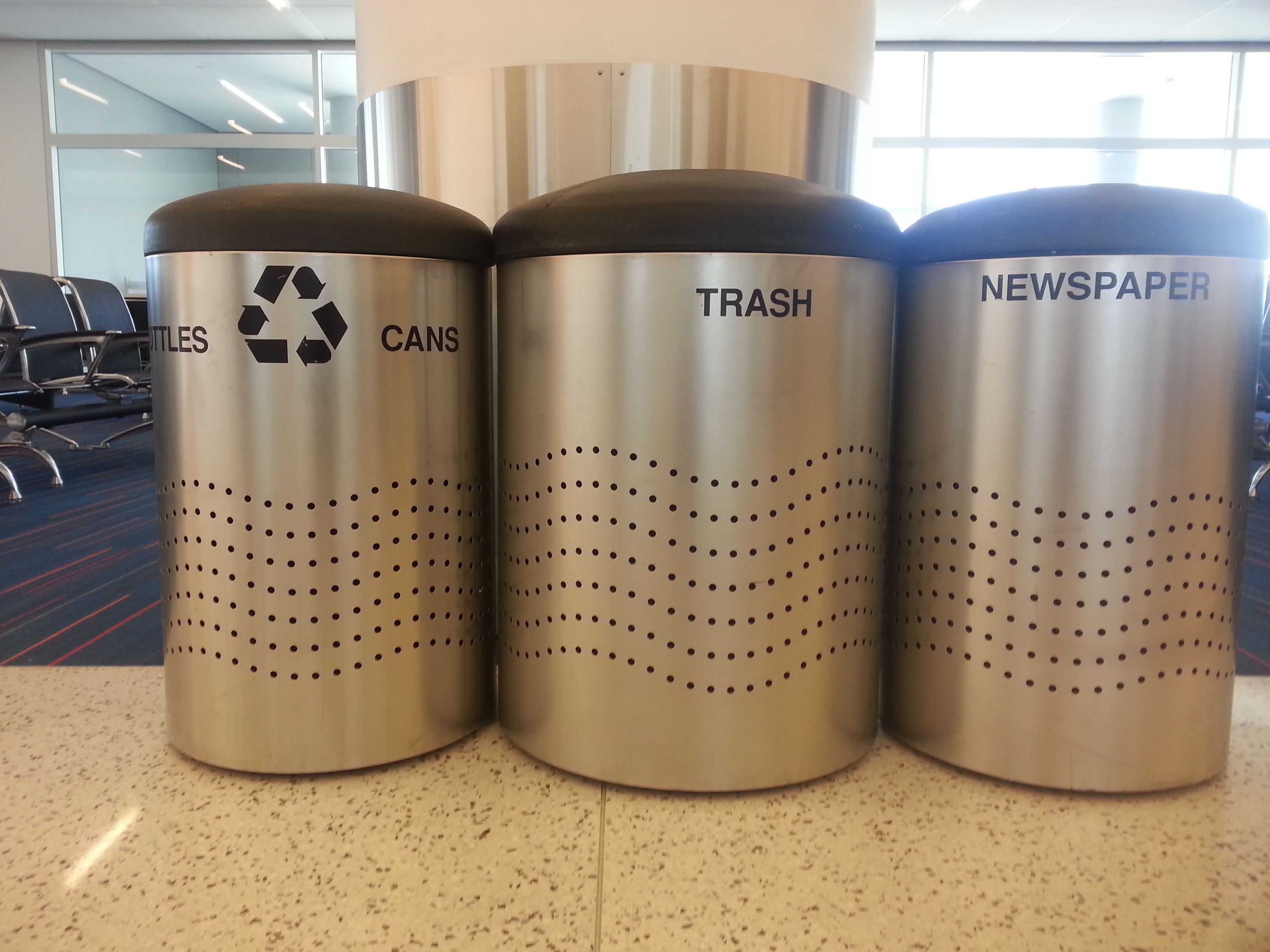
  • Hold Out for Recycling – When I first entered JFK’s immigration area I saw only a collect-all garbage can which got me feeling a bit down, but after going through security and walking around the terminal I noticed that there were in fact recycling receptacles throughout the airport. Relief!

Recycling Bins

  • Get Fresh Air – JFK had a cool new rooftop area at Terminal 5. I had some time to waste so I checked it out. After being around so many people and breathing the dry, stale air on the plane, the outdoor rooftop was a welcoming retreat. It also featured recycling bins. The grass wasn’t real, but plants and flowers bordered the area. It was nice to stretch my legs and do a little yoga after the long journey.
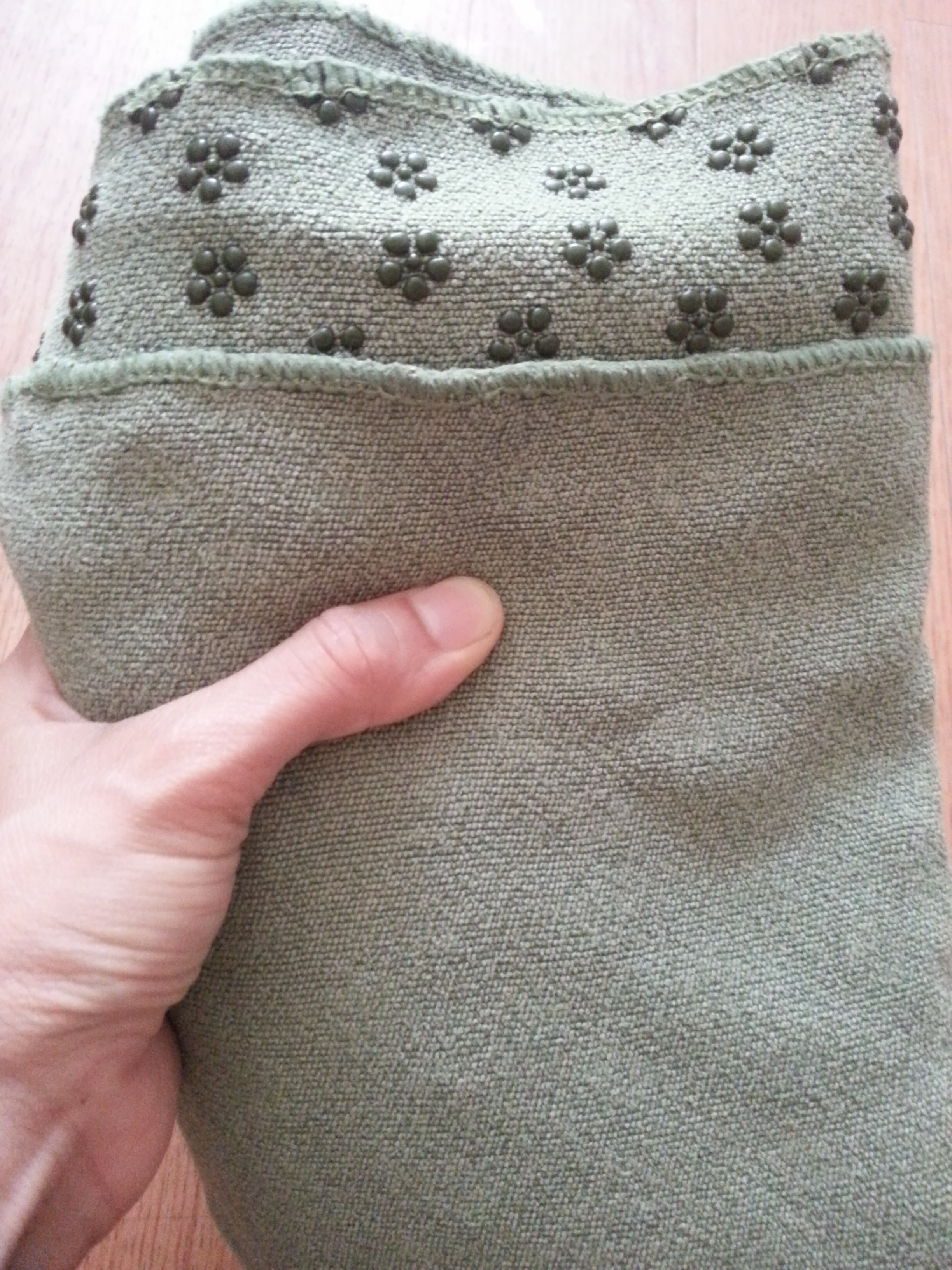
  • Bring a Travel Mat – If you don’t have a packable, travel yoga mat that folds up easily, then I suggest getting your hands on a yoga towel. They’re commonly used for hot yoga classes as the micro-fiber prevents sweaty palms from slipping in downdog. When
    Folds up easily.

    Folds up easily.

    traveling, I toss mine into my carry on bag, this way I can whip it out during lay overs and stretch my weary muscles. If you don’t have a yoga towel, then striking poses in a quite corner right on the carpet would suffice, just as well (I’m just a bit of a germaphobe!) Another bonus of the towel is that it doubles up as a blanket or rolls up as a pillow on the flight. Tucking your improvised pillow between the back of your seat and your lumbar spine (low back) adds an exponential amount of comfort from those flat-backed seats as well.

  • Aisle All the Way – For long flights I always request an aisle seat. Because of the dry air I drink a lot of water on flights which means a lot of bathroom breaks. While I wait in line I take the opportunity to do a simple, standing runner’s stretch to create space in my front body. Another good one to do is to find a flat surface and do downdog at the wall.
    • How To Standing Runner’s Stretch: Stand next to a wall, bend one knee and reach down for the foot with your hand. Pull the heel in towards your glutes, lining the bent knee up with the standing leg’s knee. If balancing is difficult, then use the wall to support you. Hold for a few breaths and switch sides.
    • How To Downdog at the Wall: Stand hip distance, facing a wall, with a slight bend in your knees. Be close enough to the wall that you can lift your arms overhead at shoulder’s distance and place the hands on the wall, elbows straight.  Gently bend at your hips and knees and press in and down into your palms on the wall. Stretch from the shoulders down to the low back. Stay and hold for a few breaths. Repeat as necessary.

Travel is a rewarding privilege; it is a way to see and learn about the world, a chance to relax and take a break from work life and daily chores, but the act of traveling is not always so fun, especially on trips that last literally for days. Take the time in preparation for a trip to make sure to have your essential water bottle or tumbler tucked away in your carry on. Bring along your travel mat or yoga towel for impromptu yoga sessions in the airport. Breathe long through the process of travel and know that you shall reach your destination in time.

Tropical Storm Brings Trash to Gwangan Beach

Last Sunday, July 12, 2015, was a turbulent day of wind and rain brought to Busan by tropical storm Chan-hom. There had been talk of a typhoon making it’s way to us, but it settled down into a tropical storm. Winds were high and the rain went from heavy to light throughout the day. This article on weather.com, states that winds were recorded as high as 47mph here in Korea.

Although it was not an ideal day for a bike ride, that’s exactly what I did during a period when the rain wasn’t so heavy. We took the boardwalk path on the way back to my apartment and were shocked by how much trash had washed up on the beach from the winds and surf. I snapped a few pictures, but most of the photos in this post are from early Monday morning, the following day. This amount of trash on the beach is extreme; there is always litter, casually dropped by beach walkers (cigarette cellophane, lighters, candy wrappers, straws, coffee cups, etc.) but the storm brought a whole array of trash.

Things that I noticed were shoes, balls, a lot of plastic drain filters, plastic beverage containers (water, soju, makgoli,) styrofoam and so on. There were great big styrofoam buoys, corners and bits from styrofoam coolers, and tiny pieces that had been broken down by the ocean. These little pieces are the ones that threaten the life of birds and fish because they resemble fish eggs so are consumed as food.

I noticed that there were still tourists snapping pictures at Gwangali Monday morning, however they were ignoring the length of beach covered in trash and instead aimed their phones at the bridge. I suppose to most people when they see a sight like that they think about how ugly it is and feel no responsibility to it so simply ignore it, but when I saw it, I wondered where was it coming from, how do we stop it, and how many innocent wildlife will die from our waste?

As I was taking pictures Monday morning, about half of the beach had already been cleaned up. Busan is great about getting crews out there every morning to make the (tourist) beaches look pristine. While the beautifying of the beach seems beneficial to us all, I can’t help but wonder if habits would change if people’s litter and trash stayed on the beach instead of miraculously disappearing every dawn.

Witnessing the debris that was washed up on the shore was depressing but also inspiring for me to question how I can decrease my impact on this finite planet even more. This month there has been a campaign online – Plastic Fee July, take a look at the link of their facebook page where you can get ideas about how to decrease your plastic use. Here’s a previous blog post of mine with tips. We can all do our small bit by carrying reusable bags, refusing bottled water, creating and using DIY cleaning/beauty products and most importantly sharing and inspiring others with our efforts.

How are you having a Plastic Free July and Plastic Free Life?


Better quality photos taken by Ben Lear.