Busan Beach Yoga

This is my third summer leading yoga on the boardwalk at Busan’s Gwangali beach and each year gets better and better. Sure, our beach may not be a white sandy one with palm trees galore; it’s more of the man-made type with neon lights, but there is still a lot of beauty to be seen during the practice. Here are a few specifics to Busan’s beach yoga scene that I’ve observed in the past three years.

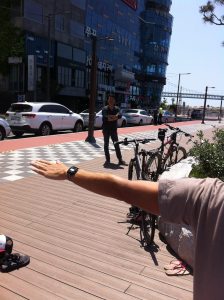
  • Boardwalk vs. Sand – It is my experience that practicing on the boardwalk is more beneficial than on the sand. One reason is pretty obvious – keep those grains of sand off of you. But if you have no problem being one with nature and getting sand in all your nooks’n’crannies, then by all means, give it a go! The second reason, and more importantly, is that the boardwalk provides a flat, even surface that is needed for balancing poses. Actually, in any and all circumstances, I would suggest practicing yoga on a flat and even surface because it allows for the best support for the wrists and ankles. It may seem idyllic to plop down into Downard Facing Dog on the sand, but you’ll be brushing the sand away endlessly and you might even be straining your wrists.

Boardwalk Yoga

  • Accept Your Performance – Practicing yoga in public is not a time for you to feel as if you’re being judged, really at no time should you feel as if you’re being judged, other students are more concerned about their own practice than seeing what’s going on over on your mat. There is no judgement in my classes, but for sure in Busan at beach yoga, there are pedestrian observers. Here is why: There is a different sense (or lack of?) of personal space here than we are used to in many of our home countries, people brush up right next to you, stand uncomfortably close in lines, on buses, and almost everywhere. Practicing yoga is no exception, people will stop and watch, try the poses with you, and many even take out their phones and take pictures. At first I tried to protect my students’ privacy by shooing them away, but I have come to accept it now as a major cultural difference. It’s not harmful, just different. As a student practicing on Gwangan’s boardwalk, I hope that you can remember that by practicing in a public space you may be subject to what we in many other countries consider an invasion of privacy, but try to see it from the eyes of the country that you are in and know that things are just different here. People are curious. And as for taking photos of a group of strangers practicing yoga, well their kakao story has to be updated with something today!
  • Prepare for the Elements – The sun has left it’s mark on me even through a cotton shirt, so I try to wear screen when I practice on the beach. It helps as well to have sunglasses and/or a hat. These days I’ve been wearing a baseball cap to shield my eyes yet still make it possible to look students in the eyes without being weird in my sunglasses. I look a bit like a yoga camp counselor, but it saves me from early-onset-crows feet!
  • Practice with the Sun – The best times to practice are when the rays aren’t so strong. Early morning, around 7AM and sunset, at 6PM are good times here in Busan. My 10:30AM class is also a good time slot and has been much more popular than the sunrise class – understandably, it’s not easy to wake with the sun for most of us! Sunday Sunset classes have been well attended as well, a great way to end the weekend and start the week.

Wherever you are located, I hope that you can seek out a yoga class in the elements. Beach, park, riverside, your own backyard – they’re all great locations. If you are here in Busan and would like to join a class, then please follow below.


Beach yoga classes led by Kara are held most weekends in Busan. Follow the Busan Yoga & Meditation group on Facebook and check out the group’s events to find out more.

Sunset Yoga at Gwangan.

Sunset Yoga at Gwangan.

Savasana- Not to be Skipped!

Lying on your back on the floor with eyes closed might not seem like an advanced yoga pose, but it is, and it should not be ignored. Savasana, or corpse pose in English, is how most classes end, and what a good ending it is. Dim lights, bundle up, and get comfy, cover the eyes, and just be. Students have asked me if it’s ok to skip Savasana and just jump back into their day; my answer to this question is no.

Here’s why Savasana should not be skipped:

  • Absorb All the Goodness – After the challenging work of a vinyasa flow class, or after long holds in a restorative class, Savasana gives your body and mind the opportunity to soak it all in.
  • You Deserve a Rest – Nap time ended long ago for most of us and we rarely allow ourselves the gift of just taking a break. A yoga class might seem like the only break you need, so why not just get on with they day, right? Wrong – let yourself have a few minutes of quiet before rolling up your mat.
  • Still Your Mind – During a yoga practice the goal is to focus on the breath and movement, but how many of us find our minds wandering to thoughts of dinner, wondering how our poses look, or to the song playing in the car that’s driving by, “Wait, is that Miley Cyrus? I like Miley Cyrus.” Focusing, in other words not being distracted, is a little bit easier in Savasana, since by closing your eyes you shut out the outside world; you let your body lie still as can be, and you let go of even the controlled breath, of the practice. Don’t fidget and try not to sleep. Be sure to be as comfortable as can be before totally letting go. It will be hard at first and maybe for a long time to follow (it took me years to relax in Savasana fully, and there are days when I still struggle,) but try your best to still your mind along with the body. Thoughts will come, but just let them go, do not hold on.

How  To Do Savasna:

  • Make your way to seated. Bring your feet in front of you, firmly planted to the mat with your knees pointing up to the sky. Hold behind your knees for support  raise your arms out in front of you, palms face each other. Slowly, roll back onto your back one vertebrae at a time. If this is difficult for you, then lower one elbow at a time down next to, and slightly behind you, to begin the rolling of your spine on your mat. Then gently lower your entire back onto the mat behind you.
  • Extend your legs out in front of your body down onto your mat. Allow your feet to splay to either side of the mat naturally, toes, feet and ankles relaxed. If you feel any tension in your low back, place your feet flat on the mat (knees point up to the sky,) apply gentle pressure through the feet, and lift your bottom up and off of the floor, think of rolling your pelvis out and down towards your feet. Place your lower body back onto the mat. This should give you more length in the low back.
  • Rest your arms out by your side at an angle, not right next to your body, but a bit away. Flip your palms up to the ceiling; this rolls your shoulder blades down your back. Be very relaxed and let your fingers curl ever so slightly inward towards your palms. Adjust the shoulders until you are perfectly comfortable. There should be no fidgeting after you have found your perfect pose. Keep your eyes closed through the entirety of the pose and keep them closed as the teacher brings you to the end of the class until instructed to open them. Placing an eye pillow on your eyes will block any and all light and is a relaxing touch.

Savasana

It seems like Savasana should be an easy pose, but easy it is not. We are so used to multitasking and filling our schedules that we constantly think about what did or didn’t get done and what has yet to be accomplished. All of this thinking can get overwhelming and lead to anxiety, worry, or stress. By calming the mind we give ourselves a little break. It is inevitable that when you first begin to practice Savasana that you will either A) fall asleep – that’s ok, your body might really need it! or B) continue to think, but keep practicing and it will get easier. Savasana is a yoga pose that requires practice to improve.

May you delight in your practice and destress in your Savasana.

Namaste.

Acro Yoga – A Performance

Recently I was approached by my friend and studio owner, Mindy Sisco, to represent her studio along with three others in an acro yoga performance. Mindy is away, traveling and training in the US so cannot perform herself, so instead the line up is: her business partner, Simon, two other talented local acro yogis, and myself. An event in Seoul celebrating International Yoga Day on June 21, 2015 is where  we will show off our work.

It is because of this upcoming performance that I have been doing less and less yoga and more and more acro yoga these days.UNWorldYogaDay As mentioned in a previous post, I am fairly new to acro and do not have a solid and disciplined practice like I do with my traditional yoga. Therefore, I must admit that I was hesitant to agree to join the group when first asked. I didn’t feel that I was good enough or well-practiced enough. I also struggled with the idea of “performing” when it comes to yoga. I’m aware that there are such things as yoga asana competitions in which men and women push their bodies’ to the limit in order to demonstrate advanced postures in front of judges who then chose a winner. Odd, right? To me yoga is about the body and mind; it is a personal and mental practice of leaving your ego off of the mat. Competing with others to see who can do a balancing pose the best seems to me to be the antithesis of yoga. Logically then, I should have politely declined the opportunity, of myself performing yoga in front of people at a big event, right? Well, maybe, but there are a few reasons why I went against my beliefs.

First of all, acro yoga and traditional yoga are similar, yet different. Acro is generally done not only for the enjoyment of working with a partner and pushing individual/partner limits, but also to be watched and appreciated by others. Often groups of friends or strangers get together in public spaces to practice and play. I am sure that the majority of acro yogis do not practice in public simply to boost their ego, but more likely it is to share their art and skill.

It would be a sad, sad world if artists and musicians practiced and played mostly behind closed doors; I think it is the same for acro yoga.

Secondly, I knew that pushing myself and having a clear deadline to perfect a performance piece with others would be good for me. There is never an endsight with an asana yoga practice, it always continues, it is unlikely that someone will practice for years on end and then one day – “poof!” cross the finish line and complete their yoga practice. Yes, it is common to use a certain pose as motivation, for example trying to hold headstand (Salambasana) in the middle of the room is a common goal, but once that is achieved there are other variations of it to try and so many other challenging postures to work towards. It is exciting and rewarding to push the limits, which is how I look at this performance.

The final, reason why I am practicing 5-6 days a week, 2-3 hours at a time is because I hope that our final product will act as inspiration to others. I know I am not the only one who searches for images or videos of yoga or acro yoga. I enjoy finding new yoga-eye-candy online to watch in awe and admire the feats of the human body. I am a humble person, but I do hope that the audiance at the event, as well as those who view a video of our practices or performance will take something away from it that tickles their acro or yoga fancy and inspires them to jump back into bird after repeatedly falling on their face.

Beginners’ Yoga with Kara – Tuesdays, June & July

My good friend and studio owner, Mindy Sisco, is ditching town for a few months to lead workshops in the United States and get some training in acro a littler further north in Montreal. While she’s away being amazing at what she does, I’ll be subbing at her studio, leading class every Tuesday through July.

The class that I’ll be leading is a Beginners’ Yoga class. All of my classes are designed with beginners in mind, as well as advanced students, but teaching this class gives me an opportunity to really break it down for students (which all levels benefit from.)

During the eight week session, classes will teach students about the basics of standard yoga poses, give great alignment cues to improve studio/home practice, and utilize a lot of props. As the weeks progress students will notice a building of strength, flexibility (of body and mind,) and understanding of yoga. Poses will also progress into more playful and empowering balancing poses and inversions.

Classes begin this Tuesday, June 9th and run every Tuesday through July 28th. Directions and costs can be found on the Facebook page.

Lessons from Acro Yoga

Acro yoga was never very appealing to me. I had played around with it here and there in the past with friends, but with no technique or guidance it never went far. I am so deeply in love with my asana yoga practice, that I never considered experimenting with acro, all that much… until I attended Little Birds, a beginners acro yoga series taught right here in Busan. The series is held monthly at Kaizen, and is taught by a good friend and fellow yoga teacher, Mindy Sisco.

It has been about a year since I first dipped my toe in the sea that is acro, and during the past year I have been wading deeper and deeper into the experience. It can be said that acro is both very similar to hatha yoga and at the same time completely different. If you’re coming from a yoga background  and try acro, then you will notice that a lot of the shapes and even the vocabulary are similar, Vishnu’s Couch and Parsarita’s Twist are two pose name examples. Also, strength and flexibility built-in a regular yoga practice will compliment acro immensely. How acro differs from yoga requires a longer description. Here are my personal lessons from acro.
Lessons from Acro

  • Trust – Falling onto someone’s legs, especially a stranger’s, and giving them all of your weight and yourself means that there must be a lot of trust between partners. There are drills to build trust that helped me to trust. In the beginning I was very untrusting, it was hard to give up the control, but with time and practice and learning of technique, I have grown to be open and comfortable to new bases and partners.
  • It’s ok to Fall – Just as it’s ok to fall out of a balancing pose in a hatha class, it is ok to fall out of an acro sequence. Falling is part of the learning process. If you never try you will never succeed. You need to try new poses to test your limits and build the strength and flexibility needed to hold the pose later on down the road. That being said, I don’t recommend trying to mimic an advanced acro video off of youtube if you don’t have the basics down. Know your limits and be realistic.

“Falling is part of the learning process. If you never try you will never succeed. You need to try new poses to test your limits and build the strength and flexibility needed to hold the pose later on down the road.”

  • Importance of  a Spotter – Acro is a two person activity, but should always be considered a three person activity in actuality, when you include a spot. The spotter has a highly important job of trying their best to make sure that neither participants break their noses or crack their teeth. As a yoga teacher, I have found that practicing spotting has mirrored my yoga teaching in that I have to be very aware of others’ bodies and I feel a real sense of responsibility in both.
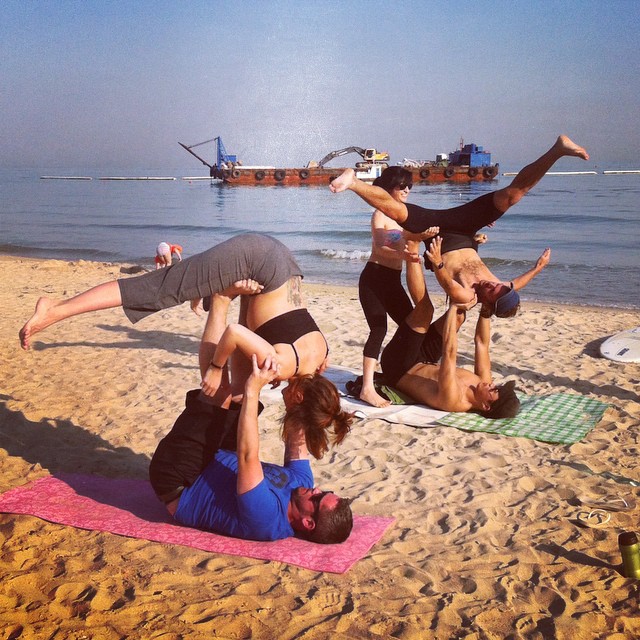
Spotting during some play time at the beach.

Spotting during some play time at the beach.

  • Communication – I’m fairly certain that ESP has been mostly disproven, which is unfortunate, as it would be really useful in acro, instead we must resort to speech. After working with a partner for a long time and learning the sequences it would be possible to get in a flow and feel it out, but in the beginning you must declare what you’re feeling and what you need, to help each other out.
  • Just Flow With It – Arguably my most important lesson from acro, is to let go of hesitations and worries and just flow with it. My day-to-day yoga practice can be rigid in terms of correct alignment; I sometimes play around with less traditional variations, but in general I tend to be a stickler for tradition. Attention to detail is primary in my practice – every joint must be in the right place, the gaze correct and strong. With that background, it was hard for me to just jump into an acro position, and I mean that quite literally – jump into a position! After some time and a little mental conversation with myself, I realized that it’s ok to do things less rigidly than I am used to. Had I not come to that realization, I never would have amazed myself with my acro abilities (if I do say so myself!) Similar to yoga, acro can be very empowering.

My acro yoga practice has grown leaps and bounds (and flips and turns!) in a matter of months. It took an open mind and willingness to fall into another person, but with each session of practice and play, I began to feel more comfortable in my own skin and with others. I suggest seeking out an acro workshop or jam in your area if you haven’t tried it. It’s a great activiity to do with friends, a partner, or family – heck, it’s even fun to do with strangers. There’s a high likelihood that you will learn a lot, not only about acro, but also about yourself, and an even higher chance that you’ll laugh while learning.


Information about acro sessions, classes, and workshops held at Kaizen in Busan can be found via their website at: http://www.kaizenkorea.com/ or on facebook via their page or the Busan Yoga & Meditation page.

Mindy and Simon of Kaizen, Busan.

Mindy and Simon of Kaizen, Busan.

Hosting a Beach Clean Up Event

Hosting a beach clean up event has been spinning in my mind as an idea for a while, but I was never really sure how to materialize it. It’s easy enough though to gather a few friends or a group of people and have them collect as much litter as they can, so that is exactly what I am doing.

Last month contained the American holiday of Earth Day, on April 22nd, unfortunately my event wasn’t planned in advance enough to be around Earth Day, but that really doesn’t matter. Each and every day should be a day in which we consider our constant impact on our fragile planet, and we should change our habits so that we cause less and less harm.

Together with a yoga friend, Jessica Rykert Holt, who has been leading mindful meditation gatherings in Busan, a straightforward beach clean up/yoga event has been organized at Gwangali, one of our local beaches. After a date was set for May 16th, Jessica was told of another beach clean up happening at another coastal location in our city, so we joined up to host coinciding events. The other event is through a local scuba diving group, Busan Scuba. Divers will meet and clean up Taejongdae, an island in the southern part of Busan.

Here’s what our beach clean up event will consist of at Gwangali:

  • Meet Up and Introduction – After learning some new names, I will start the event off by explaining my motivation, which is to create awareness about the harming of the oceans and lands, but more specifically, the oceans, by single use plastics such as to-go cups, straws, packaging and wrappers. Next, Jessica will speak about mindfulness and meditation and teach everyone about what they will be doing as they comb the beach cleaning up.
  • Time to Hit the Sand – After the tools are passed out (gloves and city purchased garbage bags in our case) participants will get to the cleanin’. Busan suffers from a lot of littering, both internally in the city and along the coasts and beaches. Daily I see candy wrappers, cigarette cellophane, straws and the like strewn about the beach when I walk my dog and on the streets. Not knowing the language well enough, it seems to me from observation, that people are simply ignorant of the lasting negative impact of their fluttering plastics that land on the beach and quickly find their way into the water via tides or winds.
  • A Yoga Practice, Of Course! – After all of the hard work and concentration on being mindful, everyone will reconvene at a large area on the boardwalk to lay out their mats and flow. The class will continue with the theme of mindfulness and individual impact, and will last an hour. The class will be designed for a range of students, from beginner to advanced.

It can be intimidating to put yourself out in the community and plan an event, but that should never hold you back from striking the match which lights the fire that is action. Let your little light shine! Planning a beach clean up is a great way to get some friends together and make an impact, or to make it bigger and involve locals.

This event is 5,000 won minimum donation with money going towards garbage collecting gear and the remainder being donated to http://www.projectaware.org/ an organization of divers who work towards cleaning and saving the oceans in their Marine Debris project as well as saving endangered sharks in their Sharks in Peril movement. Below is an infograph produced by Project Aware with facts about the impact of our trash.

TheUglyJourneyofTrashInfographic_PDF


Information about meditation events led by Jessica can be found the Busan Yoga & Meditation Group on Facebook.


Update on Beach Clean Up Event

Despite the fact that Saturday, May 16th started out as a dreary, cloudy, and quite frankly sort of miserable day, with temperatures much lower than they had been for a few weeks, a group of dedicated participants met me on the boardwalk for the clean up. After everyone had made their way to our meet up location, Jessica and I got things started. The event went exactly as planned and everyone did a fantastic job of filling up their garbage bags. It was unbelievable how much litter they were capable of collecting in just 40 minutes. Below is a gallery of photos.

Unfortunately, a lot more was left behind that we weren’t able to collect. The problem has to be corrected with people disposing of their waste correctly. An even better solution, in my opinion, is to drastically decrease individual waste production, by changing habits and cutting out all single use items from day to day life.

Radiant Life School YTTC Review

Radiant Life Yoga School, El Coco Loco Resort, El Manzano Uno, Nicaragua, May 2013

At this time two years ago, I would have been getting comfortable in my shared dorm room with my two new roommates in the eco-resort where we had all separately chosen to complete our yoga teacher training course from our three respective home countries. For myself personally, it was a big decision on where to do my training, in which I took largely into consideration things such as: cost, location, service, style of yoga, and class size. There is a lot I could say about my course, most of it very positive, but I’ll keep it short-ish and outline the majors.

Course Generals

Location – EL Coco Loco Resort, El Manzano Uno, northern Nicaragua El Coco Loco is an enchanting little eco resort located in the northern part of Nicaragua. Of course, I loved that the resort is eco with compost toilets and little in terms of the high energy use items like air conditioners/TVs. Accommodation included private bungalow’s and a shared dorm room (where I stayed.) There was a main, open-air dining/meet up area where meals were had and some practical learning was done. The fresh, home made food has to be mentioned as a highlight of my experience. And the staff were friendly, locals whom I was able to practice my Spanish with. The yoga platform where asana practice was done was a large, raised platform covered with a natural roof. The mostly isolated beach is only a minutes walk from the resort.

The Training For me it was important to find a yoga teacher training that focused on alignment and utilized props, as that is the sort of yoga that has always given me a lot of enjoyment and I knew I wanted to share with future students. Radiant Life Yoga School is led by Kimberly Waugh, ERYT 500, an American yoga teacher with well over a decade of experience. (It was important to me to find an instructor who was a native English teacher and related to me culturally as an American.) More about Radiant Life RYS 200 hr training that I experienced in May 2013:

The Good

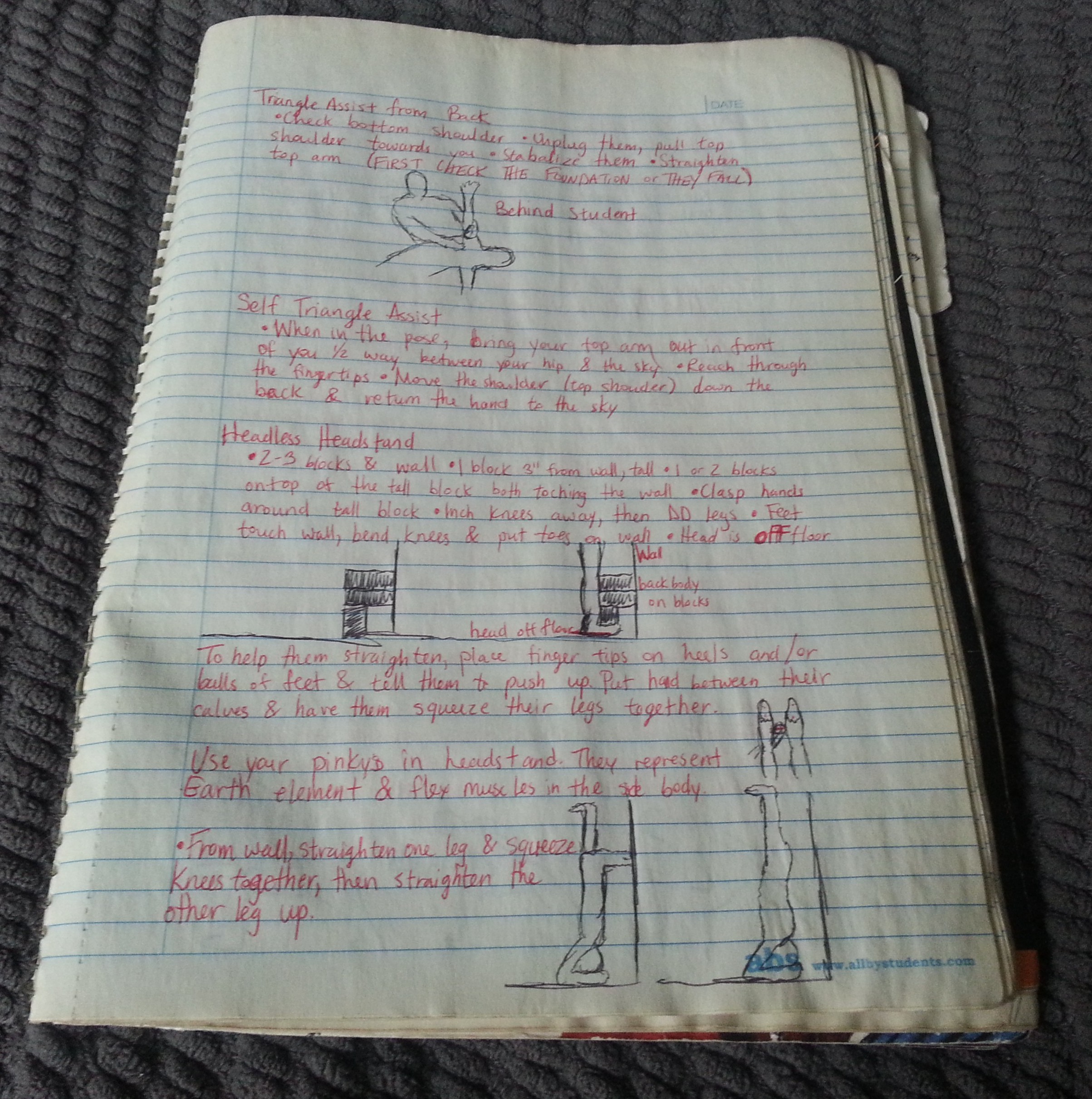
  • Lectures During my course I studied yogic philosophy and history and learned a lot of a new information which I have utilized often in my teachings. Two examples of books of study included: TheBhagavad Gita, the Yoga Sutras,  and also a well put together training manual that I have come back to time and time again. As quite a studious person, I took very detailed notes and continuously carry my training notebook with me around the world as I lesson plan.

    My notebook, complete with sketches.

    My notebook, complete with sketches.

  • Teaching/Business Knowledge Kimberly shared her vast knowledge of the industry with us and gave very practical tips and insights. Not all of the tidbits that I learned have been put to use as I have been teaching internationally and not in my home country of the U.S., but I will remember what I learned whenever I do relocate back to the U.S. I’m not sure that other training courses, especially those abroad and by instructors of other countries, would include such detailed and practical learnings.
  • This little bugger wanted to join asana practice.

    This little bugger wanted to join asana practice.

    Prop Use I love using yoga props, and although the rustic setting of the yoga platform didn’t include a plethora of props, there were the basics and I felt that I learned a lot of adjustments and modifications with the props. A word of warning, scorpions loved to nestle in the shadows of the pile of props, so be careful when you collect them for practice!

  • Workshop Study Kimberly taught multiple different and unique workshops to take away and be able to teach immediately. While learning
    Workshopping in the common area.

    Workshopping in the common area.

    these themed workshops,there was a lot of practical study, working with other trainees to practice putting students into poses and finding adjustments.

  • Focus on Seva (Service) This was the big deal breaker for me when choosing this course. I knew that I wanted some karma yoga to be included in my course and this was the right course for that. El Coco Loco Resort established and continues to run a great non-profit organization, Waves of Hope. While completing my training, I was able to get hands on and volunteer to work with local students practicing their English and get in deep and dirty by helping to build the new local high school. Find out more about Waves of Hope here.

The Not So Good

  • Anatomy There was an anatomy segment in the training course, but it was not my favorite part. Since anatomy was one of my weakest areas of knowledge going into the course, I was hoping for more of a focus on it.
  • Teaching Practicum This did happen, stepping in as the teacher to guide the other trainees in sun salutes and poses, but it didn’t happen as much as I wanted. To counter this, I took it upon myself to practice teaching the intern working at the resort at the time.

All-in-all, I highly recommend my YTTC to others. The setting couldn’t be better, the training itself was superb and left me feeling prepared to begin teaching straight away, and the food was enough to write home about.

Mmmm.

Mmmm.


Are you considering training for your 200 hr yoga teacher certification? If you are, check out my very first post, which includes great tips for doing just that.

Use Less Plastic

It’s April. This month we celebrate Earth Day, a day to recognize the beauty of nature, maybe plant a tree, spend some time outdoors, or attend a community planned event. That’s all good and great and brings nothing but smiles to my face, but ultimately, we need to spend every day as if it is Earth Day, because every day we live on and take from this planet and rarely do we take a step back and contemplate our day-to-day choices and their effects on the environment.

It has been on my mind a great deal these past few months to use less plastic. One of my resolutions for the New Year was to decrease my plastics use this year and forever more. Here are some tips of how I have been cutting back.

  • DON’T USE PLASTIC BAGS!!! These nuisances are almost unavoidable. Purchase anything and they automatically toss it in a plastic bag. This is exceptionally true here in Korea at markets and convenience stores. At least at grocery stores they charge you for the bags (here in Korea.) Give it a think, what use does that bag have to you after you bring it home and take out whatever you carried in it? Maybe you could use it as a garbage can liner, but that’s about it. I’m sure you have a larger collection of plastic bags than you do garbage cans. Replace them with reusable bags that fold up and clip onto your purse, or take an empty backpack with you to the grocery store. I’ve made it a recent habit to even take empty Tupperware with me to fill with shrimp or wet items sold fresh from the market. It works great!
  • PURCHASE WITH LESS PACKAGING Marketers wrap their products in so much unnecessary paper and plastic to make it look appealing on the shelves. Again, this is an example of a one time use by-product that has absolutely no value to you in the future. There’s no doubt that it makes its way into the garbage or recycling bin. While choosing a product at the grocery store or any other shop, compare which item has less packaging and go for that. Give preference to post consumer recycled paper board or soy printed labels. If something comes in a glass jar, then wash it out and add it to your Tupperware cupboard, or use it to store sugar or other dry goods in as opposed to in the plastic bags that they come in.
Wash and reuse glass jars after use. This way, you can store dry goods like coffee and sugar in glass rather than the original plastic.

Wash and reuse glass jars after use. This way, you can store dry goods like coffee and sugar in glass rather than the original plastic.

  • ASK FOR NO STRAW If you get an iced coffee or smoothie or even a soft drink with your meal out at a restaurant, then be sure to tell the server or barista that you do not need a straw. They are absolutely pointless utensils and cause a lot of waste. When I collect litter off of the beach a lot of the garbage is straws from drinks from the nearby cafes. Of course, be sure to bring your tumbler  along with you in your purse or bag to avoid using plastic cups and lids with that straw.
It doesn't take me long to collect straws on my morning walks,.

It doesn’t take me long to collect straws on my morning walks,.

  • NO PLASTIC WATER BOTTLES This is an obvious one, especially with my previous post on the usefulness of tumblers, which is hyperlinked just above, but I’ll say something quick as a reminder. Plastic bottled water is as unnecessary as a straw, you don’t need ’em. They have become modern-day conveniences and the norm for most, but change your habit by buying a home use water filter, purchasing a metal water bottle or tumbler to be filled with the filter or even straight out of the tap if it’s safe to do where you live.
    • Side note: Isn’t it sad that it is unsafe to drink from the tap! I was warned when I moved to Korea that it’s a big no-no. Most people create a lot of waste by buying large, plastic bottles of water.
  • CHANGE YOUR PLASTIC USE HABITS This is incorporated into all of the tips above in a way, yet deserves more explanation. In order for me to cut back on my plastics use, I have to make small decisions every day. For example, there is a bakery around the corner from me that I enjoy, but I will not allow myself to go in there unless I have a container on me to carry the bread away with. At first they looked at me funny, but after about the fourth time, they gave me a day old bread free of charge (or service as they say here) because they may have thought it was cute that I brought my own Tupperware.

Changing habits, whether it be stopping bad ones or starting good ones, takes time and effort and won’t happen overnight. It might seem, at first, like a big pain to have to cart around a metal water bottle with you everywhere you go and you might find yourself grimacing at the checkout line when you realize that you’ve left your reusable bags at home – AGAIN! If you keep at it and make little notes, place the bags near your car keys or always in your purse, then it will begin to be the way things are for you and you’ll be cutting your plastics use down bit by bit.

Get Outside! Take Your Yoga Practice into Nature

One of the best things about yoga is that you can practice it anywhere. It can be done with or without a yoga mat in nearly any space that is big enough to outstretch your arms, whether that be in your tiny Korean apartment, at an airport during a layover, or at work on a break. If you need a pick-me-up or have some tightness that you want to breathe into, then all you have to do is a few breathing exercises and simple poses. Another way to enjoy yoga is to practice in the great outdoors.

There’s something about feeling the sun on your face and listening to the birds chirp that makes it a much more enjoyable experience.

Here are my recommendations for practicing in the elements.

  • Find an Outdoor Class Most people like to practice yoga outside and as the weather heats up, classes begin to move from the studio to the boardwalk. Check around your community for classes held at beaches, parks, or other outdoor venues. When the weather permits, there are classes held here in Busan on the boardwalk at the beach.
  • Practice Solo If you feel experienced enough to practice without the guidance of a teacher, then take your mat along on a walk and find a nice quiet place to roll it out.
  • Location It will be more peaceful to practice somewhere that isn’t very populated. If your closest park or beach gets really busy then consider making it a priority to get up early and beat the crowds. It might be hard to answer to the alarm clock to go out for a sunrise yoga session, but you might find that it’s worth the serenity. Plus, starting your day with yoga clears your mind and opens your body up for whatever tasks lay ahead.
  • Surface In order to keep your wrists safe during chaturunga, it’s best to practice on a hard, flat, leveled surface. Avoid sand, or thick grassy lawns. Find a flat piece of ground or platform to practice on. A mat is not necessary, but will keep your hands and feet free of dirt, which could be a distraction while you practice. If you’re travelling or heading somewhere afterwards where you don’t want to be taking your mat, then consider purchasing a travel mat, yoga towel, using a beach towel, or some nifty little yoga socks and gloves which have sticky little grippy, circular, textured pads on them. Practicing a sequence of only standing poses means that you won’t even have to remove your sneakers.

    Comfy and useful.

    Comfy and useful.

  • Layer Up Wear layers for wind or clouds. Be sure to apply sunscreen to exposed skin to keep safe from sun burn or unwanted tan lines. Layering allows you to keep warm on the walk to your practice space and shed your top layer after the sun salutations that will warm you up quickly. Once it’s time for Savasana, it’s a good idea to put your layers back on and have something to shield your eyes from the sun, such as an eye pillow or just use the sleeve of your jacket.

An outdoor practice came to the forefront of my mind recently after hearing some shocking statistics on a podcast. The author being interviewed, Dr. Scott Sampson, had recently written a book titled, “How to Raise a Wild Child: The Art and Science of Falling In Love With Nature,” and the tagline of the interview was that American children on average spend only a measly FOUR TO SEVEN MINUTES A DAY PLAYING OUTDOORS!!! That finding deserves an all caps delivery; can you believe it?!?!

I have the good fortune of having an extremely handsome dog companion who comes with the responsibility of needing a walk two to three times per day, which means that I have to spend time outdoors rain or shine every day. I also live close enough to my work that I commute by bike, so that’s another 30 minutes per day during the work week that I spend outdoors by necessity. I also have a very active partner and friends that enjoy being out, so a lot of our weekend activities are outside. Even as an adult I spend my play time outside, and it’s much more than seven minutes.

When I was a child, I remember spending hours outdoors playing with my twin sister and our best friend. During the short Western New York summer months we would explore our expansive yards catching fireflies until our mothers called us in. So it’s hard for me to even fathom children of today not having that experience and it’s also really sad. I witness my Korean students live their lives indoors for the majority of the day, shuffling from school, to academy, to home where they might continue their studies well after dark meeting with tutors or doing homework.

During the interview the author made an excellent point, which boils down to this: If today’s children aren’t spending time outdoors, then they are not going to appreciate nature now or in the future, and therefore, who will be tomorrow’s environmentalists; who will fight to protect national parks, wetlands, and the environment in general in the future? Pull the plug on the screen, throw on a jacket, and get out there already, and be sure to bring the little ones along for sure.


Beach yoga classes in Busan and other outdoor seasonal events such as equinox and solstice events can be found via the Busan Yoga & Meditation page on Facebook.

Beach Yoga

Preparing to lead a beach yoga class.

Creative Back Bends

Recently, I had an opportunity to co-host a small event on a warm Sunday afternoon. The event was an art and yoga meet up through the website http://www.meetup.com. Earlier in the year I had attended an art therapy meetup event in Busan which I really enjoyed. The hostess Justina, is a Korean art therapist who lived and worked abroad for many years; she has been offering meetups in which participants create art together in a group setting. Justina and I discussed hosting an event together that involved yoga and art, which materialized just two weeks ago, and I believe that it was a success!


When I considered what I was going to teach for the event, I knew right away that I wanted the lesson to have an element of community. The reason being that I knew some group art would be made together by the participants. To create a sense of community, I started class with a chant of Om. I absolutely love the feeling that I get when I close my eyes and make the single syllabic sound with other yogis. Om creates this vibration that encircles everyone and brings the class together. It’s natural to have a sense of nervousness or roll your eyes at a room full of adults chanting together, but it’s something that should be tried. There’s no need to feel shy because all eyes are closed, just follow the lead of the teacher and ride it out.

After the opening chant, I led the six participants through a quick 30 minute yoga session. I designed a class focused on heart opening. Practicing heart opening poses, such as a simple back bend in tadasana, help to open up the upper spine and back and are good to practice to create a sense of general openness in the body. Not only did I want everyone to feel open in their bodies but also in their hearts, open to the experience and to each other, and likewise open-minded.

group art work

Example of some group art work.

After the yoga we reconvened in a small room to start the art which Justina led. We created works individually and together. It was a fun afternoon and good experience for me as a teacher. Below are some poses that you can try before activities involving creativity.


  • Back Bend in Tadasana After warming up with some sun salutes, stand at the top of your mat with feet hip distance. Check your alignment, make sure that your feet are pointing directly forward and that your knees are above your ankles, your hips over your knees, and shoulders over your hips. From there, point your fingers up to the sky behind you and place your hands on your lower back, near the top of your pants. Hug your elbows in towards each other. On an inhalation, lift your chest and press through your hands to move your hips forward. Focus on opening through the chest. Gently release your head back, but if that causes you any discomfort, then tuck your chin to your chest. A slight bend through the knees may increase comfort. Hold for a few breaths. Return to standing on an inhalation.
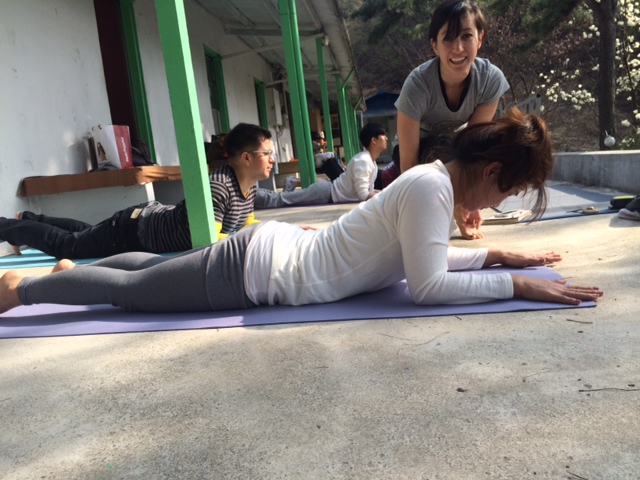
  • Sphinx Pose Also known as, SalambaBhujangasana in Sanskrit, is one of my favorite back bending postures. It’s a very subtle pose that has great effect. This pose begins on the belly. Align your elbows directly under your shoulders. You should have a 90 degree angle, if you look at your elbow and your bicep is  touching your forearm, creating a long crease, then you probably need to bring your elbows up closer to the front of the mat. Spread your fingers wide and place your palms down directly in front of your elbows. On an inhalation,isometrically pull your arms back towards the back of your mat, whilst simultaneously pulling your sternum through your arms. Your body won’t actually move much, but imagine that you’re performing these actions and you will feel your lower back working to open your chest. If you have any pain in the low back, then decrease the action. Exhale to come out.
Assisting an event participant in sphinx pose.

Assisting an event participant in sphinx pose.

  • Back Bending Tree This is a fun variation of vrksasana or, tree pose that plays with balance. It’s best to try this at a wall for support. Stand with the left side of your body at the wall. Place the sole of your right foot either somewhere on your calf, low on the thigh (just above the knee,) or reach down for your right ankle and place your foot as high as you can on your inner left thigh. Never place the foot directly on the knee to avoid knee pain. Place your hands on your hips. Once you find your balance you can try to bring your hands to prayer at the chest. If that feels good then inhale your arms up over your head, palms face in towards each other. To bring the back bend into the pose, inhale and lift your chest up towards the sky while leaning back carefully. It will be a little bit easier to do this with your hands at prayer at the chest or on the hips as opposed to arms extended, so adjust your hand placement for more stability, or keep them overhead for a challenge. Use the wall to support you if you start to fall out. Just like in tadasana, be mindful of your neck and find a placement of your head that feels comfortable for you. Inhale to bring your torso back over your hips. Exhale and release the lifted leg down. Switch sides.

    Having fun in tree pose.

    Having fun in tree pose.

Have fun trying these poses that open you up both physically and mentally. Maybe they will open you up to feel inspired to create something for yourself, whether you create art, a meal, something with your hands, or simply openness in your body.


The event was an art and yoga meet up through a group called Busan Creative Art Healing : http://www.meetup.com/justina