Don’t Shop, Swap!

Clothing swaps are great alternatives to shopping, and make for excuses to have a social gathering with old friends or new. They’re very easy to put together and require very little planning. Plus, everyone will hopefully go home with something new (to them) and exciting!

I first attended a clothing swap with my boyfriend’s mom where she lives in the south of France. On a fall afternoon a large group of women gathered in a friend’s home and laid out items that no longer got much use from them, to be shared and swapped with all in attendance. It was a lot of fun and a few years later I found myself hosting a swap in my expat community of Busan, South Korea. Here’s a quick how-to on hosting a clothing swap. Details are specific to an expat community, but a swap can be held anywhere.

Browsing items :)

Browsing items 🙂

  • Invites: Social media makes planning a breeze, with a few clicks and a nice photo you’re done! For my events I made the events public, open all in the community. For your friends you could make it more intimate by inviting them by phone or even send out some nice stationary, but doing things electronically saves paper and time.
  • Choose a Time: I have had a lot of success hosting swaps when the seasons are changing. People tend to pack up their shorts and tanks and pull out the sweaters in the fall, so that’s a great time to host an event, likewise spring is another great time. I encourage people to bring summer and winter clothes as people might be vacationing to warmer places, or can store the items for later.
  • Inform Your Guests:  Some people may not know what a clothing swap is, so let them know that it’s a chance to hand in unwanted clothes for others’ lightly used items. You can have your event be for ladies only, or extend it out to men or even make it a family event for children as well, as I’m sure a lot of families may have clothes that are getting too small and equally would be in need for someone else’s larger sizes! Be sure to plan the event a few weeks in the future to give people time to go through their closets. Decide if you want to include accessories and footwear and let everyone know. Be sure to tell guests that only lightly used items are appreciated.
  • People at Table Talk English Cafe, swapping away!Chose a Venue: As a very casual event you could host a swap in your living room, or on the porch in warmer months. You could make it more fun by incorporating a potluck. For a more public event, seek out a local cafe and encourage your guests to support the cafe by purchasing a drink or food. The chosen location might not even charge you rent if you let them know guests will be buying their fare.
  • Arrange Drop Off Times: Expat communities see people come and go routinely. Plan your swap to coincide with the waves of expats coming in and out. For example, here in Korea the school year begins in March, so people leave in February and newbies arrive in March- a great time to host a swap. In order to collect off of the people who are flying out, ask the cafe if you can collect a few weeks early and store there, if that’s not an option, consider storing and collecting at your place.
  • Donate the Extras: Storing all of the left overs might not be reasonable, so search your local area for a charity shop, orphanage, or women’s shelter to take the clothes that remain. Call ahead to make sure that they’ll accept what you’ll have to bring.

Hosting a swap does not require much at all and can be such a fun event. For my first swap, I held a talk at the beginning for those interested about the sustainable aspect of the swap, which might be a good idea if you want to give your event a deeper meaning.

Here is the Facebook Event link to my upcoming Swap in Busan on March 14th. The swap is open to the public. As the host I encourage anyone to come have a look through the clothes, whether you have anything to contribute or not. The reason for this is that by taking an item off of someone rather than buying it new in the shop, you save the item from the landfill and also don’t contribute to mass consumption… but that’s a whole other blog post!


Update, here a few photos from the Swap that was held in Busan on the 14th of March. It was a success I believe, with people walking away with mounds of clothes. I learned from this event and am hopeful that next season’s will be even more successful and run more smoothly. This past event I happened to become ill during the swap and was running a fever for most of it, thankfully some good friends stepped in and helped me out so much. Thanks ladies!

DIY Natural Dying

I learned about using compost to make natural dyes via a podcast that my boyfriend was listening to one night, and it caught my attention. On the podcast, the woman was talking about collecting onion skins from restaurants to turn them into dye and I thought, well we go through a lot of onions, so might as well start collecting. I also asked some girlfriends to save their onion skins for me and had quite a collection. This past weekend I finally put the skins to use and the results were surprisingly nice. They will be sewn into eye pillows and cases.

How To

The Collection: I’m not sure on an amount, but if I had to guess I’d say that I used about 20 onions worth of skins. Initially I froze the skins, but I found that that’s not necessary. The skins keep well at room temperature as long as none of the flesh is on them. It’s winter now, so that might not be the case during the humid summer.

The Process: I followed this blog. Outlined below are the stepsSoaking the skins I took to dye my fabric.

  1. After collecting and storing the skins until I was ready to dye, the first step I took was to soak the onion skins. I covered the skins in water until they were all covered, but of course some were not submerged because they floated to the top. I had read that soaking over night gets the best results, so that’s what I did.
  2. The next day I boiled the skins in the water. They didn’t remain
    boiling for long. After they reached boiling, I lowered the heat to simmer. They simmered for about an hour. When I went to turn off the gas completely, I noticed that a lot of the water had boiled off and the water was colored an orange-brown. I removed the skins as much as I could.
  3. The next step is soaking the fabric in thedye. Using different types of metal creates different colors, so I used two different pots and experimented a bit. One piece of fabric was completely submerged in a cheap camping pot (I’m not sure what type of metal it is, but it’s cheap) while the other fabrics I played around with and explain how below. For the best results the blog said to soak the fabric in thedye while it is heated on the stove for about an hour.
    1. Two fabrics I tie-dyed. The first fabric I planned to use for eye pillows. The second was a shirt that I altered when I first bought my sewing machine (it has very rough hems from learning how to sew!)
    2. The other effect I daydreamed about making was an ombre effect, or fading from dark to light. I theorized that if I strategically hung the fabric above the dye only submerging the end and then lowered more into the dye every hour, then I’d end up with the part that was soaking the longest would be darker in color and that which was soaked for the least amount of time would be lighter in color. The end of the fabric wasn’t submerged at all and stayed the original cream color (minus some staining from the steam of the dye.
  1. After the fabrics were in the heated dye, I turned off the heat and let them cool in as they were. For better results it was recommended to have them sit in the dye overnight which is what I did. The following day (3 days into the process now) I took them out of the dye and rinsed them in cold water until they stopped running.

The results of this process came out great, I thought. I hope to play around with other natural dyes in the future. A student recommended dying with turmeric and fruit skins. Have you had any success with natural dyes?

The Humble Tumbler

I’m assuming that tumbler is not just a Konglish word used over here in South Korea, but is also a term used in the wider world, but just in case that that isn’t the case, I’d better clarify. A tumbler is a mobile, reusable, totally sealed thermos for your coffee or tea. I was gifted mine back in 2010 and it still makes the daily rounds with me pretty much wherever I go. I prefer it to a water bottle because it holds both hot and cold, and it insulates. So my ice water on the beach in July is nice and chilly and my green tea in December fogs up my glasses on the subway. Here is some more info on this wonderfully useful device.

The fact that it has a vaccuum seal lid raises it far above it’s cousin the travel mug, and this is because it can be tossed in any bag and carted along without getting your precious belongings splattered or drenched in a sticky chai tea latte. Recently in the past year I have been biking to and from lessons more often than I used to, and I have had absolutely no hesitation throwing my full tumbler in my backpack. I can’t say that this would be the case if I had a lesser quality tumbler, so if you’re looking to purchase maybe read reviews.

It’s also cost efficient. If I compare the cost of a tumbler, which is about $20-$30, to buying a plastic bottle of water at a convenience store at about $1, it would of course take only 20-30 times to equal the cost of the tumbler. That’s only about one month of yoga classes, so in one month my tumbler has earned her keep. That time frame is decreased if I get a to-go coffee at a chain, as they usually give a discount if you ask them to put the coffee in your tumbler.

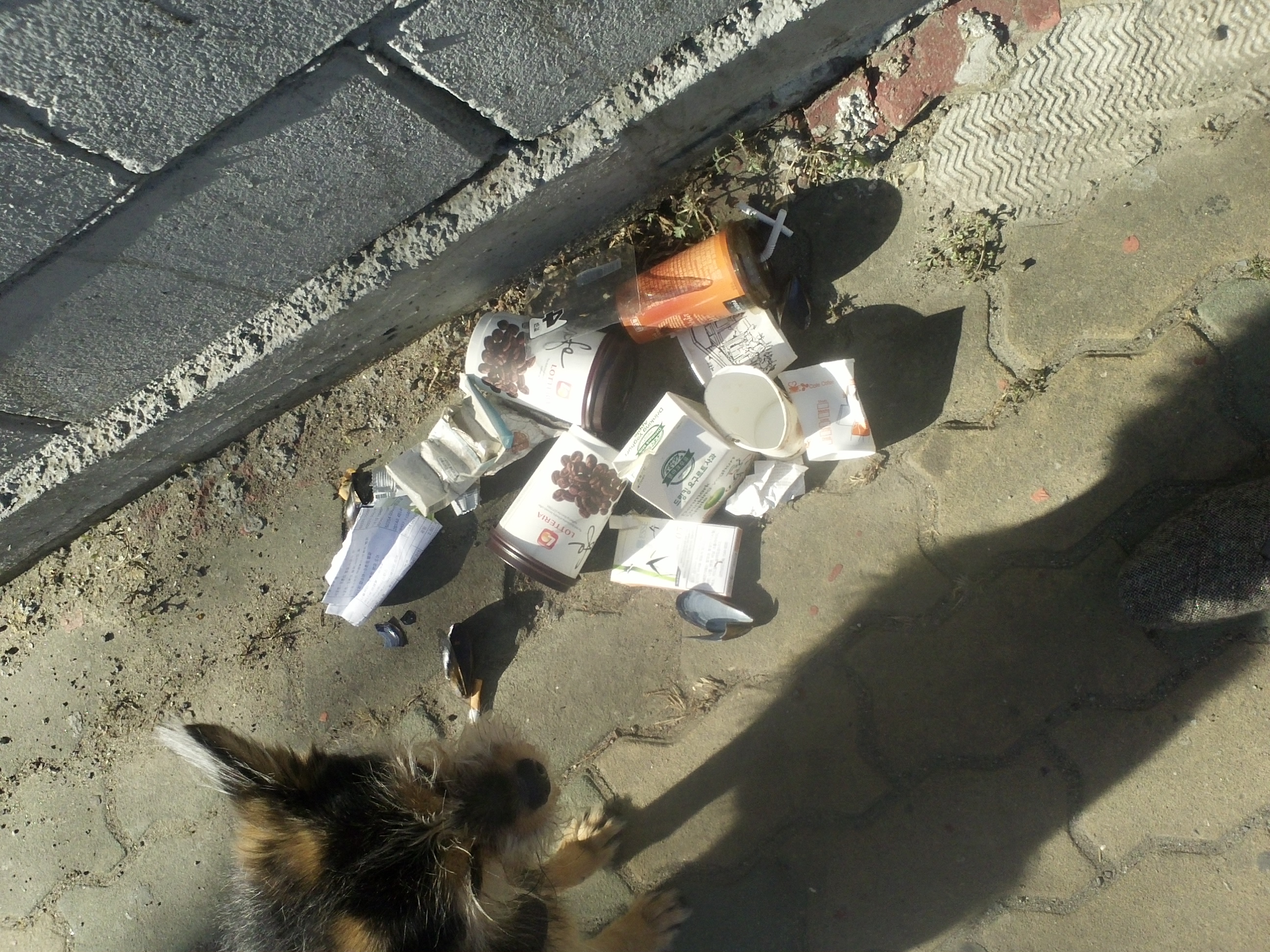
A minuscule sample (I didn't see anyone else drinking out of a mug or reusable tumbler besides myself in this busy cafe) of single use paper and plastic containers. A drink of choice was purchased and poured in, then said drink was drunk, and then they were tossed.

A minuscule sample (I didn’t see anyone else drinking out of a mug or reusable tumbler besides myself in this busy cafe) of single use paper and plastic containers. A drink of choice was purchased and poured in, then said drink was drunk, and then they were tossed.

Another reason why I prefer using a metal tumbler to using plastic water bottles is of course sustainability. I’m trying more and more to cut back on using single use, disposable items (think plastic forks, water bottles, straws, etc.) with the hopes of one day quitting use totally. Litter is an unfortunate, daily problem here in South Korea. I’m not going to try to explain this problem here, because I don’t want to judge the culture of the country that I have been calling my home for 3+ years, but I will say that I don’t condone the littering. Cafe culture is HUGE here, I live one block from a main tourist beach in Busan and there are innumerable cafes (ok, realistically about 50ish on a 1.4km/.87mi long beach) and the majority of patrons of those cafes get single use to-go cups. Employees don’t even ask preferrence, they just give the to go cup, plastic or paper, regardless of whether you’re about to stroll the beach or sit down and study for an hour. That’s a lot of waste each and every day; waste that is usually just littered on the beach or street since the city doesn’t provide many waste receptacles. There are recycling areas sporadically on the beach, but the cups and other waste items don’t always make it there.

streetlitter

Fred disapproving of litter outside of our apartment building. There are at least five single use containers for hot liquid here. The coffee would have been drunk in minutes and then littered.

And if the cups do make their way to the recycle bins then all is fine and well, right? Well not totally, ok yes, they can be recycled, but recycling uses a lot of energy, so it’s better to reuse. That plastic bottle has to be taken to a processing plant (shipping fuel,) where it is sorted, cleaned (water/energy waste,) processed into pellets (more energy waste,) and then the pellets start their journey to be turned into more plastic bottles or plastic bags. But imagine if we just stopped using those plastic bottles/bags, then there’d be no demand for them. Instead we could use metal tumblers and cotton reusable bags. In the description I use the word waste purposefully because if we change our perception of plastic use to waste, then maybe we’ll stop using (wasting!!!) so much plastic.

The final reason why I’m antiplastic bottle is the negative effects of leaking chemicals into the food or drink that we consume, especially with a heated food or liquid. The research has been out on BPA (bisphenol A) for a while. I’ve heard and read some pretty scary stuff about the chemical which is used to make plastics more durable. You can read up on the stuff yourself here, and at breastcancer.org, and with this PDF, and lastly if you’re more of an auditory learner then this is a very informative interview with a scientist who wrote a book about testing her own breast milk for toxins.

DIY Yoga Eye Pillow

A yoga prop that I love to utilize in Savasana (corpse pose) is an eye pillow. I started to use one regularly years ago after being introduced to them at a yoga studio. What an eye pillow is, is what it sounds like; a tiny little pillow to rest on top of your eyes. Usually they are made of a soft fabric like silk or cotton that feels comfortable on your face. The filling is made up of flax seeds coated in an essential oil- lavender being my favorite. Not only does the soft scent of the lavender calm you as you inhale in your Savasana, but the flax seeds make it impossible not to close the eyes and also block out any light in the environment.

Unfortunately, I lost my eye pillow months back while travelling and never replaced it. Instead I had a goal to teach myself how to make them and it turned out to be much easier than I might have imagined. I acquired a sewing machine, found a tutorial online, and cut apart an old pillow case to upcycle* into the eye pillow, and while I was at it I created half a dozen for the students of my classes to use. These lovelies were a long time in the making and even include hand-picked, dried lavender kindly sent from England, upon request, from my boyfriends mother.

IMG_4689IMG_4663IMG_4693

The How To

What You’ll Need:

  • Sewing Machine
  • Cotton or silk upcycled fabric
  • Flax Seeds 1-1 ½ C
  • Lavender (to relax) or Mint (to revitalize) essential oil
  • Measuring cup
  • Funnel
  1. Cut your fabric to 25x25cm.
  2. Fold the fabric inside out (print on the inside) in half and sew to close two sides leaving an opening to fill the pillow.
  3. Scent the flax seeds to as strong as you like (careful not too much, I once re-scented mine more than I should have and the lavender oil burned my eyes!)
  4. Turn the pillow right side out. Fill the pillow with about 1 ½ C of the scented flax seeds depending on how dense you want your pillow.
  5. Sew the opening to close the pillow.

Follow this link to a blog where I found these directions as well as easy to follow directions to make the pillow cases.

*A note on upcyclying and why it’s great; this is when you give new life to an old, no longer used, soon to be discarded object. As this is a blog dedicated to both yoga and sustainability, I am glad to write this post about creating (DIY) rather than consuming with the added benefit of keeping some pillow cases out of a landfill.

(expensive!) Yoga Gear

Previously I used to scoff and pity those yogis who bought expensive yoga gear to practice in. It seemed very absurd to me to spend a lot of money on a hobby that can literally be practiced anywhere, at anytime, and in any clothes, ok well maybe not a great idea to float into bakasana in a mini skirt, but you know what I mean.

Ever since I can remember, I’ve always practiced in typical sweats bought at any box store, and I never had any personal complaints. The clothes I practiced in never really had any positive or negative effect on my practice. All was well.

To a degree I still feel that way, with a few exceptions. Primarily, practicing in the heat. Whether you love that odd feeling of “it hurst so much it feels good” that you purposefully attend yoga classes at hot yoga studios and practice in the heat and humidity that is pumped into the room and then increased by the twenty other yogis sweating it up next to you, or if you find yourself practicing in a naturally hot and humid atmosphere, say for example, in Costa Rica (where I first deeply fell in love with my practice,) in those cases technical wear might be the best option for you. Clothing made out of material that won’t retain the heat and in which sweat can “wick away” can really make your practice much more comfortable. And nobody likes to be the girl with the visible sweat soaked T-shirt after class!

However! Let me interject here with another strong belief that I hold: I try my best to be aware of the materials that I wear during practice. Spandex and similar materials are great for stretch and advanced technology has made yoga clothes comfortable, stylish, and breathable, but those synthetic fabrics are chemically made and our skin is a living, breathing organ that absorbs. For that reason, I try to practice in cotton (organic cotton even better!) or merino wool in the winter (a very light weight, movable, breathable wool that wicks away moisture.)

Another product to consider using is a yoga towel that stretches the length of your mat and soaks up the drips that you drop. I’ve been using my towel regularly for years now and it’s made a huge difference in my ability to not slip ‘n slide during asanas. I have no brand preference and microfiber yoga towels with rubbery pads on the bottom that adhere to your mat or the floor can be found online or in a lot of shops that sell yoga accessories. My towel was found and purchased from TJ Maxx actually and it works just fine.

You may have gotten the vibe that by no means am I a loyalist to any brand or label. In fact I have never actually purchased any top names of the yoga clothing industry. I have been fortunate enough to have friends hand their gently used items down to me; I am oh-so-grateful to those thoughtful friends, too, by the way! Reason one why I haven’t purchased on my own is that I don’t see the value in spending over $50 on a tank top. To support a great company that uses sustainable materials and ecofriendly methods maybe, but I haven’t found that perfect company yet to fall in love with. Reason two is that I am making an effort to consume less, but more details on that in a coming post.

When it comes to a milder climate practice or winter practice, then I say wear whatever you feel comfortable in. During my winter practice I wear yoga pants, sweat pants, leggings, whatever. I’m much more conscientious of my outfit when I teach however, for it is important that students are able to see what’s going on with my ankles and knees when I demo poses, so no flowy pants. On top a track style neckline on a hoodie or sweater are most preferable because a hood can become annoying in Downdog or other inversions or forward folds. A simple crew neck sweatshirt is another viable option.

My last recommendation on yoga products is about the surface of practice itself- the practical yoga mat. For years I practiced on a standard Gaiam mat. I never had any complaints, loved the print and color, and it held up after more than three years of practice, albeit with some stains. The reason why I upgraded to a Manduka ekotravel mat is twofold. Primarily, I wanted to practice on a natural material. Throughout the practice we stick our noses right down in our mats from all the chaturungas and work on the belly, and if the mat you practice on is made out of plastics or chemicals, then it straight up stinks. I hate the idea of deeply inhaling those chemicals throughout my practice, so I upgraded. Yes, the mat is made from natural rubber and therefore had a unique stench to it itself, but I quite enjoyed that smell and anyway it dissipated after about two months. Plus, it was designed to travel with so it folds up to a remarkably small size and can be taken with me anywhere.

To conclude, there’s no need to spend a fortune on your yoga practice. I really dislike how commercial yoga has become and how much of an industry rather than a lifestyle it is marketed as in the west. There are times and reasons to require technical yoga gear, and once you buy a quality piece of clothing or mat, then it is more than likely going to last you years. Even better if you do some homework and find companies that produce eco products in a sustainable manner. To be even more sustainable, give a friend’s hand me downs a second home or shop from a consignment shop. Recently I learned of this site where you can buy and sell all sorts of clothing online. And if you like to treat yourself to nice pieces of yoga clothing, then great, there’s nothing wrong with that, just let me know when you tire of them!

Here’s a small gallery of myself in practical, everyday wear.