Rana Plaza Remembered

Rana Plaza, located just outside of Dhaka, Bangladesh was an eight story building that collapsed due to poor construction and lack of maintenance on April 24, 2013. Thousands of workers were housed within the walls of Rana Plaza and were forced to go to work although there was knowledge of a large crack in a column of the structure that eventually led to the collapse. One thousand-three hundred-thirty four people lost their lives in Rana Plaza and more than two thousand people were injured.

One thousand-three hundred- thirty four (1,134) people lost their lives in Rana Plaza and more than two thousand (2,000) people were injured.


The thousands of laborers worked for very low wages for big-name western companies such as Joe Fresh (Canada,) Carrefour (France,) Primark (UK,) J.C. Penney (U.S.,) and Zara (Spain.) As of this 2014 Forbes article some companies had paid  financial compensation to the families of the deceased, and some had not. Other large companies like Walmart and the Children’s Place (both U.S.) had paid compensation even though they did not house workers in the building at the time of the collapse, but had  at some point in the past. On top of financial compensation, those found responsible for the collapse were charged with murder back in 2015.

Even though such large North American and European clothing manufacturers are overdressedassociated with the collapse at Rana Plaza (and countless other collapses and tragedies,) consumers often fall deaf to such news. Personally, I first learned of Rana Plaza a few months after the tragedy via an NPR interview by Terry Gross with author Elizabeth Cline speaking about her highly recommended book on the Fast Fashion industry, “Overdressed: The Shockingly High Cost of Cheap Fashion.”

My shopping habits have changed drastically since hearing that interview and reading the book (I haven’t shopped at or even entered a large clothing chain since summer 2014.) You can read about my lifestyle changes in previous blog posts which outline hosting clothing swaps, a great alternative to supporting Fast Fashion.

Swap in full Swing


I don’t write this post to be self-righteous or to encourage readers to shift their shopping habits as drastically as I have, but rather to inform consumers, because we are all consumers, of a tragedy that they may not be aware of. The collapse at Rana Plaza happened just three years ago,but I’d bet that many shoppers have never heard of it. You can dig and dig and dig and find many other similar stories of ill-treated, cheaply hired labor in developing countries. Laborers whose stories are not shared enough and who may even sacrifice their lives in poor working conditions for a cheap price tag in a department store. Bangladeshi workers work for a fraction of the cost of other laborers elsewhere and are often forced to work 12 hour days in unsafe conditions. The lives of laborers are the hidden costs of cheap clothing that we blindly consume.

It’s never fun to be the bearer of bad news, and I often feel that I’m a “Debbie Downer” because I share tragic news with friends and readers, but if we never know the truth then we’ll never change our ways, and if we, the consumers never change our spending habits then we’ll never shift the way of production. Whether you decide to go to a second hand shop this weekend instead of a mall or department store, or share this link or story with a friend, every little bit helps and adds up eventually. But we have a lot of sharing and changing to do to defeat the Fast Fashion industry.
Kaizen Korea, Busan – Studio Review

There has been plenty of mention in my writings of my good friend and mentor, Mindy Sisco, who has been running the only English language yoga studio in Busan, South Korea since 2012. She works as a team together with co-owner/teacher, Simon Kang. During my two years in Busan I had the good fortune of learning from each of them, practicing an array of classes at Kaizen.

Whether you’ve recently moved to Busan as an English teacher or are visiting a friend for a short time, you should make time in your schedule to get to a yoga class at Kaizen, and here’s why.

NO SMOKE & MIRRORS 

Yoga has a tendency to get frilly-la-la/hippy-tastic, which is nothing bad (I’m sometimes found guilty of drifting into that lotus-flower field,) but don’t expect so at Kaizen. Their yoga classes jump right into the deep end of the physical practice and stay there through the end. There might be some om-ing to end class, but it’s yoga – it’s expected.

THE STUDIO

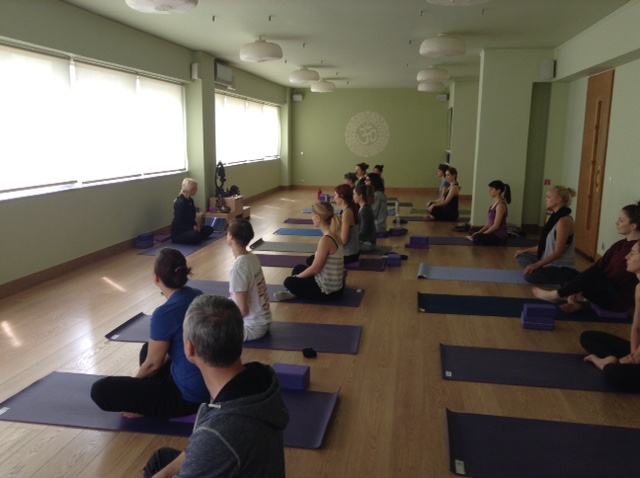
The same can be said for their studio, which is minimal in nature, but has all the props a prop-aholic like myself could want – blocks, straps, eye pillows, and more blocks. There are cubbies for you to keep your personal items and mats for borrow (ask which are public and which are private first, since some students store their mats there long-term.)

THE TEACHING – They Know Their Stuff!

Mindy & Simon have done their fair shares of trainings and there’s no sign of slowing down. Teaching yoga is what they do, and they are good at it.

12983453_10156683111315567_662446499601727085_oMindy teaches Ashtanga-Vinyasa classes that bring in elements that feel like physical training. It’s never the same old, same old sun salutation warm ups in her class – she switches it up to work different muscles and prep students for what’s to come. As a fellow teacher, I highly appreciate the design details that each class has and I truly learn from classes, instead of just being guided through poses. The sign of a good yoga teacher.

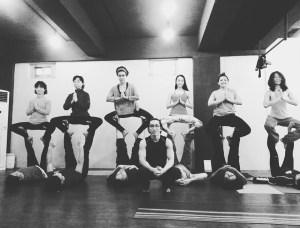
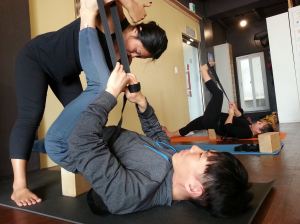
Her teaching style is creative and unique. Students leave having worked their muscles, often in partner exercises which are an extension of the playful and challenging acro yoga classes that Mindy also teaches. If you thought I couldn’t compliment Mindy’s yoga teachings anymore, then you were wrong because her acro classes are an equally fun way to learn more about yoga, yourself, and yourself through yoga. You can read more about my Kaizen acro experiences here and here, oh, and here (I told you I went to a lot of her classes.)

Simon, the other half of Kaizen, has a background in body weight training which comes through in his classes that push students physically, but most importantly safely. Simon’s other trainings (he also teaches jui-jitsu) aid him as a teacher of yoga and therefore benefit the students by giving them a well rounded practice from start to finish.

His Handstands Club class for example, is a four-week series that works on form, Simonalignment, and technique. Rather than just having students hop up into handstand against a wall, Simon works the areas of the body necessary in the advanced pose, and he works on them for the full four weeks. It’s a continuous series, and while the goal isn’t to perform handstand in four weeks, which is very unrealistic, he will get you pointed in the right direction to maybe one day to master the pose.

DIRECTIONS

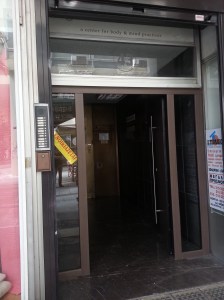
Take the green line of the subway (Line 2) to stop #212, KSU (short for Kyungsung University) or 경성대학교 in Hangul. Go out Exit 5 and walk straight. Take your first left directly in front of Artbox. Walk two and a half blocks until you see a boutique called Zebra on your left (on the right is a yellow cafe [of course – there are a gazillion cafes in Busan] called Compose Coffee.) Walk into the building entrance which is just left of Zebra, and take the elevator to the 6th floor. There is no sign for Kaizen in the elevator, look for Man to Man Fitness in Hangul on a red sign for the 6th floor, which is what the studio was called before Mindy and Simon took over.


COST

Since classes at Kaizen are designed and taught in four week series it is best to buy a month’s pass. You can buy a 4 class pass to cover a specific class, say Simon’s Handstand Club, or you can buy a bigger quantity, or you can get a one-month-unlimited-membership pass which covers all classes. Visit this page for details on pricing. Drop in classes are 20,000 won (roughly $18.)

mindy&simonacro

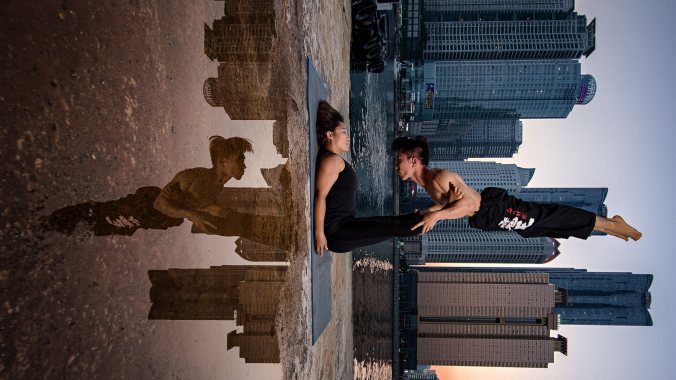
Mindy and Simon of Kaizen, Busan.


Disclaimer: The reason that I have not written my Kaizen studio review for so long is because I was a stand in substitute teacher at Kaizen when trainings and workshops took Mindy hopping around the globe. Teaching at Kaizen then became a regular class in my teaching schedule. I felt it unprofessional to review the studio while teaching there, so am writing the review after my Busan departure.


Bhavana Yoga Center, Athens, Greece – Review

My time in Athens is short, so I’m happy that I was able to find a  community class at a centrally located studio right in the hustle and bustle of the old city. Bhavana Yoga Center  is easy to get to (directions below) and hosts frequent classes throughout the week.

The class that I attended was a Saturday noon-time community class. You can find specifics about community classes, like who’s teaching and what style it is, and all other classes (they host an array of styles and list level specifics) on their website under Weekly Class Schedule.

Directions

Bhavana Yoga Center is located on a popular pedestrian street called Aeolou, which you’ll likely find yourself on as you explore Athens. It’s not far from the Acropolis and is home to lots of cute cafes and restaurants. There are also two Greek Orthodox churches on Aeolou Street which are good landmarks to use to find the yoga studio as it is situated between them, so if you pass both of them then you’ve gone too far.

The address is: 43 Aeolou St. & Kolokotroni                     20160402_141723.jpg
105 51, Athens – Greece


The Studio

Is beautiful. I couldn’t stop thinking how beautiful it was while I was having a look around before class began. Everything about it is warm and homey with sprinkles of humor thrown in (a handmade sign on the cork bulletin board read: “Warning: yoga causes health and happiness.”) The entrance way invites you to remove your shoes straight away and silence your phones. There’s a changing room for each of the sexes as well as bathrooms and showers. They have lockers which you can lock up if you bring your own lock. There are mats to borrow as well as props.

Be sure to arrive 15 minutes before your first class to fill out a student form and get changed. There’s a comfy lounge area with a couch and yoga books to browse if you arrive a bit too early. Directly in front of the check in desk is merchandise to buy like mats, straps, and teas. 20160402_141201.jpg

The yoga studio is long and open with windows all along the front. There are a lot of yogic relics like Hanuman and Shiva around that made me feel homesick for India and that add to that warm feeling. The community class I attended lasted an hour and 45 minutes. The teacher was a visiting teacher from Germany and the class was taught entirely in English, which is not always the case I was told afterwards. Classes are taught in the native Greek as well, but with some Sanskrit knowledge and peeking while in poses classes can be taken anywhere in any language. (Side note – the studio and their website were one of the most English friendly, and therefore tourist friendly, that I saw while searching for a studio in Athens.)

IMG_0449


Cost

The cost of Saturday community classes are 8€. If you try a mid-week class and it’s your first class at the studio, then the cost is also the same low 8€ with regular drop-ins costing 15€, not too bad for a European capital city.

More detailed information on pricing can be found via their website here.


Bhavana Yoga Center, in my opinion, is a must for a travelling yogi or yogini in Athens. All in all it was a great experience visiting the yoga center and I left ready to start my Saturday touring Athens with much needed energy and warmth.