Celebrate International Day of Yoga

Wednesday, June 21st is International Day of Yoga, or at least it has been since the prime minister of India  and the United Nations General Assembly declared it so three years ago. On that first day of International Day of Yoga in 2015, thousands of people practiced yoga in hundreds of different cities in many different countries around the world and did so again in 2016. Just the same, there will be thousands of celebrations around the world this year, and there may be one near you.

International Day of Yoga is a day in which people are encouraged to practice on their own or find an event to attend, the day is a day to take time to practice for health and well-being, and it is also the summer solstice – the longest day of the year in the northern hemisphere, which makes it a great day to practice outside in nature.

This internationally celebrated day, as opposed to other silly national and international days (say National Donut Day, sorry to throw a dash of negativity in here, but I do find it slightly infuriating that more people recognized National Donut day as compared to World Ocean’s Day  here where I am in the U.S. and nobody I know locally participated in National Ride Your Bike to Work Day, but there’s hope for next year and chance of redemption with International Day of Yoga) is a day that promotes health and well-being in yoga studios, communities, and schools. The practice of yoga is beneficial for the physical and mental body. Yoga strengthens muscles and increases flexibility in muscles and joints. Yoga is a safe form of physical activity for all ages when taught and practiced with awareness. When meditation and breath practice is included, yoga has the added benefit of calming the nervous system and mind and relaxing away tension. This is a day that encourages all of this and on which you can likely find an event nearby to practice at, in my opinion this is an international day worth recognizing and participating in.

Most events are free or donation based. Many are held in front of monumental and historical landmarks such as the Capital Building in D.C. and the Eiffel Tower in Paris (shown below). For the past two years I have had the good fortune of teaching at and being apart of events in Busan, South Korea, my old expat-hometown. I have since relocated back to the United States and am excited to be bringing an International Day of Yoga celebration to Jamestown, New York, it’s first I believe – very exciting.
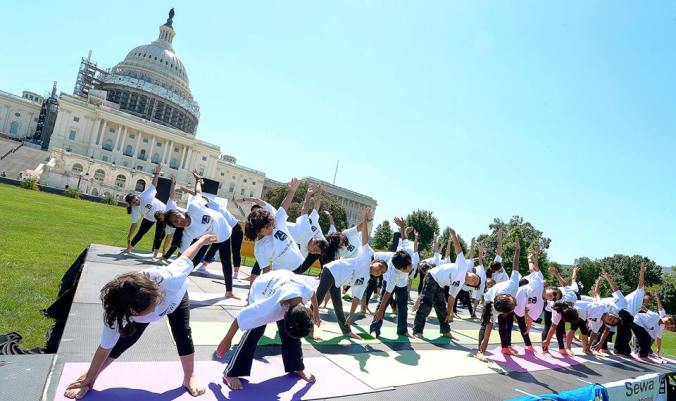
Yoga-dcYogaEiffelTower

Our event in Jamestown, which is being hosted by Sun Moon Yoga, the beautiful, newly-relocated studio that I have had the pleasure of teaching at for the past few months, and will be held in the second story court yard of the historical building where the studio now resides. The two-hour session will consist of 108 sun salutations, also known as a yoga mala. There will be at least three teachers teaching a wide array of styles of sun salutations to students who are encouraged to rest in child’s pose or even step off of their mats for a rest and refuel with provided refreshments. Jumping into a practice of 108 sun salutations is a major increase to students who may only be used to doing 3-6 salutations in a class, or may have never even done them, so taking rests are highly recommended. International Day of Yoga is by no means a day only for those who practice yoga regularly, but rather it is a day for newcomers to try yoga, maybe for the first time, so that they too can reap the benefits of this ancient science.

Celebrate International Day of Yoga

To find an event near you, which may be occurring this coming weekend, June 17-18th or the following weekend of June 24-25th, simply google an event in your city, ask your neighborhood yoga studio, or look for events on Facebook. To attend the event in Jamestown, arrive to the Pearl City Arts Building located on Cherry Street between 2nd and 3rd a little before 6pm to set up. The event in Jamestown has a suggested donation price of $5 or whatever you can give (if money is tight for you at the moment, please come regardless and practice for yourself and the community, donations are suggested, but not required) which will benefit Saint Susan’s Center in Jamestown, a local soup kitchen that provides meals to those in need.



Teachers – Create a Community in Your Class

We all know the usual drill of attending a yoga class – walk in with your mat, take off your shoes, roll out your mat, either at the back of the room if you’re shy or a beginner, or at the front of the room if you’ve been practicing a while or show up late. Then sit on your mat, maybe stretch out a bit (before you’re about to stretch out) as you wait for the teacher to begin class. Often times it’s quiet in the studio, no music, and generally students don’t speak to each other unless they already know each other outside of class.

The class commences, sometimes without the teacher getting names, the flow is guided, students follow, it all ends in a relaxing Savasana from which the teacher pulls you back into reality and everybody silently rolls up their mats, exits the studio space to slide their shoes on, and walk out the door.

Although the yoga practice itself is calming and rejuvenating, in an atmosphere of solitude and isolation on individual mats feelings such as loneliness and anxiety can also creep in as a result of slight social anxiety and students comparing their body’s abilities in poses to the rest of the class and the teacher, as teachers we have a responsibility to make everyone as comfortable and at ease as we can, which requires some effort from the teacher.


As a yoga teacher there are a few easy things that we can incorporate into our teaching to make students feel a part of a community in class.

Meet & Greet

Get names. Ask names as soon as a new student walks in, shake their hand, and give them your name. It seems a simple and polite thing to do, but I’ve been to plenty of classes as a student in which I never meet the teacher and vice versa. Also, have students introduce themselves to each other, it may feel a little forced as if it’s the first day of school (which it technically is,) but by meeting each other relationships may build over the course of the series or if returning students continue to attend.

Definitely as the teacher you should know your students’ names to greet them as they enter class, inquire about their days, and to then use their names to ask permission to make a physical adjustment. I have even attended a class in which the teacher asked us to write our names on a sticker that was put on the top edge of our mats. It was effective for the teacher to remember our names, but I don’t like to be wasteful, so would not suggest to do this unless you are hosting a large workshop.

20160420_090612

Music

Play music before and after class. Even if as a teacher you choose not to play music during class you should have something on as students enter and leave to break any awkwardness. Like music in a waiting room at a doctor’s office, gentle background music can lighten the mood of the room as people enter. It does not have to be elevator music, it could be yoga music or contemporary, just be sure that it is non-offensive and not too loud.

Share Events

Before class begins and as you are waiting for students who are running late, introduce any upcoming events at your studio to promote and ask students if they have any events coming up. This is a great way to learn about things going on in the community and gives students to share any events that they are a part of or care about.

These are a few basic ideas of how to make your class feel more like a community. At this time of polarization and divisive fear-mongering, your yoga studio should be a safe and welcoming place, create that atmosphere as a teacher and keep spreading the love.

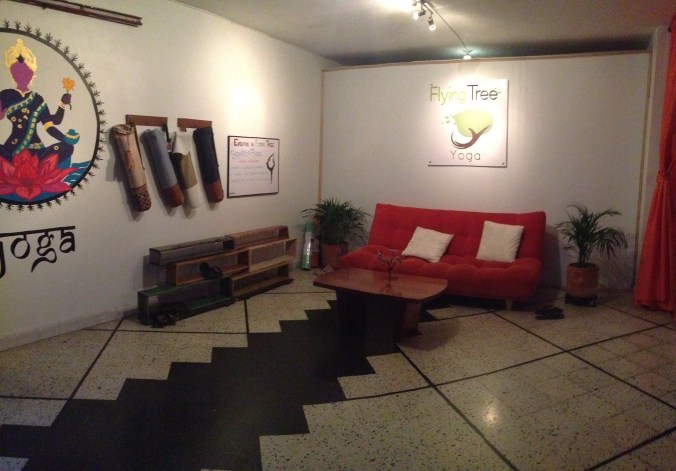
Review: Flying Tree Yoga Studio, Medellin, Colombia

Do yourself a favor and visit Flying Tree Yoga Studio if you find yourself in Medellin. This intimate studio is well worth the 20 minute warm up walk from Estadio Metro Station, address: Transversal 39a #71-85, Medellín, Colombia.

Please note, I did not receive any incentives for this post; it is pure observation and opinion. Some content was provided via email with the studio. 

Class Review – Yoga Flow

Unfortunately, my schedule only allowed for one class at Flying Tree during my time in Medellin. But, boy was it a class to remember. I attended a Friday evening, English “Yoga Flow” class taught by yogi Elodie Huart. Along with five other students, Elodie guided the class with vigor and flair, through one of the toughest yoga classes I have ever taken.

My understanding of what to expect from the class occurred as we rested in child’s pose at the start of the hour-long class. At which point Elodie gleefully stated, “this is the only child’s pose of the night”, translation: “get ready for boot camp style yoga.” The class had me pushing boundaries, overheating, and there may have been a point of quietly cursing on the inside, but I loved it! The class covered a few advanced poses (think, head stand to side crow) and included pilates influences (high plank ab work). With such a manageable class size and practiced students, Elodie was able to work individually with each student according to unique needs.  It was clear she wanted to boost each student’s confidence while guiding with her expertise and talent. In fact, after the end of the class she stayed late to work longer with me on my head stand, further proving that she’s dedicated to her students’ growth.

By the end of the night I was beaming with confidence in my practice and strength. I left with an abundance of energy and felt the repercussions for about four days, a good thing. The class was more advanced that I had expected. Therefore, I would not recommend this class to someone fresh to yoga. On the other hand, please get yourself to one of Elodie’s classes if you are itching for a powerful session with a talented teacher.

More than Your Average Yoga Studio

Flying Tree offers a range of classes in both Spanish and English, which immediately drew me. For a drop in single class you’ll pay $20,000 pesos (under $7 US dollars). But if you are around for a week or more you can up your visits and save your pennies by buying their 4 class pass (must be used within 30 days) for $65,000 pesos (about $5.50 US dollars per class) or a monthly unlimited pass for $120,000 pesos ($40 US dollars). Monthly schedules can be found at their attractive website. Classes are offered in three levels: Beginners classes are taught in the gentle style, Relaxing Yoga classes are yin and restorative based, and Yoga Flow classes are for those looking for a challenge. Another bonus of the studio is that they provide mats, straps, eye pillows and bricks for students without any additional charges. This is always a plus, but is especially appreciated by travelers – hallelujah.

The studio is more than simply a yoga space. The teachers lovingly host events to encourage local and international community. The week I visited they had hosted a “Brownies & Fruta” (brownies and fruit) night after their Wednesday evening class (two things I love!). Other ways they build community are through events such as: teas, potlucks and workshops. To me, yoga is community and an extension of the self, a way to give inner peace to those around you. It’s fantastic that Flying Tree Yoga embraces their ability to encourage communal well-being. A listing of upcoming events can be found via their site.

IMG_1593

The studio also runs an internship program for budding teachers. The program is a month-long commitment (I completely recommend a month in Medellin) in which experienced staff work with interns to find their voice as a teacher. During the four weeks attendees take part in: a two-week Spanish language course designed for yoga to expand their student base, plan and teach classes to the Medellin yoga community, participate in workshops and nurture the self. Check our www.yogainternships.com for full details. An attractive opportunity for teachers looking to grow and travel!

As if all of this wasn’t enough, the studio offers reiki and a variety of massages, additional information can be found via their site.

If you couldn’t tell by now, I was really impressed and happy with Flying Tree Yoga. The space is calming, the staff friendly and their community based work is what the world needs more of. Beyond the links offered in this post, you can find the studio on Facebook and Instagram at, www.instagram.com/flying_tree_yoga/ and www.instagram.com/yogainternships/.


Rise Up! MLK Day Flow @ embrace yoga d.c.

This past weekend was a long holiday weekend here in the U.S.; the holiday was in celebration of the great life and work of Dr. Martin Luther King, Jr., a remarkable man remembered by history as peacefully bringing attention to race inequality in the fight for Civil Rights and to beginning work towards ending segregation. Every January American’s remember his legacy and on the third Monday of the month schools are closed and adults have the day off from their jobs in honor of Dr. King. In many communities there are events that commemorate Dr. King and his life’s work; gratefully, while visiting my sister in Washington D.C. such an event was being held at a downtown yoga studio, embrace yoga d.c., and we were able to attend.

The class was entitled “Rise Up! MLK Day Flow” and was more of a workshop than a class which included a flow, relaxation, meditation, and community building. In the description of the class, which was free, the class was described as being held in honor of Dr. King’s legacy and was meant to empower attending students’ noble work in our changing world. Work that could be professional or personal, but all the same powerful.
The class was collaboratively taught by five different teachers from the embrace studio, which made the event feel as if it really were based in community building and collaboration.  It is enjoyable as a student to receive multiple styles of teaching in one class, because sometimes a teacher doesn’t jive with a student in terms of style of yoga taught, adjustments given, cues spoken, or levels of spirituality. In a collaborative class, students can be happy with the blends of styles and learn more than they would by having just one, solo teacher.
The teacher’s at the MLK class broke up their teachings to cover a warm up, gentle-modified sun salutations, a high-intensity flow of standing poses, calming cool-down poses, a guided Savasana, and a lovely meditation. The transition between teachers was smooth and each one had a strong point of view and confidently led their sections. Before the movement began an introduction was given which included a reading by Dr. Martin Luther King, Jr. as well as a reflection by head teacher, Faith Hunter.
img_0025The heavy theme of creating community is something longed for by many during this tumultuous time of political transition in the U. S. The studio is located in the center of D.C., a city that is smack-dab in the center of the White House transition, or rather the White House transition is smack-dab in the city. The 2016 American presidential election was an emotional event for many because the country is extremely polarized politically, with Washington D.C. being no exception. An NBC Washington news poll claims that more than 90% of D.C. voters voted for Hillary, so therefore it is safe to say that there is a lot of unrest about the outcome of the vote and a lack of support for the incoming president, mostly due to his hateful rhetoric during the campaign trail, insensitive speech that is still being spouted via twitter and press conferences. Posters, such as the one to the right, were visible throughout most neighborhoods that I traversed while in D.C., there was a strong anti-Trump sentiment.

One idea expressed by Faith Hunter that got me excited was her insight that we are in a time of Siva at the moment. In Hinduism, Siva is the destroyer of the universe, and while destruction is often thought of as something very negative, it is also sometimes necessary. In order to come into a new era, the last one must be come to an end. Phoenix rising, you could say. Yes, it is a difficult and dark time to many in this country, but we must be hopeful and positive that the time of Siva will come to an end and we will reemerge into a bright, new era. As President Obama said after the November 8th election, “The sun will come out tomorrow.”
img_0028
The MLK yoga class addressed the darkness felt by many by taking a few moments in the middle of the class to have students voice their fears. The cathartic screaming out of fears, which seemed to be generally fueled by social injustices in the city and the country as well as race based issues, had the entire room of students closing their eyes and yelling out the first things that came to their minds as causing fear in their lives, many specific to the political change in their city. As loudly as they could, students yelled out  whatever it was that has been unsettling them. The small, intimate studio was filled with individual shouts by students. A lot of emotion was felt during this powerful exercise, and while it might be assumed that one of those most strongly felt emotions may have been anger about the issues being aired out, instead an emotion of relief was prevalent over anger. Personally, I felt relief in the fact that there were others, others around my age, whom practice yoga, and who have the same fears as I do in this country. It gave me relief that I wasn’t alone and then I felt hopeful that through building community and discussing uncomfortable topics, that we will be able to overcome hate and celebrate diversity.
Immediately following that exercise Kapalabati was practiced to build a fire, to grow strength to conquer the hate and injustices. Then the flow began to slow into a cooldown and ended in a group meditation. The focus of the meditation was on reaching out to others, to take this experience and go and spread it to those surrounding us outside of the studio and yoga community, to share our ideas of caring and love and to support those who are victims around us.
Yoga is not just a means of toning and stretching, yoga is a tool to better the self and the community. By practicing with others and taking the time to learn their names and their stories, we can better understand the larger community and country. By meeting our neighbors and joining together we can bit by bit get a better grasp of what’s really going on in this divided nation. “Rise Up! MLK Day Flow” was exactly what I needed to refuel my soul, to be filled with the needed energy to live each day from a place of love and kindness and to remember that we will overcome hate and injustices, one day at a time.

Yoga Butts

Introducing Mindy Sisco, yoga teacher extraordinaire, this first post, Yoga Butts, is a perfect post to have in mid-January, a time when we’re tempted to body-hate ourselves after weeks of holiday parties and Resolutions that aren’t always fulfilled. In this writing, Mindy gets personal and insightful about yoga and it’s back-end-benefits, that aren’t for show, but for strength and empowerment.


Many have lusted after it. Lululemon made millions off of it. It has its own entry in Urban Dictionary. The holy grail. The Quan. The Yoga Butt. Against all my scoffing, it turns out to be just as powerful as all the hype.

But(t) before going further, let’s go back. Practicing outside of a Western context, I’m new to the concept having only heard it uttered by a non-yogi friend last summer in Montreal. A Google search of “where did yoga butt start” led me to a string of articles about struggles with body image. This is particularly topical as of late in Korea as pop star, JYP, just released a song about butts. I’ll let you google that on your own. To even greater disgust (I’m looking at your Bill Maher!), afterwards he was chastised, not for his objectifying message, but that the butts he chose to lust after weren’t big enough.  Korea is first in the world for number of cosmetic procedures, a whopping 1/5 have had some sort of augmentation. In a place of immense competition and commodification, Tina Fey’s sentiment couldn’t ring more true.


I’m not immune from the sexualization of yoga here in Korea but I do have the luxury of being sheltered from it. This is based purely on limited passive exposure to media in my native language. I don’t pick up on ads playing in restaurants or images in print the same as I would back in the States. I’m lucky and thankful to be in these circumstances, this bubble. Beyond the bubble, it was yoga that gave me back some ownership of my body. It wasn’t about how it looked, it was about what my body could become capable of. Nobody really looks cool splaying their toes likes a monkey, but mine definitely outstretch most. And I love them. They are hands (feet?) down some of the most dexterous toes in the game.

I decided: I’m reclaiming it. The Yoga Butt is real, and it’s awesome.  When I talk “yoga butt,” I’m going past an ornamental accoutrement made to parade around overpriced pants. Sure, let that be the bait to get you there. I’m talking ass-blasting power that keeps your sacrum stable and you balancing on one leg like King Flamingo. I venture to say that a majority of people don’t walk into a studio seeking enlightenment. What keeps you there is feeling like a badass doing something in the skin you’re in – not 10lbs lighter you, not two inches taller you, not 20 years ago you, not fatter ass you – YOU. Exactly as you are, exactly in that specific moment.

To the undiscerning eye (I’m looking at you, Bill Maher!) my butt is more pancake that apple. If you ever catch me out on a Saturday night, ask me about the time I met Sir Mix-a-Lot doing a radio show. Suffice it to say I was vapor in that studio. Dumps like a truck? No. Yoga butt? Like it’s my job. Honestly, I like it. I feel kind of like a superhero- packing heat undercover.

This is 40 inches -around- of pure balancing power. Photo by Amy Brassington

Insider’s secret: standing balances.

For a big chunk of my time with yoga, both as a teacher and student, I avoided standing balances. I like feeling fire as long as I can move with it. Standing balances were like being forced to stand still in the middle of a furnace while being melted alive. First coming to yoga as a means to work out, I expected to move, not stand still. It took me 12 years to really gain an appreciation for this part of the practice.

The science: body imbalances between the front and back body.

The problem most common across the board is a world full of “lazy butts.” Office life and desk warming leaves us sitting. The gluteal muscles aren’t put to use and if you don’t use it, you lose it.  Without the support of strong glutes, the psoas ends up working overtime to stabilize the pelvis. Hip flexion muscles, the psoas in particular, stay in a shortened position while sitting. This causes tightness over time and can change the default angle of the pelvis. A “neutral” pelvis should tilt slightly forward with the tailbone pointing down. This is why so many people struggle to sit upright on the floor. This imbalance is the start of a world of hurt: knee pain, back pain, eventually spiraling up the length of the spine to affect the shoulders and neck. Time to put that butt to work!


Click here to see the original posting of “Yoga Butts” by Mindy which includes a short sequence that will burn your glutes so good. For more information on the author, go to the About section of the blog to read Mindy’s bio.

Manifest Your Destiny, Set a Meaningful & Successful Resolution for 2017

The new year is approaching quickly. Now is a time to look back at the past twelve months and appreciate all that was good and learn lessons from the bad in order to switch out bad habits for good. Changing habits is extremely difficult, so take advantage of the New Year to motivate you into making some healthy resolutions. Read on for some simple tips to get you started on your resolutions and to come back to when the going gets tough later in the year.


Think Hard About Your Resolution

If you’re serious about starting 2017 in a healthier way, then take the setting of your resolutions seriously. Meditate on what your change will be. Sit in silence and bring your mind to focus on what would really serve you best. If you already have a yoga practice, then do this thinking after a strong yoga asana practice when your mind is clear of all of it’s normal, monkey-mind clutter. If meditating is not your thing (yet, maybe a goal for 2017?) then do a simple brain storm on paper to discover what change will be best for you in the coming year.

Share It

Once you have your goal in mind then be brave and share it with someone. It might feel vulnerable to do so, but by sharing your change with a friend or family member you will begin to turn the wheels on your new habit. Having someone else know about your goal will motivate you to put it into action, if you tell someone and it never materializes, then you might feel embarrassed about not pulling through with your commitment. The person who you inform can also act as a motivator by asking about your progress now and again. Plus, you never know, maybe your friend has been wanting to make the same changes in their life and you could be the nudge they needed to take the plunge. Two people tackling a new healthy habit together are much more likely to succeed than just one.

Start Small

Changing habits is tough, to make things easier on yourself start small. Let’s use yoga as an example. If your yoga practice has ebbed and flowed, being strong and nonexistent in 2016 and your goal for the new year is to get a consistent, strong practice back, then start small. The long-term goal might be to practice for an hour, 5x /week, but that is a major change in your schedule to begin on January 1st. Be more realistic by starting small. Instead of trying to do an hour practice every day, start by making the time in your schedule to do 20 or 30 minute practices a few times a week. It will be easier on your body and on your ego, for if you start big and fail, then you may not get the energy to try again later in the year. And by starting small you can gradually build up to your bigger goal.


I hope these simple tips can get you excited to make change for the better for your health and yourself in 2016. Whether you want to increase your practice, get your arm balances down, or give up carbs, meditating on your change, sharing it, and starting small will help you achieve your end result. Have a safe, happy, and healthy New Year!


Join me for a Flow into the New Year yoga workshop in Jamestown, NY on Saturday, December 31st from 2-4 pm. For more details follow the sidebar link to Kara Bemis Yoga Facebook page.

15621848_1276837942391683_3329750139827476700_n

Come On, Get Real – Pranic Food

I wrote a few weeks ago about trying to eat as many whole foods in my diet as I can and to try my best (it’s not always easy) to steer clear of processed food. There are definitely nutritional reasons to do this. Food that comes in boxes, cans, jars, and bags may resemble what they’re striving to be, or may very well be a frozen or only semi-processed version of what’s pictured on the label, but some processed foods are far and removed from real food. Take Lucky Charms as an example: the carbohydrate cereal part is an odd, cardboard color and the “marshmallows!” From my memory of being younger, I remember those marshmallows being hard to the bite, much unlike an actual marshmallow, and dying the milk all sorts of shades of pastel. I think we can all agree that Lucky Charms and other such sugary, grainy, processed cereals and food are very much unlike real food and therefore if placed on a scale would rate very low as to how much energy, or prana, that they provide the body.

For those of you who are unaware of prana, it is commonly translated into English as “Life Force Energy,” or more to the point as energy. Primarily prana is used to refer to the energy that is sent throughout the body by use of the breath. You may hear yoga teachers say something along the lines of, “Use your breath to send prana into all areas of your body.” Pranayama is the Sanskrit word meaning “control of the life force” and in yoga class is used to describe an array of various breathing techniques to utilize for a more advanced yoga practice, for as we know, yoga is a heck of a lot more than just asana (physical posture.)

Now, when it comes to diet and prana, then prana is the energy provided to our bodies by means of nutrition, and not all foods are created equally when it comes to nutritional value. And if you’ve studied Ayurveda at all then you’ve heard of the three doshas, (I’m afraid that that’s too deep for me to include in this post and would be better left to a person more versed in Ayurveda than I) and in order to create balance in the body and in life, then each blend of the doshas should eat foods specific to their doshas, but again, that is for another post and I don’t want to lose you, but you can’t very well write a post about Ayurveda and not include a mention of the doshas. I want to be much broader here and think of food in terms of its energy value, and I’m not talking about a caloric number.

Consider when you grocery shop, eat out, or prepare a meal how much prana, or energy that the food you are preparing and eating has within. Now I know what some of you are thinking, “Wow, this is some hippy-woo-woo crazy talk!” but stay with me here. Fresh, organic, whole foods contain a lot more energy, or nutritional energy, or prana than food that comes from an aisle and has a shelf life of many months. I understand that packaged and processed foods hold their value in low-cost and convenience, but I think that we would all agree, that eating whole foods is better for us than eating packaged foods.

I’ll use an example for clarity; think of coffee, and I know – coffee is not very Ayurvedic, but it’s a food item that most people consume daily. Here are two examples of a highly pranic coffee option and some processed, lifeless options.

Pranic Coffee 20160802_101833.jpg

Organic, fair trade, whole bean, freshly roasted, freshly ground close to the time of consumption. See photo of green coffee beans in a basket, freshly roasted dark or medium roasted beans (all organic and fair trade,) organic milk and organic raw cane sugar all set up for sampling by my friends at Ironwood Coffee Company of Owen Sound, Ontario. Check them out via the hyperlink. This is coffee that will give you energy!


Non-Pranic Coffee

20161210_155823.jpgPre-brewed, cold, highly sugared with high fructose corn syrup, sat in a cooler at a convenience store, packaged in plastic with a long shelf life; or grounds sat in a plastic (non-recyclable might I add!) K-cup; or coffee grounds bought in bulk at the grocery store that has a use by date of one year after roasting. These examples all processed more than the freshly roasted beans above and therefore have lost prana along the way.

Once you begin to think of food in terms of life held within it gets easier and easier to see the difference and make better choices when out shopping. Organic produce and products beat out non-organic, and of course freshly picked, grown in your back yard with organic compost has even more prana. While staying at the Ashram in Zdaric u Skutec, Czech Republic, Jan, my host ground his own flour on site in his kitchen because it contained more prana than flour bought at a store. He then prepared Ayurvedic meals with that flour and other local, fresh ingredients. The featured image of a meal on a tray was taken during my yoga training in India. The food served there was Ayurvedic, freshly prepared, vegetarian and full of zing. The nan shown was prepared fresh, by hand for every meal, the vegetables cooked with spices and love. Not pictured is freshly made yogurt made with milk from the cows that lived in the goshala on the Ashram grounds – now that’s pranic food! Fresh, probiotic, real living food.

Whether or not you think that prana-Life Force Energy is a load of baloney, or you’re delving deeper into your yoga to include healthy choices off the mat and into the kitchen, making wiser choices of eating fresh, whole, and when you can, organic foods is going to feel a lot better for your body than eating processed food. You don’t have to go to the extremes taken in an Ashram, start small and build up as you learn bit by bit about your body, it’s digestion, and which foods fuel it with the most prana. Live well.

Teacher Tech Tools

Being a yoga teacher requires a lot of self promotion and preparation for classes. Whether you get yourself a regular gig at a yoga studio or go completely free lance you’ll have to self promote your classes, style, skills, and experience. And then once you get in the studio, you’ll have to deliver. Here are my top tech teacher tools to help you be the best yoga teacher you can be.

Blue Tooth Speaker

Invest in a good quality blue tooth speaker, one that’s light and transportable and that delivers on sound. These come in handy to bring with you to outdoor, public space classes where other options requiring plugging in may not be available, keep in mind however, that if you host class in a very public space or near to a busy road, then even the best blue tooth speaker won’t be heard over honking horns or screaming kids. If you teach on an early Saturday when the public space isn’t busy yet, then bring your speaker for added energy to the class. Chose your playlists wisely.

Actually, Let Someone Else Chose Your Playlist

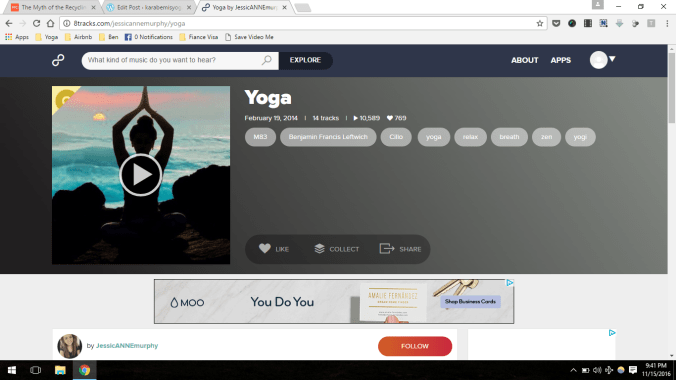
When I first started teaching I used to stress out about making the perfect playlist for each class. Honestly, I would spend more time on the music than on the sequence. I was fixated on having the best tunes for the varying layouts of each class. Thankfully for my schedule and my nerves I’ve loosened up about my music. Now I rely on a sharing service to have strangers in cyber space chose what students vinyasa and hold to. My choice of music site is 8 tracks. I know most people in the U.S. use Pandora, but Pandora wasn’t available abroad in Korea, so a friend introduced me to 8 tracks and I much prefer it. My go to vinyasa flow playlist is simply titled: Yoga.

screenshot-13


Get some Great Graphics12010532_899109916831156_7065303320034350228_o

When creating a social media event page, photos generally star as an eye catcher or are just generic-googled yoga images. But it can be more fun and more professional to create a poster or well designed social media image for your classes and events. For this you can hire out a graphics designer by using 99designs, a website where designers line up to design for you after you’ve set guidelines and price, but this site can be pricey and may not be financially feasible for a free lancin’ yoga teacher (may in fact be a better option for a logo.) Another option is Pic Monkey. This site is easy to use and offers a lot of fun fonts and backgrounds, they have recently started charging for they’re services though, which is a bummer. Above is a simple graphic made in 2015 for a community event I co-hosted with a bunch of great activists in Busan using Pic Monkey.

There you have it, a few simple tips from me to you for using tech to get the job and in class once you have it. Teaching yoga involves a lot more than just shouting out a pose name. As a yoga teacher aim to make your classes and events special and memorable by meticulously planning from the get go all the way through to the song that plays in Savasana. Utilizing tech tools can aid you in achieving that goal which in the long run will aid you in retaining students.


Grace Studios, Free Outdoor Yoga Class, Silver Spring MD

I recently visited my lovely twin sister in Washington D.C. for a few days to see the monuments and museums, but before any of the tourism we attended a free outdoor yoga class near her work in Silver Spring, MD. The class has been running weekly throughout the summer and into September. Luckily my trip caught the second to last class, but my sister’s been attending regularly.

A Silver Spring studio hosts the classes which are held quite literally downtown. I envisioned doing the class under a tree in a small green space so was a little surprised when we turned the corner of the main pedestrian strip downtown and saw the stage set up to do yoga right in the middle of the street. We laid our yoga mats down right in front of the stage and had a seat to wait for the class to begin. By the time 7 o’clock hit there were around 15 people set up all around us, a pretty good number of students.


The class was taught by a teacher named Susan who guided us first through some breathing exercises to ground us for the changing of seasons and then quickly picked up the pace with core work and flows. Personally for me it was just what I needed. Since returning to North America I haven’t been able to attend a single yoga class, so this was my first in three months – a new record I think (one that I hope stays as it is – I need to get back into my home studio again!)

Back to the outdoor yoga class experience, practicing smackdab in the middle of the main shopping and dining area of Silver Spring was slightly uncomfortable at first, but by focusing on deep breathing and dristi (staring or focus of the eyes,) I was able to keep my mind on my mat, consumed by my practice, able to ignore the passer-by-ers all around.

Doing a yoga class as a student in public was a learning experience, seeing as I’ve taught a lot of beach classes but haven’t been a student at many. I was able to feel the vulnerability and shyness that some might feel at outdoor, public classes, and with that will remember to focus and ground my future students the next time I get the opportunity to teach a public class. All in all it was a really nice yoga class. The flow was challenging, yet fun and most of all I was very happy to be able to attend a class with my sister, something that hasn’t happened since 2014.

Unfortunately this post is being written too late for most Marylanders to get to a free community class in Silver Spring, seeing as the last one is tonight, but if you find yourself in the Silver Spring/Takoma Park area and are looking for a nice flow class I’d recommend visiting Grace Studios. I must be honest though and say that I have never personally been to Grace Studios, but my twin sister has and she has really enjoyed the classes there. In fact, she even rented the studio out for a private group birthday class taught by a teacher that she favors. That alone is enough of a good reference for me to tell you to visit.


Yoga Tips for Swimming

I’m fortunate enough to have a boyfriend who likes to learn and study. When he gets interested in something new he learns as much as he can about it. That is what happened with him and swimming – therefore, in our symbiotic relationship I received his skillful knowledge in the pool. Whether you’re a freestyle swimmer in the lane or just want to increase your swimming technique for the beach, I pass these yoga tips and swimming tips along for you to try out and enjoy.

If you’re not a swimmer already  you may want to consider adding a pool session or two to your weekly schedule. Swimming is great cardio that’s much gentler on major joints suffering from strain or arthritis. At first, like any new hobby or exercise routine, i.e. – yoga; swimming can feel frustrating initially. It may feel more like flailing than swimming, but stick with it and you’ll be gliding down the lane before you know it.


Yoga Tips for Swimming

My pool regime consists of gentle warm ups and then goes straight into a few laps of freestyle. Let’s break down freestyle (you know that style that most everyone uses, arms circling up over head, face in the water, legs kicking behind you) from top to bottom of the body parts utilized in terms of yoga warm ups and swimming techniques.

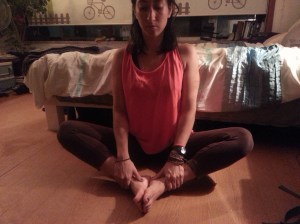
  • Swim Breath: Typically when swimming freestyle you inhale on the surface of the water by twisting your head to one side, through your mouth. Then you slowly exhale through the nose or mouth (I prefer nose.) While still on land, practice slowing down your breath only through your nose and then workshop the breath specific to Bound angle poseswimming. In a comfortable seated position, turn your head gently to the right and inhale through the mouth, allowing your mouth to open just slightly. Then slowly return the head to center and exhale through the nose or mouth – emphasis on going slowly here – count the exhalations at either a 3 count or 5 count. Turn your head to the left at the end of the empty breath and inhale through the mouth in the same manner as you did the first time. Return the head to center and exhale to your count of 3 or 5. Continue this simple, relaxing breathing technique for a few minutes. Eyes opened or closed.


  • Shoulder Openers: Of course the arms and shoulders are a major component of freestyle swimming, so be sure to safely warm up your shoulders before getting into the pool, especially if you have any shoulder issues. To warm up your shoulders, place your fingers on the tops of your shoulders, elbows pointing out at your side. On an inhalation roll both elbows in towards each other aiming to almost touch them together in front of your face, continue the roll to point the elbows up towards the ceiling keeping your fingers on your shoulders. On the exhalation, roll the elbows back behind you lifting your chest up. Continue to move with the breath and after 10 sets as described switch the direction of the elbows this time inhaling the elbows behind and exhaling them down in front of you for 10 more rounds, adding to 20 total.


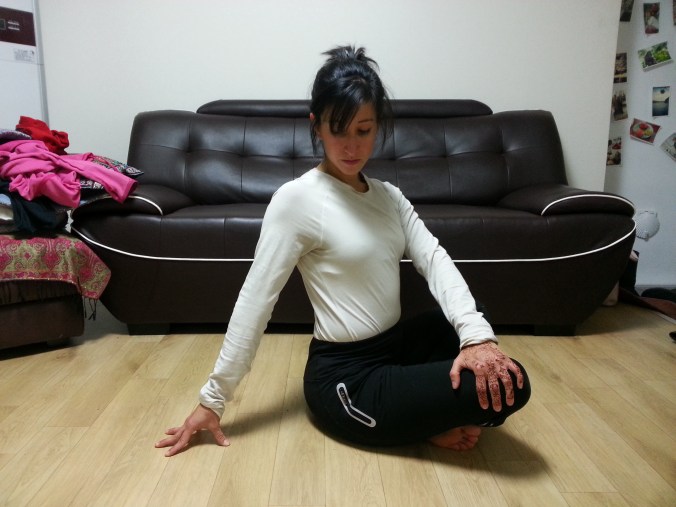
  • Twist it Out: After you get in the pool and start your freestyle swim allow yourself to get used to the stroke and breath work attempting to take your inhalations from right and left, which is why counting the breath to a count of 3 or 5 is key. By counting your exhalations to an odd number your inhalations will alter which arm is extending and entering the water, alternating right and left and therefore alternating to which side you turn your head for your inhalation. We all have a dominant side and it’s tempting to breathe in from that dominant side only, but practice inhaling from both sides for balance in your swimming. As your body moves through the swim it will automatically twist to the side that you inhale from, or the side of the back arm that’s exiting the water, elbow up as the other arm is reaching forward and entering the water in front of you. To better understand this movement try it now, seated or standing, begin “swimming” with the arms only and notice how when you reach your right arm forward and pull your left elbow back your body naturally twists at the trunk/core to the left and vice versa when the arms are switched. To increase awareness of twists in the water, warm up outside of the pool with simple yogic seated twists – parivrtta sukhasana. Sit cross legged, spine erect, inhale center and exhale twist to the right placing the left hand on the right knee and right hand behind you to aid the twist. Hold for a few breaths. Return to center on an inhale and exhale to the left. Hold and continue for 10 sets.

20160121_182009.jpg

  • Front Body: The front of our hips and lower torso are often pretty tight from sitting, driving, cycling, and other such activities where the knees are bent and thighs parallel to the floor. Swimming counteracts the sitting position because the legs are extended back behind you, but due to our tight muscles in the fronts of the legs, finding correct form in a freestyle swim can take some time and patience. When you get in the pool, try not to overly bend your knees in your kick. Before jumping in, open your front body by standing feet hip distance with a little micro-bend in your knees. Place your hands at your low back and on an inhalation start by pushing your thighs and hip bones forward extending the stretch up your front body to your chest. Lastly, on the same inhale breath, gently, gently release your neck, careful not to mindlessly drop your head as far back as it goes, but instead keep some control and if it is painful on the neck then keep the chin tucked in the entire time. Start by holding the back bend for 2-3 breaths and slowly come up on an inhalation. Increase the hold as comfortable.


Have fun reigniting or introducing a new, healthy habit into your week. For better success get yourself a pair of decent goggles and a swim cap to keep pesky hairs out of your eyes, and a sporty one piece as opposed to one with cut outs or a bikini, you don’t want to be adjusting in the water. Save the two piece for sun bathing.