What I Would Have Said

I hosted a clothing swap this past weekend in Jamestown, NY. It was the third swap that I have hosted in the area and I was determined to speak at this one about the ethics behind the event. At the previous swaps that I hosted in Korea I spoke to attendees about my reasoning behind hosting, how I disagree with the modern, fast-fashion industry, and the primary problems with the industry in terms of labor and damage to the environment. However, back on U.S. soil in the small city near the small town where I reside and teach yoga, I could not give a similar speech.

Let me explain that technically I could have and the people attending would most certainly have been polite and receptive, but at each of the three swaps in the U.S. the time for speaking came and went. I felt that there weren’t enough people and if I spoke to a handful of swappers, then it would have felt too much like preaching. At this last one I even advertised that I was going to speak on the ethics, but as the clock ticked closer to my time to speak everyone seemed to funnel out of the door. Do I think that this was intentional? Maybe on a few accounts, or maybe they had elsewhere to be and had already done their swapping for the afternoon. There wasn’t a massive collection to browse, so this is a very feasible option. Whatever the reason, my audience left the room.

I was bummed, but upon reflection I realize that “preaching” to happy people swapping their clothes for others’ may not be the best way to go about it. Posting on my website might be a better way to share my views on fast fashion and why I avoid it. For if I were to have spoken to people who happily (and blindly) shop fast fashion then it may have been perceived more as an attack, like a vegan lecturing a gang of omnivores on the detriments of factory farming at a party, at a Korean BBQ restaurant.

There is also the sad truth that environmentalists can come off as being major Debbie Downers (I have been extremely guilty of this in the past) when they share how the world is slowly ending at the hands of consumers, also known as people. That last statement, was of course a cynical joke – mostly, but on a serious note, people having a good time may not want to hear about pollution and labor rights. But if you have made it this far into the post, then you may be curious enough reading about exactly those two things and more depressing facts of fast fashion, if so, then carry on reading.

Why I Host Swaps… My Unspoken Speech at My Most Recent Swap (altered slightly for word and general public, main ideas the same)

The reasons that I host swaps can be summed up in four words: labor rights and environmental degradation.  The fashion industry today looks completely foreign to how the garment industry of the last century looked. As recently as the 1990’s, 50% of clothes sold in the U.S. were made in the U.S. Thirty years prior to that in the 60’s, around 97% of clothes were made in the U.S. for a U.S. market.

Today? A measeley  TWO PERCENT or in numerical langauge – 2%. Two percent?!?! We went from almost 100% in my mother’s generation to almost 0% in mine. For the United States that is an entire industry nearly completely lost. Jobs lost. Skills lost. The reason being? Globalization.

The textile and sewing industries were shipped to developing nations where labor could be paid far less than an American worker. Where labor rights were skim, so workers could be forced to work 10 to 12 hr. days, for very little pay, and in unsafe conditions. My fashion revelation and shift in consumerism occurred as a result of learning about the tragedy at Rana Plaza in 2013. Rana Plaza was an eight story building that housed seamstresses in a shoddy building. In a day in April, 2013 the building collapsed killing 1,134 people.  Read more details here about Rana Plaza.

My other gripe with fast fashion is how utterly unsustainable it is. We do not need even a fraction of the amount of clothing that we buy these days and we certainly do not need close to the amount of clothes that companies and the media try to convince us that we need. Fashion trends come and go, and come and go, and come and go again and again and are so in our faces that we feel lesser-than if we don’t keep up. Luckily for us we can generally afford to keep up with the trends because clothes are becoming cheaper with the outsourcing of the work and lower grade fabrics. Clothes have become so cheap, that they are disposable.

We buy without limit. Sometimes we buy without even liking what we buy and definitely without knowing anything about the item. Without knowing that a lot of water, air, and soil pollution was created by production. By material being shipped around the world to be dyed, cut, sewn, and shipped to a shop near us. That those dyes are harmful to the communities that live near the factories that produce them. That most of the items at fast fashion shops are made of synthetics, many of which (polyester & acrylic I’m glaring at you) are plastic based – i.e. come from oil production.

20150905_171037.jpg

[Sidenote – It is this sort of information that makes me feel slightly sheepish for sharing. Nobody wants to be the bearer of bad news, but isn’t it better to be aware of how our choices affect others half way across the world? Anyway, it’s about to get a little more positive.]

This is where the clothing industry has evolved to. It is totally different from the past when people used to make their own clothes or buy from a skilled, local tailor in their community. But we don’t have to shop fast fashion all the time. We have options that are more ethical that we can use to supplement our closets with.

A clothing swap is one, or second hand. Buying fair trade or organic is another way. Or simply getting by with what you have and ignoring the billboards of what’s new and desireable. Ask yourself when you shop: “Do I really need this? Do I have something in my closet already that fulfills this need? Is there a more sustainable way that I can obtain a similar item? Can I just borrow from a friend?” And hopefully by having that dialogue in your head you will realize that you can happily go without another polyester tank top in your closet.


That is roughly what I would have said if I had had an audience to say it to. Changing habits is hard, especially when the habit you are changing is one that brings you a lot of joy. Retail therapy, anyone? But you can still feel the buzzy high of finding a good find a thrift store, or a really well made top of environmentally friendly fabrics and made by fair trade labor. The shift may take some time, but it’s still fun and much more rewarding.

Falling for Yoga

The seasons are changing – weather is chilling, moods are shifting. It’s a time of transition, something that those of us that live in regions that experience four seasons go through four times each year, but each time still feels new and fresh. Sometimes excitement for cozy blankets and books, sometimes with sadness to lose the heat of summer. Likely a bit of both.

For me this change of season is a time to rededicate myself to my yoga practice. People are sometimes surprised to learn that my practice ebbs and flows. This is hard to admit. I know that I should, and need, to be practicing yoga daily, but like all other human beings living in our high paced, overworked, distraction filled modern times, I too have difficulty at times practicing as much as I should. Recently this has become more apparent to me via workshops and meditation.

As a yoga teacher I have been trying my humble best to give my students as much of my knowledge and genuine self as I can. I spend a lot of time studying articles and books about sequencing and anatomy, but what gets pushed aside for the book work and for balancing my time with my family, my full-time job, and teaching gigs, is my practice.

I have never totally lost my practice, it just gets smaller and smaller to where I am sustaining my flexibility and strength but am not evolving it. With this public post and inspiration from the falling leaves, I recommit to setting my alarm, abiding by it, and rolling out my mat. Making a habit stick takes time, 21 to 60 days at least, so I am hopeful that by the time winter rolls around that I will have made personal progress.

The primary goal not being to “land” or “master” certain poses nor to improve my Instagram feed – although if being totally honest, both of those things are benefits of a constant practice, sad as it is we live in a social media world; the primary goal is to have personal discipline and to learn my body more in-depth. By doing these two things I will improve my personal practice and my teaching abilities.

With the weather cooling down and the hygge setting in, I am ready to fall for my yoga practice again. To fall in love and to fall out of inversions. To heat up with vinyasa and to cool down with restorative. To be the forever student that I so love to be, not just a bookworm, but a student of the mat.

Tea Parties – Not Just for Sarah Palin

When planning an upcoming, intimate, period themed event – say for a bridal shower, birthday party, or just because, consider having your party be a Victorian inspired high tea. Give me a chance to explain, they are fun, especially if you’re a history loving nerd like I am that likes to spend weekends watching dorky BBC documentaries. The history part of it is what makes it fun, it wouldn’t be as exciting to pull out some nice china, brew fancy loose leaf tea and wear a trendy romper or worse yet, leave the china in your grandma’s cabinet and drink tea out of styrofoam or Ikea, no that’s not what I’m talking about. The fun part is dressing the part and putting on the Downton Abby theme song while sipping tea out of antique tea cups.

For the wild and crazy kick off to my bachelorette party, my girlfriend treated me to a high tea at a cafe in a nearby town. The tea came complete with a lace table cloth and heated, raised tea pot with a lit candle underneath to keep it warm. We chose our selection of sandwiches that came out as triangles on tiered serving trays. There were little sweet treats on beautiful china. The other events of my bachelorette party were not nearly as reserved as my Victorian collared shirt of the high tea, but for two whole hours we were as proper as ladies of the house.

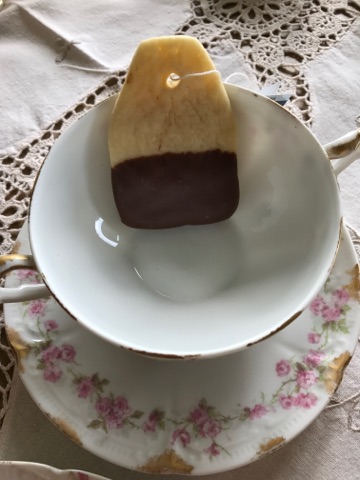
Somebody paid attention to my affinity for tea and history and planned a gorgeous tea bridal party. The bridal party was put on by my aunts and sister. The location could not have been more perfect – it was held on the wraparound porch of  my aunt’s fantastically restored Victorian brick house. There were five tables on the porch for guests with each one having  it’s own individual set of vintage china. My aunt had collected them at estate sales and second hand shops and she put them to good use for the tea party. She even IMG_3193made homemade cookies that so precisely resembled a real teabag that I had to double take at the teacups when I first walked on the porch to realized that they were edible. There’s a recipe here for similar cookies.

Tea parties are a nice  changes of pace to parties with alcohol because they’re generally quite and well mannered so conversation can be easily had. They cost less since alcohol doesn’t add to the cost of hosting, but they do require time to plan ahead. Things need to be collected, borrowed, or pulled out of cupboards. Hunting for the bargains and the sets with the most beautiful or unique patters is fun though, so the work ahead of time doesn’t feel like work at all. Our local thrift store often does 50% off of items if they’ve been in the store prior to a specific date, so it wouldn’t be uncommon to walk out of there with a four piece china set for around $5.

Of course the major benefit of using vintage items is that they’re real. No plastic forks, cups, or straws. Less waste and an appreciation for what was once very special items of the home. At my bridal tea party, my aunts took the zero waste even further than the teacups and saucers, they also put vintage table cloths on each table along with linen napkins. Some napkins had vintage lace napkin holders that added to the period theme. Another way to decrease waste would be to use teabags that do not have strings or labels, my favorite brand in the U.S. for that very reason of not messing with strings is Celestial Seasonings. A step beyond would be to get loose leaf tea in bulk in a reusable container brought in from home or even beyond that, to dry your own herbal teas from the garden, mint being my favorite and easiest.

Other ideas for your future tea party are to dress up for the occasion. Theme your tea party as Victorian like mine was or more modern such as the 1950’s. If you have it in the summer have some iced teas as well or instead of hot teas. If hosting a tea party seems like too much work then find a local cafe or bed and breakfast that hosts one. The tea that I went to was in Warren, PA at a cafe called The Arbor Coffee House (reservations are required for high teas in advance.) Make your tea party unique to you, try to create as little waste as possible, and remind yourself that tea parties are for grown ups (and men,) too.


Yoga Teachers – Continue Education

A two hundred hour training is not very long to learn an ancient practice of the breath, body, mind, and spirit, yet that is all that is required to be yoga teacher, and really it is not absolutely required because as of right now there is no licensing required to be a yoga teacher. That is why it is beneficial to the teacher and therefore to their students to attend as many classes as they can, go to workshops, and if possible attend multiple trainings.

That being said, yoga teacher trainings are expensive. The cost of mine in 2013 in Nicaragua was around $3,000, not including flight. The cost of my most recent training in India was much less, but still at least $1,000. Those prices may look high, but they are pretty low compared to what else is out there. When I was researching trainings I found some for as much as $3,000 for a two week, two hundred hour training (how you can cram 200 hundred hours and thousands of years of knowledge into two weeks is beyond me) which did not include any accommodation or food. The trainings listed above were both month long intensives that included room and board for the entire month. The current, official Bikram training, held at a fancy resort is $16,600 USD for a single room, the training is around two months long, therefore double the length of either of my individual trainings, but still very pricey.

Examples of costs of trainigns are to emphasize that I realize that most people cannot afford to take multiple trainings. That being said, what teachers can do is attend workshops, join studios, find a private teacher, and/or study online. Finding classes and workshops that are designed to be continued education. YMCA, power yoga classes are not what I’m talking about. Those are fine for a teacher to take to get ideas about sequencing, playlists, and cues, but in order to learn more about yoga, teachers must practice themselves and continue to study as much and as often as they can.

Workshops are great because they break poses down and actually teach how to teach, if geared towards teachers. Even if a workshop is for the general public and not towards teachers then teachers are still likely to learn something more than they would in a workout-style class.

A teacher could take every workshop and training available in their area and still not learn yoga in totality. That is impossible. What you can do it specialize your practice and teaching skills. Take workshops that are geared in what is needed in your local market or that you have a keen interest in. Areas of specialization might include prenatal, vinyasa, alignment, etc.

Once you get to a workshop make it worth as much as you can, ask questions, introduce yourself to the teacher and other students, network, and practice hard. Take handouts and study them. Take a notebook and pen and take notes. Treat your workshop time as you did your teacher training time and study.

Self study and being a forever student is what a yoga teacher needs to do to better their own personal practice and therefore to improve their ability to teach their students and to continuously offer more. A stagnated teacher leads to stagnated students, and yoga is about progression.


Plastic Free July

It’s the end of July 2017 and to your knowledge or not it is the end of another annual campaign to cut back on plastics use. Plastic Free July is a worldwide campaign that began in Australia a couple of years ago. I mention that you may not have been aware of the movement because sadly it is still on the fringes of public awareness. My feeds are sprinkled with posts and hashtags, but yours may not be. Mine are because I am a known plastic hater, I seek out information on how to cut back on use and what other’s are doing around the world to make a change to the mindless use of single use plastics.

Plastic Free July is a challenge simply put and you don’t have to think too far out of the box to get a sense of what it’s all about. Of course the challenge is not to cut plastic out of your life for a month 100%-completely, that would be impossible. Plastic makes up the computer I type on, the fibers in the carpet I lie on, the watch face of the sports watch that I wear and never take off, and almost everything else in the room that I am in at the moment (fan, lamp shade, parts on my bike, my phone, my phone case, the list goes on.) No, it would be very close to impossible to give up plastic totally, instead what the campaign is about is cutting back on single use plastic.

Single use plastic make up big portions of our day-to-day lives in the modern world, but unlike what was listed in the last paragraph, single use plastics can (and very much should) be cut from your life.

To the point, single use plastics are described in the name but if you can’t think of an example  then let me list a few: plastic forks, knives, spoons, plastic zip lock bags, plastic bags at any grocery store or shop, saran wrap, straws, lids on to go cups, plastic cups, lids, and straws for cold beverages, most packaging of processed foods and many vegetables at grocery stores, etc. These are things that have a life span, or a use of roughly 20 minutes which is said of plastic shopping bags and straws. Oh how I hate plastic straws. Those little buggers get given to us without thought or question at restaurants and cafes. If accepted they’re sipped out of for a few minutes or at the most for the length of the meal at the restaurant which may extend to be an hour or so. After the meal or smoothie is finished they’re tossed in the garbage can – they are not recyclable – from the bin they are put in the dumpster, taken to the landfill, buried underground or possibly first put on a container ship and shipped to another location where they may make their way into the ocean on their way and stay there for quite sometime. Whether in the landfill or the ocean that little straw that was useful for less than 30 minutes will then stay on this earth for up to 200 years.

Think about that. Two-hundred-years. That is a long time for an item that has a life cycle of five minutes from opening the wrapper to tossing in the garbage. If John Quincy Adams, the sixth president of the Unite States, had enjoyed his beverage of choice with a straw, it would still be here today. The next time you’re at a restaurant, cafe, or bar, look around you and notice all of the straws in use there. I bet it’s a lot, and those are just the straws in use while you’re there, think of how many were used during that entire day, week, year… all of them will be around for a very long time.

litterstraws.jpg

It doesn’t take me long to collect straws on my morning walks,.

Straws are almost the worst of the single use plastic items in my opinion because at least with a plastic bag you can recycle it when you return to the store (although I’d argue that most people don’t – I have dug many plastic bags out of other people’s garbage cans) if you don’t recycle them you can use them as trash can liners (which is what I do with all of the plastic bags that I rescue from trash cans.)

To give up single use plastic for the month of July you have to think ahead. You have to remember to bring your reusable bags to the store. You have to tell the waitress when you order your drink that you do not want a straw. Everywhere you go you must carry your water bottle with you – to work, in the car, to your yoga class.

And why? Why do all of this hard work to not use plastic? The dramatic answer is to save the world. Or at the very least to save the ocean and her inhabitants. And if you’re like me and you live hundreds of miles from an ocean so may think that floating plastic islands the size of Texas in the ocean are not only unfathomable to you but do not really affect you living in the middle of a big country, think again. Those plastics break down in the sun, are consumed as food by fish and other sea life, we consume that fish which has chemicals from the plastics inside it’s body, then the plastic is inside of our bodies and they cause a lot of disruption in there. If you don’t like seafood, do you drink bottled water or soda from a plastic bottle or iced coffee from a plastic cup? If you answered yes then the same chemicals are making their way into your system, too.

Plastic is for sure a convenience in our lives, we almost cannot live without. It’s in everything, likely even the clothes that we wear (if you’re wearing synthetics), but single use plastics can be avoided and refused. Learn to say “No straw” at a restaurant and “I don’t need a bag” at the checkout. Those are the best places to start.

The month of July will be over in a few days, whether you knew of the Plastic Free July challenge or not, I encourage you to try the Plastic Free Life from now on. Habits are hard to change, but with effort they can be altered.

Arm Balance Fun

Are balances are poses that constitute “crazy”-contortionesque yoga poses, the sort that elicit students to think to themselves that they could never do that, but they really could, or might be able to, with enough dedication to drilling strength and technique. Just as with all poses it takes time to develop the bodily awareness of what each area of the body should be doing in terms of strength, where to push and pull, what to engage, what should be lifting or sinking. Every pose, even those considered beginner poses such as Warrior II involve a lot of technique, the same is of course true for arm balances. If you’re struggling with an arm balance that has been evading you for months, or if you’re just considering taking the leap into practicing them, take a deep breath and read on.

They should be fun. All yoga should be fun and enjoyable. If you find that your practice causes frustration and annoyance at not being able to do a pose, then you need to breathe more deeply and recognize the negativity in your mind, push it out of there, and replace it with positive thoughts such as – “I am trying my best” or “I am building strength” or ” One day I will succeed, it may not be today, but the work I do today will bring me there when my body is ready.”

That last part is important to remind yourself of because your body may not be ready for what your yoga teacher is doing, at least not yet. All poses require strength and flexibility, for arm balances the strength is in the core, so work that a lot. Flexibility will vary pose to pose, but consult a teacher to find out where you should be opening for each individual pose. Once you have the knowledge of what to work to move towards the pose that you’re aiming for then work it, a lot. Train your body for what you’re asking it to do. This will take time and effort. There are poses that I have been working towards for years that are still out of my reach, so I work them. This may continue for a few more years and I may or may not ever reach what I’m trying for, but I build strength and awareness while I practice and I try to be unattached to the pose, whether I land it or not.

To practice nonattachment to your goal pose you must focus on the physicality of it and then release whatever emotions that it brings up. As mentioned earlier, if you find yourself becoming frustrated because you “can’t” do a pose (and there’s no such thing as being bad at doing a pose in yoga, for more on that read here) then simply shake those frustrations out of your head. The same is true for the reverse, if you try something different or for the 100th time and are finally able to get your body into the pose, then smile and have a humble celebration within, but also let that go. Do not let the ego run away with itself, practice nonattachment to either outcome.

The fun in arm balancing comes in opening your heart to try new things, in pushing your body to it’s limit and expanding it’s capabilities, and in one day lifting off and flying. When you’re ready to tone up and build strength put on some of your favorite tunes and welcome the sweat then use that heat to stretch out your body and work your poses. You’ll get there one day, or you won’t, it’s the journey that matters, enjoy and have fun.


Beginner’s Workshop at Yoga Roots, Cleveland Heights, Ohio – Studio Review

Yoga workshops, can’t get enough. Workshops are more than classes, they’re longer and they’re for learning and generally they cost a fair bit more than a normal drop in class, but not the Beginner’s Workshop at Yoga Roots in Cleveland Heights, Ohio. In fact, their Beginner’s Workshop is totally free, but it’s still two hours long. I know, I couldn’t believe it either, so I checked it out.

I admit that it might sound odd that a trained yoga teacher would attend a workshop for beginners, but I went with a friend and I enjoy taking beginner’s classes sometimes because, guess what – I teach beginners! Attending beginner’s classes is a good opportunity for me to witness and hear how other teachers communicate effective teaching to their students. This workshop was no different and it was really inspiring as a teacher to attend.

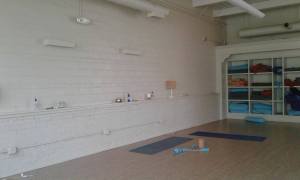
19866498_10100474775782817_358879747_nThe studio space at Yoga Roots is pretty cool. It has an industrial feel with a high ceiling and exposed heating units. There’s a wall of props and a nice floor space to practice on (it’s heated, too – must feel amazing in winter.) My friend and I walked in somewhat late so we took spaces up front right next to the teacher. The room was packed full of at least 30 students. The teacher settled us all in and we began gently, after she explained how when she began yoga years ago that she had injured herself by pushing herself too far beyond her physical abilities, and therefore she enjoys teaching beginning workshops so that she can teach others to avoid doing the same thing to their bodies. I very much appreciated her openness and honesty to a roomful of mostly strangers, who likely had the same emotions of the ego as she had as a beginner. By sharing her intimidating experience as a beginner the teacher broke the ice and brought her down to the level of of everyone else in the room.

The workshop that continued from her introduction was similar to a typical vinyasa class, but was broken down into pieces, first teaching a vinyasa itself bit-by-bit and then standing poses that are common posses in classes at Yoga Roots. I have not attended a general class at Yoga Roots, but I gather from things said by the teacher that a typical vinyasa class consists of little breakdown of poses and is taught more as a guided vinyasa sequence, which are great for students who know what the heck the difference is between Warrior I and Warrior II, but very intimidating (and not necessarily safe) for beginners.

That is where the Beginner’s Workshop comes in. It is a long class where beginners can feel comfortable in a room full of other students that practice at their level and where basics are broken down and taught to them. It’s Yoga 101. Then, when they are comfortable and ready, they can make the leap into other classes on the schedule at Yoga Roots, and there are a lot, classes at time slots at all times of the day, seven days a week.

The best part, in my opinion, of the Beginner’s Workshop was that it was Q & A. Students were encouraged by the teacher to ask questions about poses if any arose and once one student asked a question, many followed. Some questions were personal, such as about a previously acquired injury and how to perform a posture, which displays how special this event was, that a student could ask a trained and qualified teacher a very specific and personal question, not common in all yoga classes and certainly not while practicing with YouTube. By asking questions students will have gained confidence in areas of uncertainty so that they could then go into a class at Yoga Roots feeling sure of themselves. At the end of the class they offered everyone who attended a discount if they signed up for a membership, another, and happily surprising bonus; unfortunately, I don’t live in the area.


It would make anyone happy to enter this nestled studio. Initially it was difficult for my friend and I to find, but a guy in the neighborhood helped us out (it’s down a driveway right next to the hair salon.) When you enter the studio there’s a counter to sign in at and merchandise to browse if you’re on top of your game and arrive early. Remove shoes upon entrance and sign in. There’s a bathroom and separate changing room as well as cubbies to keep your personal items. A special event happening while we were there that I was told about after the workshop was a yoga challenge and it wasn’t one of those “do an impossibly challenging pose in your cutest Lululemon and post it on Instagram” type of challenges, it was an actual challenge. Students earned gifts for attending classes. The first mark to make got you a mug then a T-shirt and finally if you attended 30 classes in the month time frame of the challenge then you received a gift card to the studio. The amount of participants was impressive and the fact that they were improving their well-being and being a bigger part of their yoga studio community by attending more frequently were secondary bonuses beyond the gifts.

To wrap up, if you live in the Cleveland area and are looking for a great studio then try Yoga Roots. If you are a beginner then get to their next Beginner’s Workshop which happens monthly, except for in the summer, check their website for exact dates.

Celebrate International Day of Yoga

Wednesday, June 21st is International Day of Yoga, or at least it has been since the prime minister of India  and the United Nations General Assembly declared it so three years ago. On that first day of International Day of Yoga in 2015, thousands of people practiced yoga in hundreds of different cities in many different countries around the world and did so again in 2016. Just the same, there will be thousands of celebrations around the world this year, and there may be one near you.

International Day of Yoga is a day in which people are encouraged to practice on their own or find an event to attend, the day is a day to take time to practice for health and well-being, and it is also the summer solstice – the longest day of the year in the northern hemisphere, which makes it a great day to practice outside in nature.

This internationally celebrated day, as opposed to other silly national and international days (say National Donut Day, sorry to throw a dash of negativity in here, but I do find it slightly infuriating that more people recognized National Donut day as compared to World Ocean’s Day  here where I am in the U.S. and nobody I know locally participated in National Ride Your Bike to Work Day, but there’s hope for next year and chance of redemption with International Day of Yoga) is a day that promotes health and well-being in yoga studios, communities, and schools. The practice of yoga is beneficial for the physical and mental body. Yoga strengthens muscles and increases flexibility in muscles and joints. Yoga is a safe form of physical activity for all ages when taught and practiced with awareness. When meditation and breath practice is included, yoga has the added benefit of calming the nervous system and mind and relaxing away tension. This is a day that encourages all of this and on which you can likely find an event nearby to practice at, in my opinion this is an international day worth recognizing and participating in.

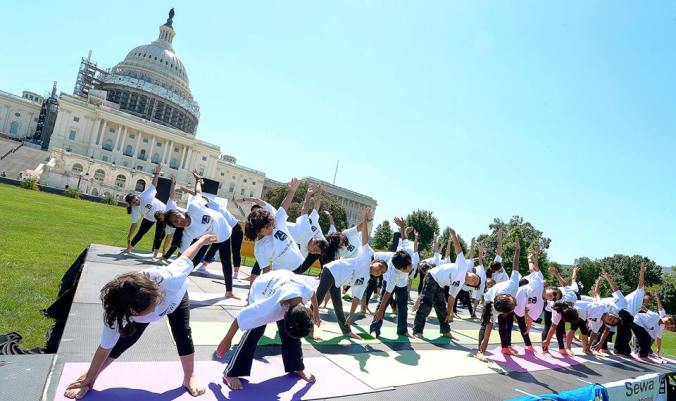
Most events are free or donation based. Many are held in front of monumental and historical landmarks such as the Capital Building in D.C. and the Eiffel Tower in Paris (shown below). For the past two years I have had the good fortune of teaching at and being apart of events in Busan, South Korea, my old expat-hometown. I have since relocated back to the United States and am excited to be bringing an International Day of Yoga celebration to Jamestown, New York, it’s first I believe – very exciting.

Yoga-dcYogaEiffelTower

Our event in Jamestown, which is being hosted by Sun Moon Yoga, the beautiful, newly-relocated studio that I have had the pleasure of teaching at for the past few months, and will be held in the second story court yard of the historical building where the studio now resides. The two-hour session will consist of 108 sun salutations, also known as a yoga mala. There will be at least three teachers teaching a wide array of styles of sun salutations to students who are encouraged to rest in child’s pose or even step off of their mats for a rest and refuel with provided refreshments. Jumping into a practice of 108 sun salutations is a major increase to students who may only be used to doing 3-6 salutations in a class, or may have never even done them, so taking rests are highly recommended. International Day of Yoga is by no means a day only for those who practice yoga regularly, but rather it is a day for newcomers to try yoga, maybe for the first time, so that they too can reap the benefits of this ancient science.

Celebrate International Day of Yoga

To find an event near you, which may be occurring this coming weekend, June 17-18th or the following weekend of June 24-25th, simply google an event in your city, ask your neighborhood yoga studio, or look for events on Facebook. To attend the event in Jamestown, arrive to the Pearl City Arts Building located on Cherry Street between 2nd and 3rd a little before 6pm to set up. The event in Jamestown has a suggested donation price of $5 or whatever you can give (if money is tight for you at the moment, please come regardless and practice for yourself and the community, donations are suggested, but not required) which will benefit Saint Susan’s Center in Jamestown, a local soup kitchen that provides meals to those in need.


Teachers – Create a Community in Your Class

We all know the usual drill of attending a yoga class – walk in with your mat, take off your shoes, roll out your mat, either at the back of the room if you’re shy or a beginner, or at the front of the room if you’ve been practicing a while or show up late. Then sit on your mat, maybe stretch out a bit (before you’re about to stretch out) as you wait for the teacher to begin class. Often times it’s quiet in the studio, no music, and generally students don’t speak to each other unless they already know each other outside of class.

The class commences, sometimes without the teacher getting names, the flow is guided, students follow, it all ends in a relaxing Savasana from which the teacher pulls you back into reality and everybody silently rolls up their mats, exits the studio space to slide their shoes on, and walk out the door.

Although the yoga practice itself is calming and rejuvenating, in an atmosphere of solitude and isolation on individual mats feelings such as loneliness and anxiety can also creep in as a result of slight social anxiety and students comparing their body’s abilities in poses to the rest of the class and the teacher, as teachers we have a responsibility to make everyone as comfortable and at ease as we can, which requires some effort from the teacher.


As a yoga teacher there are a few easy things that we can incorporate into our teaching to make students feel a part of a community in class.

Meet & Greet

Get names. Ask names as soon as a new student walks in, shake their hand, and give them your name. It seems a simple and polite thing to do, but I’ve been to plenty of classes as a student in which I never meet the teacher and vice versa. Also, have students introduce themselves to each other, it may feel a little forced as if it’s the first day of school (which it technically is,) but by meeting each other relationships may build over the course of the series or if returning students continue to attend.

Definitely as the teacher you should know your students’ names to greet them as they enter class, inquire about their days, and to then use their names to ask permission to make a physical adjustment. I have even attended a class in which the teacher asked us to write our names on a sticker that was put on the top edge of our mats. It was effective for the teacher to remember our names, but I don’t like to be wasteful, so would not suggest to do this unless you are hosting a large workshop.

20160420_090612

Music

Play music before and after class. Even if as a teacher you choose not to play music during class you should have something on as students enter and leave to break any awkwardness. Like music in a waiting room at a doctor’s office, gentle background music can lighten the mood of the room as people enter. It does not have to be elevator music, it could be yoga music or contemporary, just be sure that it is non-offensive and not too loud.

Share Events

Before class begins and as you are waiting for students who are running late, introduce any upcoming events at your studio to promote and ask students if they have any events coming up. This is a great way to learn about things going on in the community and gives students to share any events that they are a part of or care about.

These are a few basic ideas of how to make your class feel more like a community. At this time of polarization and divisive fear-mongering, your yoga studio should be a safe and welcoming place, create that atmosphere as a teacher and keep spreading the love.

Review: Flying Tree Yoga Studio, Medellin, Colombia

Do yourself a favor and visit Flying Tree Yoga Studio if you find yourself in Medellin. This intimate studio is well worth the 20 minute warm up walk from Estadio Metro Station, address: Transversal 39a #71-85, Medellín, Colombia.

Please note, I did not receive any incentives for this post; it is pure observation and opinion. Some content was provided via email with the studio. 

Class Review – Yoga Flow

Unfortunately, my schedule only allowed for one class at Flying Tree during my time in Medellin. But, boy was it a class to remember. I attended a Friday evening, English “Yoga Flow” class taught by yogi Elodie Huart. Along with five other students, Elodie guided the class with vigor and flair, through one of the toughest yoga classes I have ever taken.

My understanding of what to expect from the class occurred as we rested in child’s pose at the start of the hour-long class. At which point Elodie gleefully stated, “this is the only child’s pose of the night”, translation: “get ready for boot camp style yoga.” The class had me pushing boundaries, overheating, and there may have been a point of quietly cursing on the inside, but I loved it! The class covered a few advanced poses (think, head stand to side crow) and included pilates influences (high plank ab work). With such a manageable class size and practiced students, Elodie was able to work individually with each student according to unique needs.  It was clear she wanted to boost each student’s confidence while guiding with her expertise and talent. In fact, after the end of the class she stayed late to work longer with me on my head stand, further proving that she’s dedicated to her students’ growth.

By the end of the night I was beaming with confidence in my practice and strength. I left with an abundance of energy and felt the repercussions for about four days, a good thing. The class was more advanced that I had expected. Therefore, I would not recommend this class to someone fresh to yoga. On the other hand, please get yourself to one of Elodie’s classes if you are itching for a powerful session with a talented teacher.

More than Your Average Yoga Studio

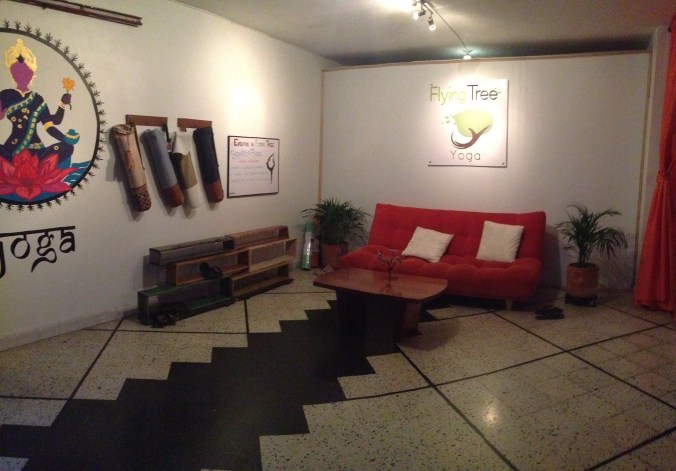
Flying Tree offers a range of classes in both Spanish and English, which immediately drew me. For a drop in single class you’ll pay $20,000 pesos (under $7 US dollars). But if you are around for a week or more you can up your visits and save your pennies by buying their 4 class pass (must be used within 30 days) for $65,000 pesos (about $5.50 US dollars per class) or a monthly unlimited pass for $120,000 pesos ($40 US dollars). Monthly schedules can be found at their attractive website. Classes are offered in three levels: Beginners classes are taught in the gentle style, Relaxing Yoga classes are yin and restorative based, and Yoga Flow classes are for those looking for a challenge. Another bonus of the studio is that they provide mats, straps, eye pillows and bricks for students without any additional charges. This is always a plus, but is especially appreciated by travelers – hallelujah.

The studio is more than simply a yoga space. The teachers lovingly host events to encourage local and international community. The week I visited they had hosted a “Brownies & Fruta” (brownies and fruit) night after their Wednesday evening class (two things I love!). Other ways they build community are through events such as: teas, potlucks and workshops. To me, yoga is community and an extension of the self, a way to give inner peace to those around you. It’s fantastic that Flying Tree Yoga embraces their ability to encourage communal well-being. A listing of upcoming events can be found via their site.

IMG_1593

The studio also runs an internship program for budding teachers. The program is a month-long commitment (I completely recommend a month in Medellin) in which experienced staff work with interns to find their voice as a teacher. During the four weeks attendees take part in: a two-week Spanish language course designed for yoga to expand their student base, plan and teach classes to the Medellin yoga community, participate in workshops and nurture the self. Check our www.yogainternships.com for full details. An attractive opportunity for teachers looking to grow and travel!

As if all of this wasn’t enough, the studio offers reiki and a variety of massages, additional information can be found via their site.

If you couldn’t tell by now, I was really impressed and happy with Flying Tree Yoga. The space is calming, the staff friendly and their community based work is what the world needs more of. Beyond the links offered in this post, you can find the studio on Facebook and Instagram at, www.instagram.com/flying_tree_yoga/ and www.instagram.com/yogainternships/.